
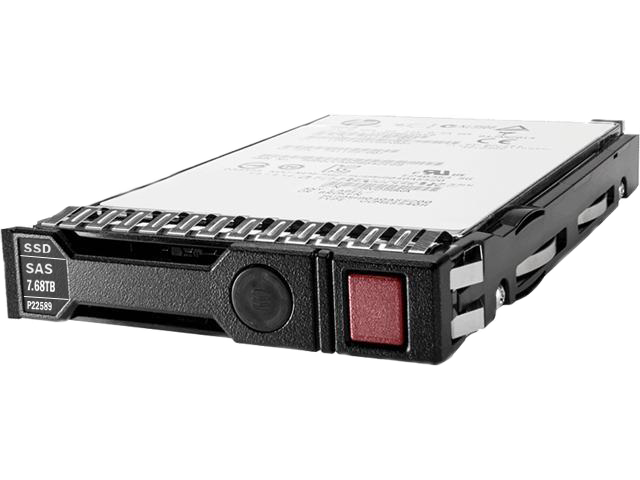
Unlock 7.68TB of Lightning-Fast Read Power: The HPE P21145-B21 SAS 12Gb/s Smart Carrier SSD for ProLiant Gen9/Gen10
HPE’s P21145-B21 7.68TB 2.5-inch (SFF) Digitally Signed Firmware (DS) SAS 12Gbps Smart Carrier Read Intensive SSD is a high-capacity, enterprise-grade storage option designed for HPE ProLiant Gen9 and Gen10 servers. Built for read-heavy workloads, it combines strong throughput, simplified serviceability via the HPE Smart Carrier, and firmware integrity features through Digitally Signed Firmware—making it a solid fit for modern data centers prioritizing performance, compatibility, and supply-chain/firmware assurance.
Overview of the HPE P21145-B21 SSD
The HPE P21145-B21 is a 7.68TB SAS (12Gb/s) solid state drive in a 2.5-inch SFF form factor, delivered in an HPE Smart Carrier for hot-swap ProLiant bays (where supported). It is positioned as a Read Intensive (RI) SSD—optimized for applications where reads significantly outweigh writes, such as analytics queries, web serving, content delivery, and fast-access reference datasets.
What “Read Intensive” Means in Real Deployments
Read Intensive SSDs are typically selected when:
- The workload is read-dominant (frequent reads, comparatively fewer writes)
- You want high capacity SSD tiers for data that must be accessed quickly
- You’re optimizing cost per TB versus write-intensive enterprise SSD classes
Common RI workload examples include VDI boot images (read-heavy), media libraries, product catalogs, search indexes with moderate updates, and reporting/BI queries.
Key Specifications (At a Glance)
This section highlights the most searched and decision-critical specs buyers typically compare.
Core Specs
- Part Number: HPE P21145-B21
- Capacity: 7.68TB
- Form Factor: 2.5-inch SFF
- Interface: SAS 12Gb/s (SAS-12Gbps)
- SSD Class: Read Intensive (RI)
- Carrier: HPE Smart Carrier
- Firmware Security: Digitally Signed Firmware (DS)
- Target Servers: HPE ProLiant Gen9 / Gen10 (subject to model and storage controller/backplane support)
Why Choose SAS 12Gb/s for ProLiant Gen9 and Gen10?
While SATA SSDs are common, SAS SSDs remain popular in enterprise servers because they’re designed for higher availability architectures and are often preferred in business-critical environments.
SAS Benefits in Enterprise Server Storage
- 12Gb/s SAS bandwidth for strong sequential performance in supported configurations
- Dual-port capability (in many SAS enterprise designs) for redundancy in certain storage topologies
- Better alignment with enterprise RAID controllers and SAS backplanes commonly deployed in ProLiant systems
- Strong ecosystem compatibility across data center storage practices
The Value of Digitally Signed Firmware (DS)
Firmware authenticity is a growing priority in enterprise IT. HPE’s Digitally Signed Firmware helps ensure the drive firmware is validated and trusted.
How DS Firmware Helps Reduce Risk
- Helps protect against unauthorized or tampered firmware
- Supports stronger platform integrity practices in secured environments
- Aligns with organizations implementing supply chain security and firmware governance
(Exact enforcement and reporting behaviors depend on platform, controller, and management tooling.)
HPE Smart Carrier: Serviceability and Visibility
The included HPE Smart Carrier is designed to simplify installation, hot-swap servicing, and status identification in supported ProLiant drive bays.
Operational Advantages of the Smart Carrier
- Clear drive status indicators to assist with troubleshooting
- Faster field replacement workflows for IT teams
- Designed for consistent fitment in supported SFF hot-plug bays
Compatibility: ProLiant Gen9 and Gen10 Server Fit
This SSD is marketed for HPE ProLiant Gen9 and Gen10, but real-world compatibility depends on your chassis, backplane, and storage controller.
What to Verify Before You Buy
- Your server has 2.5-inch SFF bays (not LFF 3.5-inch bays)
- The backplane/controller supports SAS 12Gb/s drives
- Your RAID/HBA controller firmware is current and supports the drive class/capacity
- Your server model supports the Smart Carrier style used
Performance and Capacity Benefits (7.68TB in SFF)
A 7.68TB SFF SSD provides a high-density storage tier without expanding server footprint.
Where 7.68TB SFF SSDs Shine
- Maximizing TB per rack unit (RU)
- Consolidating datasets onto fewer drives (simplifying RAID groups)
- Improving application responsiveness versus HDD-based tiers
- Building dense virtualization or database read replicas without adding shelves
Best-Fit Workloads for a Read Intensive SAS SSD
If your environment needs fast access and high capacity, the P21145-B21 is best considered for read-heavy tiers.
Ideal Use Cases
- Virtualization: datastore tiers for read-heavy VMs and golden images
- VDI environments: boot storms and read-heavy user sessions
- Content repositories: large libraries with frequent access
- Analytics & reporting: repeated scans and query acceleration
- Search and indexing: fast read lookups with moderate write churn
RAID and Controller Considerations
Most ProLiant deployments pair SAS SSDs with an HPE Smart Array RAID controller or an HBA, depending on the storage strategy.
Practical Tips for RAID Planning
- For availability, consider RAID 1/10 for performance-sensitive volumes
- For capacity efficiency, RAID 5/6 can be used where write penalties are acceptable (workload-dependent)
- Ensure controller cache settings and queue depth are configured appropriately for SSD behavior
- Keep controller firmware and drive firmware aligned with HPE support recommendations
(The “best RAID” depends heavily on your write ratio, latency needs, and rebuild tolerance.)
Installation and Deployment Best Practices
A clean installation approach reduces downtime and prevents compatibility issues.
Recommended Deployment Steps
- Confirm the bay type: SFF SAS hot-plug compatibility
- Update system components where applicable:
- Server BIOS/UEFI
- Smart Array controller firmware
- iLO and storage management components
- Install the SSD in an appropriate bay and confirm it is recognized
- Configure RAID (if used) and validate:
- Drive health
- Link speed negotiation (SAS 12Gb/s where supported)
- Background initialization and monitoring alerts
Reliability, Supportability, and Lifecycle Fit
Enterprise SSD selection is often about operational confidence as much as raw speed.
Why OEM-Qualified Drives Matter in Servers
- Better alignment with server/storage firmware ecosystems
- More predictable behavior with management and monitoring tools
- Typically smoother experience for organizations standardizing on HPE-qualified parts for maintenance and fleet consistency
Is P21145-B21 the Right SSD for You?
The P21145-B21 is a strong candidate if you need:
- 7.68TB capacity in a 2.5-inch SFF bay
- SAS 12Gb/s connectivity for ProLiant storage backplanes/controllers
- A Read Intensive SSD for predominantly read-heavy workloads
- Digitally Signed Firmware and Smart Carrier serviceability features
Consider a Different Class of SSD If…
- Your workload is write-heavy (logging, heavy OLTP writes, sustained ingest)
- You need maximum endurance more than capacity
- You’re building a write-intensive cache tier (a higher endurance class may fit better)
Conclusion
The HPE P21145-B21 7.68TB SFF SAS 12Gbps Read Intensive SSD with Digitally Signed Firmware and Smart Carrier is a high-density, enterprise-aligned storage upgrade for HPE ProLiant Gen9 and Gen10 servers. If your priority is fast read access, high capacity, SAS reliability expectations, and firmware integrity controls, this SSD is a compelling choice for virtualization, analytics, content delivery, and other read-heavy production workloads.
Recent Posts
-
HPE 737390-B21: Unleashing Enterprise-Class Speed and Reliability with a 300GB 15K SAS Hard Drive
In the demanding world of enterprise computing, storage performance plays a vital role in keeping ap …Oct 14th 2026 -
HPE 516814-B21: The 15K SAS Storage Workhorse for Legacy ProLiant Servers
HPE 516814-B21: Reviving Enterprise Performance with 300GB of 15K SAS Storage Power Introduction: De …Oct 13th 2026 -
HPE 516824-B21: Unleashing Enterprise Storage Performance with 300GB 15K RPM SAS Technology
Introduction: Reliable Storage for Demanding Enterprise Environments In today's data-driven business …Oct 12th 2026