
HPE 516814-B21: The 15K SAS Storage Workhorse for Legacy ProLiant Servers
HPE 516814-B21: Reviving Enterprise Performance with 300GB of 15K SAS Storage Power
Introduction: Dependable Storage for Demanding Server Environments
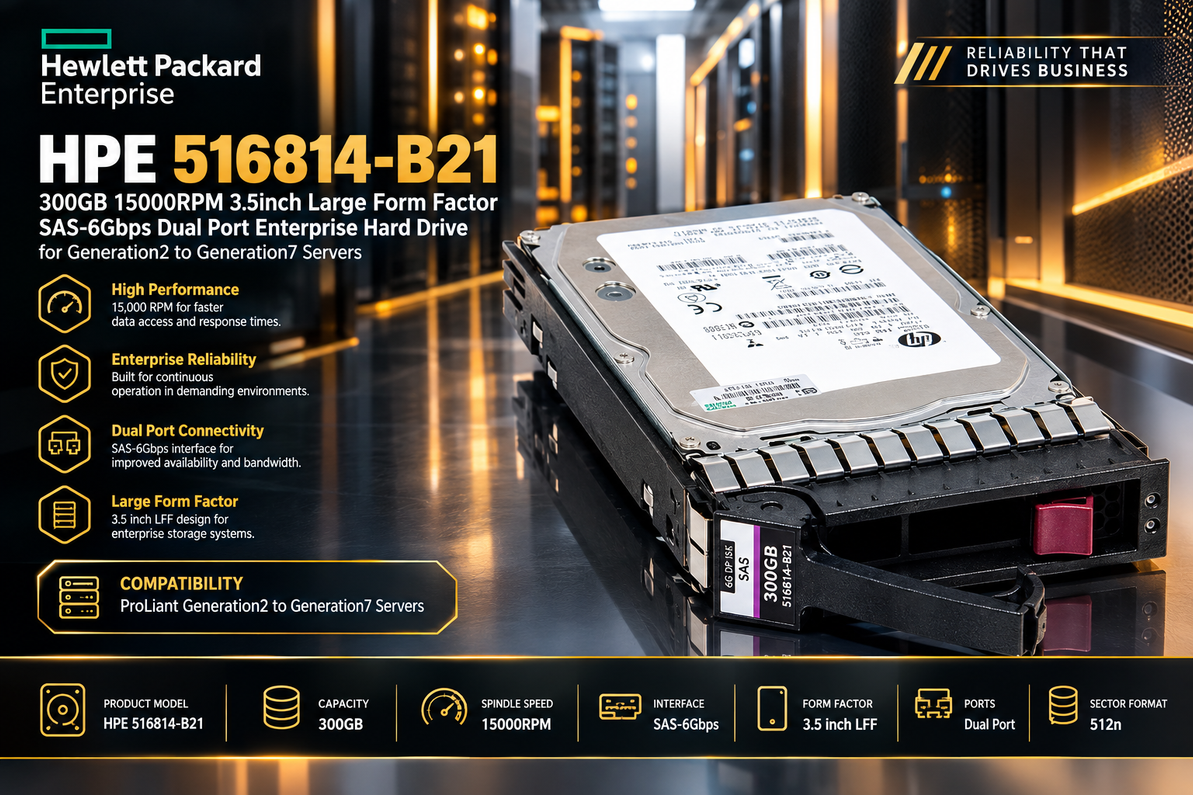
Reliable storage remains essential for keeping business applications, databases, and enterprise systems running smoothly. Even as solid-state drives become more common, traditional enterprise hard disk drives continue to play an important role in maintaining and upgrading established server infrastructure. For organizations that depend on compatible legacy HPE ProLiant servers and storage arrays, the HPE 516814-B21 300GB 15000RPM 3.5-inch Large Form Factor SAS-6Gbps Dual Port Enterprise Internal Hard Drive offers a purpose-built storage option.
Designed for enterprise environments, this drive combines a 300GB storage capacity with a high rotational speed of 15,000 RPM, a 6Gbps SAS interface, and dual-port connectivity. These characteristics make it suitable for supported server configurations where responsive access to frequently used data, reliable operation, and compatibility with existing hardware are important considerations. HPE documentation also lists the 516814-B21 as a 300GB, 6G SAS, 15K RPM, 3.5-inch dual-port Enterprise hard drive. <Cite refs={["turn618234search1","turn618234search12"]}/>
For IT administrators, data center operators, and businesses maintaining older server platforms, choosing the correct replacement drive can help preserve existing infrastructure without requiring an immediate, expensive storage redesign. Understanding its specifications, potential applications, and compatibility requirements is the first step toward making an informed purchasing decision.
HPE 516814-B21 Hard Drive Overview
The HPE 516814-B21 is an enterprise-class mechanical hard drive intended for supported HPE server and storage configurations. Its combination of high spindle speed and SAS connectivity distinguishes it from lower-speed drives designed primarily for capacity-focused workloads.
Key Product Specifications
-
Manufacturer: HPE, formerly Hewlett-Packard
-
Option part number: 516814-B21
-
Spare part number: 517350-001
-
Storage capacity: 300GB
-
Rotational speed: 15,000 RPM
-
Form factor: 3.5-inch Large Form Factor (LFF)
-
Interface: Serial Attached SCSI (SAS)
-
Interface signaling rate: 6Gbps
-
Connectivity: Dual-port SAS
-
Drive category: Enterprise hard disk drive
-
Installation type: Internal server or storage drive
-
Typical platform family: Selected HPE ProLiant Gen2 through Gen7 systems and supported storage arrays, subject to model-specific compatibility
These specifications are supported by HPE documentation and product listings. Actual compatibility depends on the server or array model, controller, drive bay, carrier, and firmware configuration. <Cite refs={["turn618234search1","turn618234search4","turn618234search11"]}/>
300GB Storage Capacity for Essential Enterprise Data
A Practical Capacity for Established Infrastructure
The 300GB capacity of the HPE 516814-B21 makes it a practical option for maintaining older server installations where the existing storage architecture was designed around smaller enterprise drives. Although modern applications may require much larger capacities, a 300GB drive can still be useful for targeted workloads, operating system volumes, application data, and structured storage arrangements.
Businesses do not always need to replace an entire storage environment when a single drive reaches the end of its service life. In many cases, replacing a failed or aging component with a compatible unit is a more manageable approach. It can help preserve established configurations, simplify maintenance, and reduce disruption while an organization plans a broader infrastructure upgrade.
Supporting Storage Arrays and Multi-Drive Configurations
In supported storage arrays, individual drives can form part of a larger storage pool. Depending on the controller and array configuration, multiple drives may be organized into RAID groups to balance capacity, performance, and fault tolerance.
The HPE 516814-B21 can be considered for a compatible configuration that requires a 300GB enterprise SAS drive. However, the drive's individual capacity does not determine the usable capacity of a RAID group. RAID level, drive count, parity requirements, spare-drive policies, and array overhead all influence the final amount of available storage.
15,000 RPM Rotational Speed for Responsive Storage
Why Spindle Speed Matters
One of the main characteristics of the HPE 516814-B21 is its 15,000 RPM rotational speed. In a mechanical hard drive, the platters spin while the read/write heads access data at specific locations. Faster rotation can reduce the average rotational waiting time before the required data passes beneath the head.
For a 15,000 RPM drive, the average rotational latency is approximately 2 milliseconds, based on the rotational speed alone. This is one reason high-speed enterprise HDDs have historically been used in applications that benefit from frequent access to stored information.
Workloads That Can Benefit from High-Speed HDDs
The 15K RPM design may be useful in supported legacy environments handling workloads such as:
-
Frequently accessed database records
-
Transaction-oriented business applications
-
Operating system and application volumes
-
Enterprise services with regular read and write activity
-
Virtualization environments that remain within the capacity and performance limits of mechanical storage
-
Existing server workloads that depend on a validated SAS drive configuration
Actual performance depends on more than rotational speed. Controller capabilities, queue depth, request patterns, RAID design, drive condition, and the number of concurrent users can all affect the results.
Understanding HDD Performance Limitations
A 15,000 RPM mechanical drive can provide responsive access compared with slower spinning HDDs, but it cannot match the low access latency of modern SSDs in many workloads. Mechanical drives also contain moving components, which influence seek time and overall random-I/O performance.
For organizations maintaining compatible legacy servers, the goal may not be to achieve the performance of a new all-flash system. Instead, it may be to restore expected functionality, maintain consistency across an established drive group, or extend the useful service life of an existing platform.
SAS 6Gbps Interface for Enterprise Connectivity
What SAS Technology Provides
Serial Attached SCSI, commonly known as SAS, is an interface technology designed for storage environments that require dependable connectivity, command handling, and integration with enterprise storage controllers. The HPE 516814-B21 uses a SAS interface with a signaling rate of 6Gbps. This rate describes the interface link, not the sustained transfer speed that users will necessarily experience.
The drive's actual throughput depends on the mechanical disk, data location, controller, workload, and storage configuration. A 6Gbps SAS interface offers a suitable connection for supported systems designed around this generation of enterprise storage hardware.
SAS Compared with SATA
SAS and SATA drives may share a similar physical drive form factor, but they are not automatically interchangeable. SAS is commonly used in enterprise storage environments, while SATA is widely associated with consumer and capacity-oriented storage devices.
Before installing the HPE 516814-B21, administrators should confirm that the system's storage controller and backplane support SAS drives. A compatible 3.5-inch bay alone does not guarantee that a drive will function correctly.
Dual-Port Connectivity for Enterprise Storage Designs
Understanding Dual-Port SAS
Dual-port SAS provides two data paths through the drive's SAS interface. In supported enterprise configurations, these paths can be used as part of a storage architecture designed for connectivity flexibility or redundancy.
This capability can be particularly relevant in storage systems that use supported dual-path controllers or multipath software. Depending on the system design, multiple paths can help maintain access when one supported path becomes unavailable.
Dual-Port Capability Is Not a Complete Redundancy Solution
Dual-port functionality does not, by itself, guarantee uninterrupted service. Redundancy depends on the entire storage design, including compatible controllers, cabling, backplanes, multipath configuration, and software support. A system with only one active or supported path will not gain the full benefits of a dual-path architecture simply by installing a dual-port drive.
IT administrators should consult the documentation for their specific server or storage array to determine how dual-port SAS is implemented and supported.
3.5-Inch Large Form Factor Design
Designed for Compatible LFF Drive Bays
The HPE 516814-B21 uses a 3.5-inch Large Form Factor design. This format is common in many traditional enterprise servers and storage systems, particularly platforms built around earlier generations of HPE ProLiant hardware.
Its physical format makes it relevant when maintaining an existing LFF storage configuration. However, the drive must also fit the correct carrier and bay assembly and work with the system's backplane and controller.
Carrier and Installation Considerations
Product listings associate the 516814-B21 with HPE enterprise drive carriers and identify the related spare part number 517350-001. The precise carrier and assembly supplied can vary according to the seller and product condition. <Cite refs={["turn618234search0","turn618234search11"]}/>
Before purchasing, confirm whether the drive includes the carrier required by your system. A bare drive may require a compatible carrier from the existing installation, while a drive supplied in a carrier may be easier to install in a supported hot-plug bay. Do not assume that every listing includes identical accessories.
Compatibility with HPE ProLiant Servers and Storage Arrays
Designed for Selected Legacy HPE Platforms
The HPE 516814-B21 is associated with selected HPE ProLiant servers and supported storage products. Published compatibility information includes models from several ProLiant DL and ML families, along with certain storage arrays and StoreEasy systems. Examples listed for this part include selected DL120, DL160, DL180, DL380, ML150, ML350, and ML370 configurations. <Cite refs={["turn618234search4","turn618234search6"]}/>
Compatibility lists should be treated as a starting point rather than a universal guarantee. A server family may have multiple generations, storage controller options, drive cage types, and firmware revisions. A drive supported in one configuration may not be supported in another configuration within the same family.
How to Verify Compatibility Before Buying
Before ordering an HPE 516814-B21 hard drive, check the following:
-
Confirm the exact server or storage array model and generation.
-
Verify that the installed controller supports SAS drives with the required specifications.
-
Confirm that the drive bay accepts 3.5-inch LFF enterprise drives.
-
Check whether the system requires a particular HPE carrier or drive assembly.
-
Review the controller and system firmware requirements.
-
Confirm that the drive's capacity and interface are appropriate for the existing RAID group or storage pool.
-
If the drive is intended to replace an existing disk, compare the current drive's part number, interface, speed, and carrier.
These checks can help reduce installation problems and prevent purchasing a drive that is physically compatible but unsupported by the target system.
Enterprise Applications and Suitable Use Cases
Legacy Database and Transaction Systems
Some organizations continue to operate older database applications because they remain stable, support essential business processes, or depend on software that cannot be migrated immediately. In these environments, a compatible 15K RPM SAS drive may help restore the intended storage configuration.
The HPE 516814-B21 may be appropriate for supported systems where the capacity and performance characteristics meet the application's requirements. It should not be treated as a universal database upgrade, since database performance also depends on memory, processor resources, query design, controller configuration, and storage layout.
Business Applications and Internal Services
Legacy enterprise servers may host internal business applications, file services, management tools, or other workloads that remain important to day-to-day operations. Maintaining a suitable replacement drive can help organizations keep these systems operational while avoiding unnecessary hardware changes.
The 300GB capacity is best evaluated in the context of the actual workload. Administrators should review current utilization and growth trends before deciding whether a replacement of the same capacity is sufficient.
Existing RAID Arrays
When a drive in a RAID group fails, replacement requirements depend on the RAID level, controller, array model, and vendor guidance. A replacement drive should meet the system's supported requirements and be suitable for the existing array.
Before replacing a failed disk, verify the fault indication and the correct physical bay. Follow the server or array's maintenance procedure and confirm that the replacement drive is recognized and the rebuild completes successfully. Never remove a drive based solely on its location without verifying the system's identification indicators and documentation.
Reliability, Maintenance, and Operational Best Practices
Enterprise-Class Design
The HPE 516814-B21 belongs to the enterprise HDD category, intended for compatible server and storage environments. Enterprise-class positioning reflects its role in business infrastructure, but it should not be interpreted as a guarantee that an individual used or refurbished drive is in perfect condition.
When purchasing replacement hardware, inspect the seller's description carefully. Confirm whether the unit is new, refurbished, or used, and review the available warranty, return policy, testing process, and any details about firmware or carrier inclusion.
Monitor Drive Health
Storage administrators should monitor supported drive-health information through the server controller, management utilities, and system logs. Depending on the platform, these tools may report predictive failure warnings, media errors, or other signs of drive degradation.
Maintain regular backups and test recovery procedures. RAID can improve availability or fault tolerance in supported configurations, but it is not a replacement for a proper backup strategy. Accidental deletion, corruption, malware, and failures affecting multiple components can still result in data loss.
Maintain Suitable Operating Conditions
Adequate cooling, stable power, clean airflow, and correct installation help support reliable storage operation. Follow the environmental and servicing recommendations for the target server or array. Avoid handling exposed drive electronics unnecessarily, and use appropriate electrostatic-discharge precautions during installation.
HPE 516814-B21 Compared with Modern SSD Storage
Where a Traditional Enterprise HDD Still Makes Sense
The HPE 516814-B21 may be a sensible choice when an organization needs a compatible replacement for an existing mechanical drive. Keeping the same supported interface and drive class can simplify maintenance and preserve a known configuration.
This can be valuable when a legacy server must remain in service, a storage array requires a matching replacement, or a planned upgrade needs to be delayed until an appropriate maintenance window.
When an SSD Upgrade May Be Worth Considering
Solid-state drives offer substantially lower access latency and can provide stronger random-I/O performance than mechanical HDDs. For applications that are sensitive to storage latency, an SSD-based solution may deliver a more noticeable performance improvement.
However, moving from an HDD to an SSD is not always a simple drop-in change. The server or array must support the SSD, its interface, firmware, capacity, endurance characteristics, and any relevant controller requirements. Costs, workload demands, migration effort, and the remaining service life of the platform should all be considered.
The most appropriate choice depends on whether the priority is maintaining existing compatibility, increasing performance, expanding capacity, or planning a broader infrastructure refresh.
Buying Guide for the HPE 516814-B21 Hard Drive
Check the Part Number Carefully
The option part number for this product is 516814-B21, and the associated spare part number commonly listed is 517350-001. Assembly numbers may also appear in product listings. Comparing these identifiers can help distinguish the intended drive from similar HPE products with different capacities or specifications. <Cite refs={["turn618234search0","turn618234search11"]}/>
Review Product Condition and Warranty
Not all listings describe the same product condition or package contents. Before buying, confirm:
-
Whether the drive is new, used, or refurbished
-
Whether a compatible drive carrier is included
-
Whether the drive has been tested
-
What warranty and return terms apply
-
Whether the seller can help verify compatibility with your server or array
For mission-critical systems, consider the operational risks of using a drive with an unknown service history. A lower purchase price may not represent the best value if the drive lacks testing, documentation, or meaningful warranty coverage.
Match the Drive to the Existing Storage Design
If the drive is intended to replace an existing unit, compare the full model and configuration details rather than relying only on capacity. Confirm the interface, rotational speed, form factor, port requirements, carrier, and controller support. When using the drive in an array, follow the array manufacturer's replacement and rebuild instructions.
Conclusion: A Focused Storage Solution for Supported HPE Systems
The HPE 516814-B21 300GB 15000RPM 3.5-inch LFF SAS-6Gbps Dual Port Enterprise Hard Drive is a legacy enterprise storage option for compatible HPE ProLiant servers and supported storage arrays. Its 15,000 RPM rotational speed, SAS 6Gbps interface, dual-port design, and 300GB capacity make it relevant to organizations maintaining established enterprise storage environments.
Its value lies in matching the requirements of the existing system. For IT teams that need to replace a failed drive, preserve a supported RAID configuration, or extend the service life of a legacy server, this model may provide a practical option when compatibility is confirmed.
Before purchasing, verify the exact server or array model, controller support, carrier requirements, and product condition. With the correct checks and sound maintenance practices, the HPE 516814-B21 can help support continued operation of compatible enterprise infrastructure.
Recent Posts
-
HPE 737390-B21: Unleashing Enterprise-Class Speed and Reliability with a 300GB 15K SAS Hard Drive
In the demanding world of enterprise computing, storage performance plays a vital role in keeping ap …Oct 14th 2026 -
HPE 516814-B21: The 15K SAS Storage Workhorse for Legacy ProLiant Servers
HPE 516814-B21: Reviving Enterprise Performance with 300GB of 15K SAS Storage Power Introduction: De …Oct 13th 2026 -
HPE 516824-B21: Unleashing Enterprise Storage Performance with 300GB 15K RPM SAS Technology
Introduction: Reliable Storage for Demanding Enterprise Environments In today's data-driven business …Oct 12th 2026