
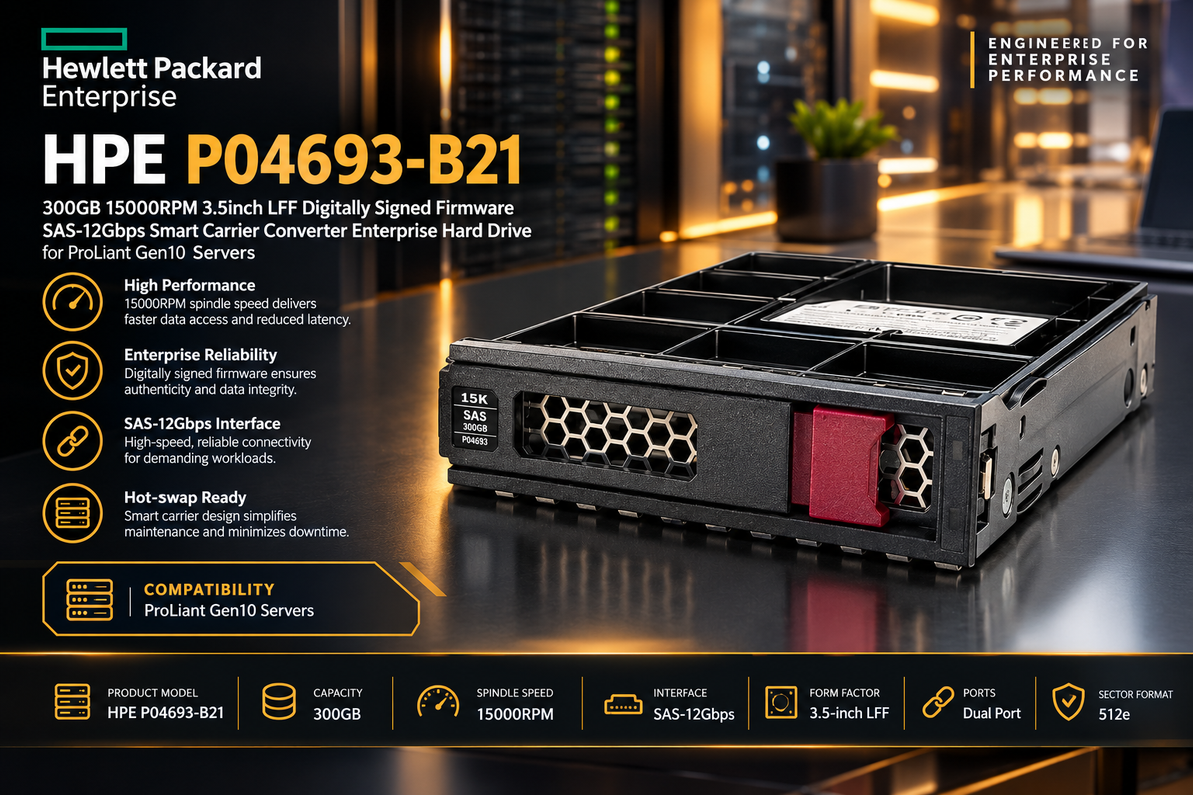
HPE 870755-B21: Unleash Enterprise Storage Power with 300GB of High-Speed 15K RPM Performance
In enterprise IT, storage performance can make a significant difference in how efficiently servers handle demanding workloads. From database operations and virtualization to business applications and critical data processing, organizations need dependable storage solutions that can keep pace with their infrastructure. The HPE 870755-B21 300GB 15000 RPM SAS-12Gbps Enterprise Hard Drive is designed for enterprise server environments that require responsive data access, reliable operation, and compatibility with supported HPE ProLiant Gen9 and Gen10 systems.
Featuring a 3.5-inch Large Form Factor design, digitally signed firmware, a Low Profile Converter, and a high-speed SAS interface, this enterprise hard drive offers a practical storage option for compatible server configurations. Its 15,000 RPM rotational speed makes it particularly relevant for workloads where quick access to frequently used data is important.
Whether you are maintaining an established server environment, upgrading existing storage, or sourcing replacement hardware for business-critical systems, understanding the features of the HPE 870755-B21 can help you make a more informed purchasing decision.
Understanding the HPE 870755-B21 Enterprise Hard Drive
A Storage Solution Built for Enterprise Environments
The HPE 870755-B21 is identified by its 300GB storage capacity, 15K RPM spindle speed, and SAS-12Gbps interface. These specifications position it within the enterprise hard drive category, where performance, compatibility, and predictable operation are important considerations.
Unlike consumer desktop drives intended primarily for everyday computing, enterprise hard drives are designed for use in supported server and storage environments. They can form part of systems responsible for handling business applications, transactional workloads, shared files, and other operational data.
For IT administrators, selecting the correct drive involves more than matching capacity. The interface, drive dimensions, firmware configuration, carrier arrangement, and server compatibility must also align with the intended installation.
Key Product Specifications
The following specifications summarize the product configuration described by its model designation.
| Specification | Details |
|---|---|
| Manufacturer | Hewlett Packard Enterprise (HPE) |
| Model / Part Number | 870755-B21 |
| Storage Capacity | 300GB |
| Form Factor | 3.5-inch Large Form Factor (LFF) |
| Rotational Speed | 15,000 RPM |
| Interface | SAS |
| Interface Data Rate | 12Gbps |
| Firmware | Digitally signed firmware |
| Converter | Low Profile Converter |
| Product Category | Enterprise hard drive |
| Server Compatibility | HPE ProLiant Gen9 and Gen10, subject to configuration support |
Always verify the exact drive configuration, carrier requirements, firmware compatibility, and supported server models before ordering. A matching generation number alone does not guarantee compatibility with every ProLiant server.
15,000 RPM Performance for Demanding Workloads
Why Rotational Speed Matters
One of the defining characteristics of the HPE 870755-B21 is its 15,000 RPM rotational speed. Traditional mechanical hard drives use spinning platters and moving read/write heads to retrieve and store information. A higher rotational speed can reduce rotational latency, helping the drive access requested data more quickly than comparable lower-speed mechanical drives.
This characteristic can be valuable in environments where applications frequently request small amounts of information from different locations on the disk. Database transactions, application services, and certain virtualization workloads can benefit from responsive random-access storage.
A 15K RPM drive is not automatically faster than every alternative in every situation. Actual performance also depends on workload patterns, disk utilization, controller configuration, RAID design, and other system components. Nevertheless, high rotational speed remains an important consideration when selecting mechanical storage for performance-sensitive enterprise applications.
Supporting Consistent Server Operations
Servers often run multiple services simultaneously. An application server may process requests while accessing configuration files, logs, databases, and shared resources. In these situations, storage responsiveness can influence how efficiently the system handles competing requests.
The HPE 870755-B21 provides a high-speed mechanical storage option for compatible environments that continue to rely on SAS hard drives. It may be suitable for organizations maintaining existing infrastructure where replacing every mechanical disk with solid-state storage is not practical or necessary.
SAS-12Gbps Connectivity for Enterprise Storage
Understanding the SAS Interface
Serial Attached SCSI (SAS) is a storage interface widely used in enterprise servers and storage systems. It supports communication between drives and compatible storage controllers, making it a common choice for infrastructure that requires managed storage, dependable connectivity, and integration with enterprise hardware.
The HPE 870755-B21 is specified with a SAS-12Gbps interface. This represents the interface's nominal signaling rate, not a guarantee that applications will transfer data at 12 gigabits per second. Mechanical drive throughput is limited by factors such as platter performance, data location, controller capabilities, and workload characteristics.
Even with that distinction, a 12Gbps SAS interface can be an important component of a modernized enterprise storage configuration. It provides an interface option for compatible controllers and backplanes designed to support the relevant SAS generation.
Integration with Compatible Controllers
Before installing a SAS hard drive, administrators should confirm that the server's storage controller and drive backplane support the required interface and drive configuration. Connector compatibility alone does not establish that a drive will operate correctly in a particular system.
Organizations should also check whether the intended controller supports the desired RAID level, drive firmware, and management functions. These checks help reduce installation issues and make storage upgrades more predictable.
Digitally Signed Firmware and Enterprise Management
Why Firmware Integrity Matters
Firmware controls important aspects of a hard drive's operation, including communication with the host system and internal device functions. Digitally signed firmware is associated with mechanisms that help verify firmware authenticity and integrity within supported hardware and update processes.
For enterprise environments, firmware validation can be an important part of maintaining a controlled hardware ecosystem. IT teams frequently manage many servers, storage devices, and firmware versions, making consistent maintenance procedures essential.
The digitally signed firmware designation of the HPE 870755-B21 is therefore a relevant consideration for organizations that prioritize supported hardware configurations and structured server maintenance.
Maintaining a Supported Configuration
Firmware compatibility should be considered alongside the server model, storage controller, and system software. Administrators should consult the applicable HPE documentation and use supported firmware-management procedures when updating or maintaining enterprise storage devices.
It is also important to distinguish firmware security features from a guarantee of complete system security. Signed firmware can contribute to integrity verification, but overall security still depends on access controls, patch management, physical security, monitoring, and the wider server configuration.
Low Profile Converter and 3.5-Inch Drive Configuration
Understanding the Converter Designation
The HPE 870755-B21 product description includes a Low Profile Converter. This detail matters because enterprise drives can be supplied in different physical and carrier configurations intended for particular server platforms.
The 3.5-inch Large Form Factor designation identifies the drive's physical class, while the converter designation describes an additional aspect of the supplied configuration. Buyers should not assume that every LFF bay, carrier, or mounting arrangement will accept the drive without checking the server's requirements.
Why Physical Compatibility Matters
A drive may have the correct capacity and interface but still be unsuitable for a particular server because of differences in carriers, connectors, drive bays, or firmware support.
Before purchasing the HPE 870755-B21, compare the existing drive's part number and physical arrangement with the replacement. Confirm the supported drive options for the exact ProLiant server model and storage controller. This simple verification step can prevent avoidable downtime and installation delays.
Practical Applications for the HPE 870755-B21
Database and Transaction Processing
Databases often perform a mixture of sequential and random read/write operations. Applications that repeatedly retrieve small records may benefit from the lower rotational latency associated with 15,000 RPM mechanical drives.
The HPE 870755-B21 may be considered for compatible database environments where 300GB of capacity is sufficient and a high-speed SAS hard drive fits the existing storage architecture. Actual database performance will depend on the application, indexing, memory, controller configuration, and I/O workload.
Business Applications and Enterprise Services
Enterprise servers support many everyday business operations, including internal applications, departmental tools, authentication services, and operational databases. Storage reliability and compatibility are important when these services must remain available to employees and customers.
For organizations that maintain established ProLiant Gen9 or Gen10 infrastructure, a compatible replacement drive can help preserve the existing storage configuration without requiring an immediate platform-wide migration.
Virtualization and Consolidated Workloads
Virtualization platforms allow multiple virtual machines to share the resources of a physical server. Their storage requirements can vary significantly depending on the number of virtual machines, application activity, and the type of data being accessed.
A 15K RPM SAS drive may be useful in certain established virtualization configurations, especially when administrators need to replace a matching mechanical drive. However, heavily consolidated environments with substantial random I/O may benefit more from SSD storage, depending on budget and workload requirements.
General Enterprise Data Storage
The drive can also be considered for compatible business data, application files, and other operational workloads that fit its capacity and performance profile. It is important to evaluate the storage requirements of the intended application rather than choosing a drive solely because it has a high spindle speed.
Reliability, Maintenance, and Storage Planning
Building a Dependable Storage Environment
Enterprise storage reliability depends on the complete system, not just the individual hard drive. Proper cooling, stable power, supported controllers, suitable drive bays, and regular monitoring all contribute to a healthy storage environment.
Organizations should monitor drive health through supported controller utilities and server-management tools. Where available, predictive alerts and device status information can help administrators investigate potential problems before they lead to unexpected service interruptions.
RAID and Data Protection Considerations
The HPE 870755-B21 may be used as part of a supported RAID configuration, provided the controller and server support the drive. RAID can improve availability or performance depending on the selected level and implementation, but it is not a substitute for a separate backup strategy.
A well-planned storage deployment should include regular backups, periodic restore testing, appropriate redundancy, and documented recovery procedures. These practices are especially important when the server supports business-critical applications.
Capacity Planning for 300GB Storage
A nominal 300GB drive may be appropriate for focused workloads, legacy applications, operating-system volumes, or environments where storage is distributed across several drives. It may be insufficient for applications that generate large datasets or retain extensive logs and backups.
Before deploying the drive, estimate the application's current storage usage, expected growth, redundancy requirements, and available free space. Planning around actual workload needs helps avoid premature capacity limitations.
HPE 870755-B21 vs. Modern SSD Storage
Understanding the Trade-Offs
Mechanical enterprise hard drives and solid-state drives serve different storage priorities. The HPE 870755-B21 offers high rotational speed and SAS connectivity for compatible systems that use mechanical storage. SSDs, by contrast, eliminate mechanical seek and rotational delays, which can provide substantial advantages for random-access workloads and latency-sensitive applications.
The right choice depends on performance requirements, acquisition cost, storage capacity, controller support, and the need to maintain an existing server configuration.
For organizations operating legacy applications or standardized mechanical-drive arrays, replacing a failed drive with a compatible model can be the most straightforward option. For new deployments or workloads with demanding latency requirements, comparing supported SSD alternatives may be worthwhile.
When a 15K RPM SAS Drive Makes Sense
A high-speed mechanical drive may remain a practical choice when the server architecture already supports SAS storage, the workload is compatible with mechanical-drive performance, and matching replacement hardware is required.
However, buyers should avoid assuming that 15K RPM automatically makes the drive the best choice for every application. Benchmark results, workload patterns, and total storage costs should guide the final decision.
Compatibility with HPE ProLiant Gen9 and Gen10 Servers
Verify the Exact Server Model
The product description identifies the HPE 870755-B21 as intended for ProLiant Gen9 and Gen10 servers. Compatibility should still be confirmed against the precise server model, storage controller, backplane, and drive-bay configuration.
Server generations contain multiple models and configuration options, and not all of them support every drive type. Check the applicable HPE QuickSpecs, drive compatibility documentation, and controller specifications before installation.
Installation and Replacement Best Practices
Before replacing a drive, confirm whether the server supports hot-swap replacement for the particular bay and configuration. Never assume that a drive can be removed while the system is running simply because it is described as an enterprise or hot-plug-compatible product.
Follow the server's maintenance instructions, confirm the status of the existing RAID array, and verify that backups are current. After installation, check that the controller recognizes the drive and that the storage system reports a healthy status before returning the system to normal operation.
Buying the HPE 870755-B21 Hard Drive
What to Check Before Ordering
When sourcing the HPE 870755-B21, verify the part number, 300GB capacity, 15,000 RPM speed, SAS-12Gbps interface, 3.5-inch LFF configuration, digitally signed firmware designation, and Low Profile Converter arrangement.
If you are replacing a failed drive, matching the original part number and configuration is often the best starting point. For refurbished or previously used hardware, ask the seller about testing procedures, drive health, warranty coverage, return terms, and the condition of the supplied carrier or converter.
Buyers should also confirm whether the product is new, refurbished, or used, as the condition and included accessories can vary by seller. Request clear information about the actual item being supplied rather than relying solely on a generic product title.
Choosing the Right Replacement
A suitable replacement should meet the requirements of the server and workload, not merely have the same capacity. Confirm the SAS interface, physical dimensions, controller support, firmware requirements, and any necessary mounting hardware.
For organizations maintaining multiple servers, documenting existing drive part numbers and approved replacements can simplify future maintenance and reduce the risk of ordering incompatible components.
Conclusion: High-Speed Mechanical Storage for Established Enterprise Systems
The HPE 870755-B21 300GB 15000 RPM SAS-12Gbps Enterprise Hard Drive is a storage option for compatible enterprise environments that need high rotational speed, SAS connectivity, and a specific 3.5-inch LFF configuration. Its digitally signed firmware designation and Low Profile Converter configuration are additional details that buyers should consider when matching the drive to an existing server platform.
For organizations maintaining supported HPE ProLiant Gen9 and Gen10 systems, this model may provide a practical replacement or expansion option where mechanical SAS storage remains appropriate. The key to a successful purchase is confirming compatibility, evaluating the workload, and checking the condition and configuration of the supplied hardware.
By combining careful product verification with sound storage planning and regular maintenance, IT teams can make more informed decisions about their enterprise infrastructure and keep established server environments operating efficiently.
Recent Posts
-

HPE P04693-B21: Ignite Your Enterprise with 300GB of 15K RPM Storage Performance
In today's data-driven business environment, server storage plays a crucial role in keeping applicat …Oct 11th 2026 -
HPE 870755-B21: Unleash Enterprise Storage Power with 300GB of High-Speed 15K RPM Performance
In enterprise IT, storage performance can make a significant difference in how efficiently servers h …Oct 10th 2026 -
HPE 737261-B21: Unleashing 15K Enterprise Performance with 300GB SAS Storage Power
Introduction: High-Speed Storage for Demanding Enterprise Environments In enterprise IT environments …Oct 9th 2026