
Compact Powerhouse: How the HPE AM244A 300GB Enterprise Hard Drive Keeps Legacy ProLiant Servers Running Strong
Introduction: Reliable Storage for Demanding Server Environments
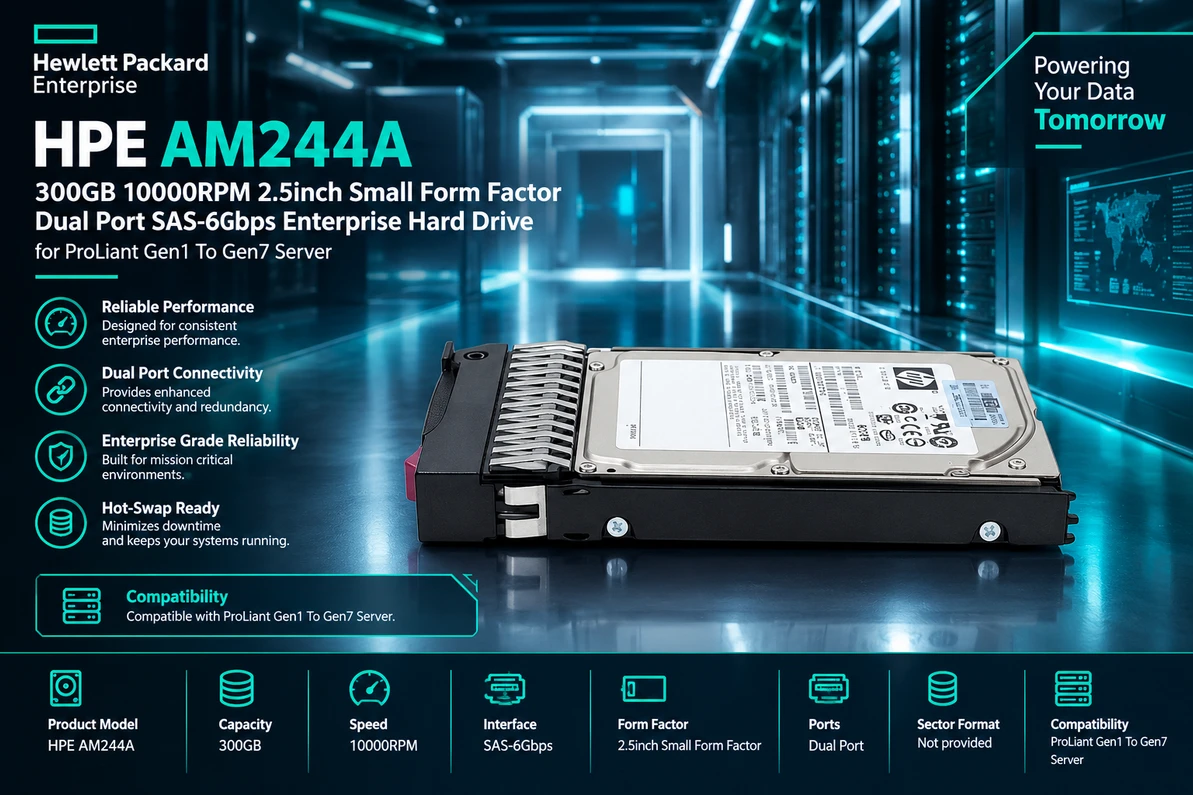
Enterprise servers need dependable storage to keep applications running, business information accessible, and essential workloads operating smoothly. Although modern storage technologies continue to evolve, many businesses still rely on established server platforms that deliver dependable performance for their existing infrastructure. The HPE AM244A 300GB 10000RPM 2.5-inch Small Form Factor Dual Port SAS-6Gbps Enterprise Hard Drive is a storage solution designed for enterprise environments where reliability, compatibility, and consistent operation remain important.
With a 300GB storage capacity, a rotational speed of 10,000 RPM, a 2.5-inch Small Form Factor (SFF) design, and a SAS interface supporting data transfer rates of up to 6Gbps, this enterprise hard drive is suited to storage requirements that prioritize dependable access to frequently used data. Its dual-port SAS connectivity also supports the redundant storage architectures commonly used in enterprise environments, provided the surrounding hardware and configuration support this functionality.
For organizations maintaining compatible HPE ProLiant Generation 1 through Generation 7 servers, the AM244A can be considered as part of a storage replacement or maintenance strategy. However, compatibility should always be verified against the exact server model, drive bay, controller, firmware, and carrier requirements before purchase.
HPE AM244A Hard Drive: Key Specifications and Features
Understanding the technical specifications of an enterprise hard drive helps businesses determine whether it fits their infrastructure and workload requirements.
Product Specifications
-
Brand: HPE (Hewlett Packard Enterprise)
-
Model / Part Number: AM244A
-
Storage Capacity: 300GB
-
Rotational Speed: 10,000 RPM
-
Form Factor: 2.5-inch Small Form Factor (SFF)
-
Interface: Serial Attached SCSI (SAS)
-
Interface Transfer Rate: Up to 6Gbps
-
Connectivity: Dual-port SAS
-
Drive Category: Enterprise hard disk drive (HDD)
-
Intended Server Family: Compatible ProLiant Generation 1 through Generation 7 systems, subject to configuration verification
These specifications describe the product configuration in the supplied title. Buyers should confirm the precise HPE spare number, firmware variant, drive carrier, and supported system list before ordering, as enterprise drives can have multiple configurations that look similar but are not interchangeable in every server.
300GB Storage Capacity for Essential Business Data
Practical Storage for Established IT Infrastructure
A 300GB hard drive provides storage space for operating system files, application data, business documents, selected databases, and other essential information. Although this capacity is modest compared with contemporary enterprise drives, it can remain useful in older server environments where workloads and storage requirements are already well established.
For businesses maintaining legacy applications, a 300GB enterprise drive may provide sufficient capacity for specific operational tasks without requiring a complete storage architecture upgrade. It can also be useful when replacing a failed drive in an existing array, provided the replacement meets the array's capacity, interface, sector-format, and compatibility requirements.
Supporting Existing Storage Investments
Replacing a failed drive with a compatible unit can help organizations extend the useful life of existing server hardware. This approach may be attractive to small businesses, IT maintenance providers, and organizations operating specialized applications that still depend on older ProLiant platforms.
Before installing the AM244A in a RAID array, administrators should verify the required capacity and sector format and follow the storage controller manufacturer's replacement procedure. A replacement drive should never be assumed to rebuild an array successfully based on capacity alone.
10,000 RPM Performance for Responsive Data Access
Understanding Rotational Speed
The AM244A's specified rotational speed of 10,000 revolutions per minute (RPM) is an important characteristic of its mechanical design. A hard disk stores information on rotating magnetic platters, and the drive's read/write heads move to access the required data.
Higher rotational speed generally reduces rotational latency, which is the time spent waiting for the required sector to rotate into position. This can improve responsiveness in workloads involving frequent random access compared with otherwise similar lower-RPM mechanical drives.
A 10,000 RPM enterprise HDD can therefore be suitable for certain transactional applications, frequently accessed files, and server workloads that need predictable mechanical storage performance. Actual results depend on factors such as access patterns, controller configuration, queue depth, cache behavior, and the performance of the surrounding storage system.
Balancing Performance and Capacity
Enterprise storage decisions involve more than rotational speed. Businesses must consider capacity, reliability requirements, workload intensity, energy consumption, and the cost of maintaining older infrastructure.
The AM244A's 300GB capacity and 10,000 RPM speed may make it appropriate for defined legacy workloads, but it should not automatically be considered faster than every alternative. Modern SSDs can provide substantially lower latency and higher input/output performance, especially for random workloads. Nevertheless, a compatible mechanical drive may remain a practical choice when preserving an existing SAS-based environment is the priority.
SAS-6Gbps Interface: Built for Enterprise Connectivity
What Is Serial Attached SCSI?
Serial Attached SCSI, commonly known as SAS, is an interface technology used in enterprise storage systems. It is designed to support dependable communication between storage devices, controllers, and other components in compatible server and storage environments.
The AM244A is described as using a SAS interface with a maximum interface transfer rate of 6Gbps. This represents the signaling rate of the interface rather than the guaranteed speed at which applications can read or write data.
Actual throughput depends on the mechanical characteristics of the drive, controller capabilities, storage configuration, workload, and other system limitations. The interface provides the connection between the drive and the storage infrastructure, while the physical disk mechanism determines much of its real-world performance.
Why SAS Matters in Enterprise Servers
SAS is widely associated with enterprise storage because it supports features used in managed server environments, including dual-port connectivity and integration with compatible SAS controllers and storage systems.
For organizations operating older ProLiant servers, selecting a drive with the correct SAS interface can help maintain an established storage configuration. However, interface compatibility alone is not sufficient. The controller, firmware, drive carrier, backplane, and server-specific support documentation must also be checked.
A SAS drive should not be assumed to work in a SATA-only backplane or with every SAS controller. Verifying the complete storage path before installation helps reduce compatibility issues and unnecessary downtime.
Dual-Port SAS Connectivity for Enterprise Storage
Understanding Dual-Port Design
Dual-port SAS drives provide two independent physical paths to the drive. In a compatible enterprise storage architecture, these paths can be connected through separate controller or expander routes to support redundant access.
If one supported path becomes unavailable, a properly configured system may continue communicating with the drive through the remaining path. This can improve storage-path resilience and help reduce the impact of certain component failures.
Dual-port connectivity does not independently guarantee uninterrupted operation. Redundancy depends on the complete system design, including supported controllers, cabling, expanders, multipathing software, and appropriate failover configuration.
Benefits for Business Continuity
For organizations operating critical applications on older ProLiant systems, storage-path redundancy can be an important part of business continuity planning. It may help support environments where access to business data needs to be maintained despite a failure in one supported connection path.
Administrators should confirm that the specific server and controller configuration supports dual-path operation before relying on this feature. A dual-port drive connected through a single active path does not provide the same end-to-end redundancy as a fully configured multipath storage system.
2.5-Inch Small Form Factor: Efficient Use of Server Space
A Compact Storage Design
The 2.5-inch Small Form Factor design is intended for server configurations that accommodate compact drives. Depending on the chassis, smaller drive bays can allow multiple storage devices to be installed within a limited physical space.
This can help organizations maintain flexible storage layouts in compatible rack servers and other enterprise systems. A smaller drive format can also make it easier to manage the physical arrangement of storage devices, although actual drive-bay capacity depends on the server chassis and backplane.
Check the Carrier and Drive Bay
Physical fit is one of the most important considerations when replacing an enterprise hard drive. Even when two drives share the same nominal form factor, their carriers, connectors, firmware, and support requirements may differ.
Before purchasing the AM244A, verify that the intended ProLiant server accepts the exact drive configuration. Confirm whether a compatible hot-plug carrier is required and whether the drive is supplied with that carrier. Never assume that a bare drive will fit directly into an existing server bay without the appropriate mounting hardware.
Enterprise Reliability and Long-Term Operation
Designed for Business Storage Environments
Enterprise storage devices are selected for their role within business infrastructure, where predictable operation, maintenance procedures, and system compatibility matter. The AM244A's specified SAS interface, 10,000 RPM rotational speed, and dual-port design align with characteristics commonly associated with enterprise mechanical storage.
However, enterprise classification does not mean that a particular used or refurbished drive is guaranteed to be healthy. The condition of an individual unit depends on its service history, operating environment, age, and maintenance.
When sourcing a replacement drive, buyers should evaluate its condition, warranty, return policy, and available testing information. Where possible, check drive health information and relevant diagnostic results before putting a replacement into production.
Maintenance and Drive Monitoring
Proactive monitoring helps administrators identify storage problems before they develop into major operational disruptions. Depending on the controller and system, useful checks may include drive status, predictive failure alerts, error logs, temperature, and storage-array health.
Organizations should also maintain current backups and verify that recovery procedures work as expected. RAID can improve availability in supported configurations, but it is not a substitute for independent backups because it does not protect against every form of data loss.
Potential Applications for the HPE AM244A
Legacy Business Applications
Organizations that continue running established applications may need replacement components that match their existing infrastructure. A compatible 300GB SAS drive can serve as a replacement candidate when the workload does not require greater capacity or the latency characteristics of solid-state storage.
Before deployment, administrators should assess whether the existing application remains adequately supported and whether the storage configuration meets current operational and security requirements.
File and Application Servers
Smaller file repositories, internal application environments, and selected departmental workloads may use mechanical enterprise drives when storage demands are predictable. The suitability of the AM244A depends on the total data volume, access frequency, performance expectations, and number of users.
Workloads with heavy random access, large datasets, or strict response-time requirements may benefit from newer storage technologies. A performance assessment can help determine whether maintaining mechanical storage or upgrading to SSDs is the better long-term choice.
Compatible RAID Configurations
The AM244A may be considered for a supported RAID configuration if the controller recognizes the drive and all relevant array requirements are satisfied. Administrators must verify drive compatibility, usable capacity, sector format, and firmware requirements before adding a replacement to an array.
Important: Never remove or replace a RAID member without confirming its status and following the controller's documented procedure. Incorrect replacement steps can lead to degraded availability or data loss.
Server Repair and Spare-Part Inventory
IT service providers and hardware maintenance teams may keep compatible enterprise drives available to shorten repair times. A correctly identified spare can help reduce delays when a drive fails in a supported legacy server.
For inventory management, record the exact model and part number, interface, form factor, capacity, carrier type, condition, and warranty status. These details make it easier to identify an appropriate replacement when maintenance is required.
Compatibility with HPE ProLiant Generation 1 Through Generation 7 Servers
Why Compatibility Verification Is Essential
The product description identifies the AM244A for ProLiant Generation 1 through Generation 7 servers. This should be treated as a compatibility target to verify, rather than a guarantee that the drive will operate in every server within those generations.
ProLiant servers differ in their storage controllers, backplanes, drive cages, firmware, and supported drive types. Some systems may require specific carriers or controller configurations, while others may not support a particular interface or drive variant.
Before ordering, check the exact server model and product documentation. Also verify whether the intended controller supports SAS-6Gbps drives and whether the system's firmware recognizes the selected drive.
A Practical Pre-Purchase Checklist
-
Confirm the exact HPE AM244A part number and drive configuration.
-
Check the server model and its supported storage devices.
-
Verify the SAS controller and backplane compatibility.
-
Confirm the 2.5-inch drive bay and carrier requirements.
-
Check RAID capacity, sector-format, and firmware requirements where applicable.
-
Review the seller's warranty, return terms, and product condition.
-
Ensure that important data is backed up before replacing or reconfiguring storage.
These checks can help buyers avoid ordering an incompatible drive and support a smoother installation process.
Installation and Best Practices
Prepare the Server Before Installation
Before handling a replacement drive, review the server's maintenance documentation and determine whether the drive bay supports hot-plug replacement. Hot-plug capability must be confirmed for the specific system and configuration.
Record the existing drive's status and identify the correct bay before removal. If the drive is part of a RAID array, confirm the array state and follow the controller manufacturer's instructions. Where a system requires shutdown before drive replacement, power it down safely.
Verify Operation After Installation
After installing the drive, check whether the controller detects it correctly. Confirm the reported capacity and drive status, then follow the required procedure to rebuild or configure the storage array if applicable.
Monitor the array until any rebuild or synchronization process has completed. Avoid unnecessary interruptions during this period, and verify that the server's operating system and applications can access the expected storage resources.
Testing should also include checking for controller alerts and confirming that backups remain current. A successful physical installation does not by itself establish that the drive is suitable for every workload.
HPE AM244A Compared with Modern SSD Storage
When a Mechanical Drive Makes Sense
A traditional enterprise HDD can remain useful when the primary objective is to replace an existing component without redesigning the storage environment. Maintaining the original drive type may simplify compatibility planning and reduce the scope of a repair.
For legacy servers, replacing a failed drive with a supported mechanical equivalent can be more straightforward than introducing a new storage architecture. This is particularly relevant when the application, controller, and server platform have established requirements.
When an SSD Upgrade May Be Better
SSDs do not use rotating platters or moving read/write heads. As a result, they generally provide much lower access latency and can deliver higher random input/output performance than mechanical hard drives.
Businesses considering a wider storage upgrade should compare capacity, endurance, interface compatibility, cost, power consumption, and application performance. An SSD is not automatically compatible with an older SAS server, so the controller and backplane requirements still need to be checked.
The best choice depends on the purpose of the upgrade. The AM244A may suit a targeted replacement, while an SSD-based solution may be more appropriate for workloads that need faster response times.
Why Choose the HPE AM244A 300GB Enterprise Hard Drive?
The HPE AM244A brings together a 300GB capacity, 10,000 RPM rotational speed, 2.5-inch form factor, SAS-6Gbps interface, and dual-port connectivity in a configuration intended for compatible enterprise storage environments.
For businesses maintaining older ProLiant servers, these characteristics may make the drive worth considering for replacement and maintenance purposes. Its potential value lies in matching the requirements of an established storage system rather than offering the capacity or performance of a modern high-end drive.
The most important purchasing decision is confirming that the exact part is supported by the target server and storage controller. Buyers should also compare the drive's condition and warranty with their operational requirements.
Conclusion: A Focused Storage Choice for Legacy Server Maintenance
The HPE AM244A 300GB 10000RPM 2.5-inch Small Form Factor Dual Port SAS-6Gbps Enterprise Hard Drive is a potential option for organizations seeking a compatible storage replacement for established HPE ProLiant infrastructure.
Its 10,000 RPM rotational speed supports the responsiveness expected from enterprise mechanical storage, while its SAS interface and dual-port design provide connectivity characteristics suited to compatible server environments. The compact form factor can also fit supported storage configurations where space and drive-bay requirements matter.
Although its capacity is limited compared with contemporary enterprise drives, the AM244A may still serve a purpose in legacy systems with defined storage needs. Careful compatibility checks, appropriate installation procedures, reliable backups, and ongoing drive monitoring are essential for successful deployment.
For IT administrators, resellers, and maintenance teams, the best approach is to verify the precise part number and system support before purchase. Choosing a drive that matches the existing infrastructure can help simplify maintenance and keep supported business workloads operating as intended.
Recent Posts
-
HPE 492620-B21: The Compact Storage Workhorse Keeping ProLiant Servers Reliable, Responsive, and Ready for Business
Introduction: Dependable Enterprise Storage for Established ProLiant Servers Reliable storage is ess …Oct 8th 2026 -
Compact Powerhouse: How the HPE AM244A 300GB Enterprise Hard Drive Keeps Legacy ProLiant Servers Running Strong
Introduction: Reliable Storage for Demanding Server Environments Enterprise servers need dependable …Oct 7th 2026 -
Small Drive, Serious Power: The HPE 537809-B21 300GB Enterprise Hard Drive Built for Reliable Server Performance
HPE 537809-B21 300GB 10000RPM SAS-6Gbps Enterprise Hard Drive: Reliable Storage for ProLiant Servers …Oct 6th 2026