
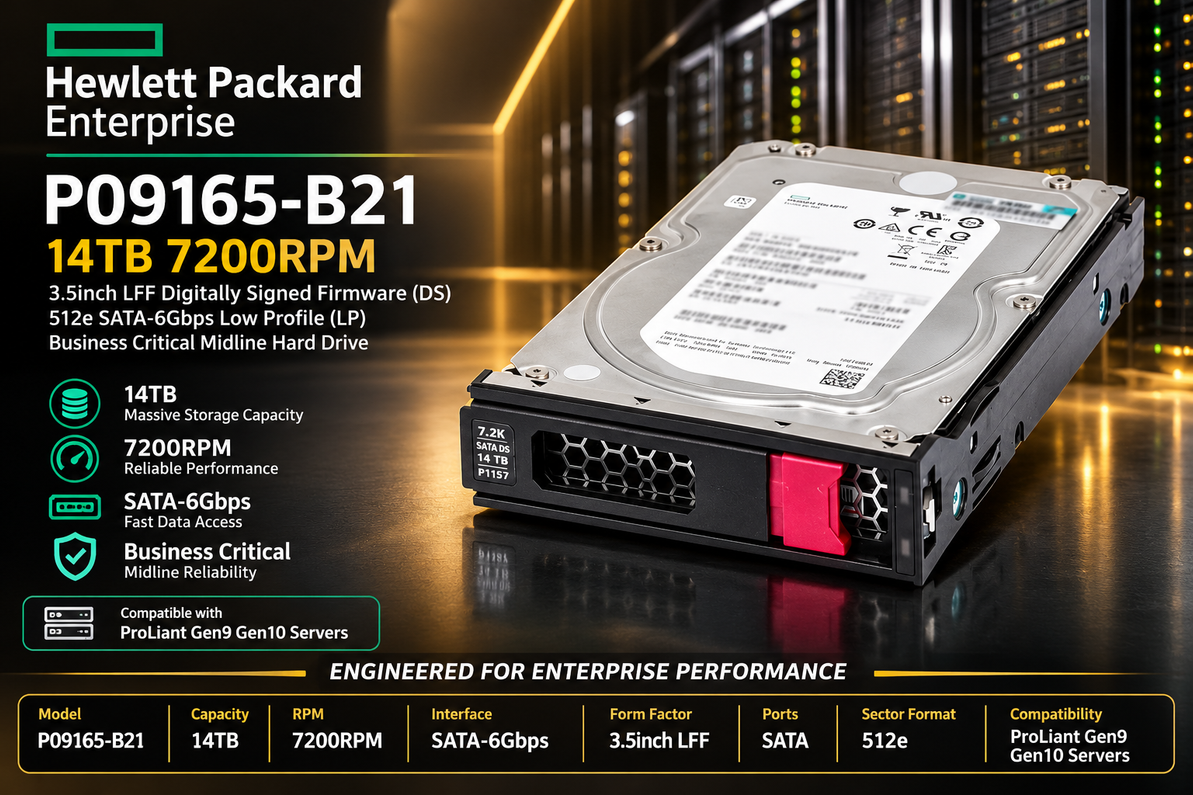
HPE P09165-B21: Powering Enterprise Data Growth with 14TB of Reliable, High-Capacity Server Storage
Introduction: 14TB of Storage Power, Built to Keep Enterprise Data Moving
In today's increasingly data-driven business environment, storage capacity is no longer simply a technical consideration. It is a fundamental requirement for maintaining business continuity, supporting enterprise applications, and managing the enormous volumes of information generated every day. From databases and business documents to virtual machine files, backup archives, and application repositories, modern organizations need storage solutions that can grow alongside their operations.
The HPE P09165-B21 14TB 7200RPM 3.5-inch Large Form Factor (LFF) SATA Hard Drive is designed for organizations seeking substantial storage capacity and dependable performance in compatible enterprise server environments. Combining a helium-filled design, 14TB storage capacity, 7200RPM rotational speed, and SATA-6Gbps connectivity, this Business Critical Midline hard drive offers a practical solution for capacity-oriented storage applications.
Beyond its impressive capacity, the HPE P09165-B21 incorporates several enterprise-focused features, including Digitally Signed Firmware (DS), 512e Advanced Format technology, and a Low Profile (LP) carrier. These features make it a relevant choice for businesses maintaining compatible HPE ProLiant server infrastructure.
Whether you are expanding an existing server, replacing an aging hard drive, building a larger backup repository, or accommodating increasing business data requirements, the HPE P09165-B21 brings together storage density, practical performance, and enterprise-oriented functionality in one drive.
HPE P09165-B21 14TB Hard Drive: An Overview of Its Core Features
Massive 14TB Storage Capacity for Growing Data Requirements
Data growth is a challenge faced by businesses across almost every industry. Organizations continuously generate and retain information through customer databases, financial applications, digital documents, enterprise software, and cloud-connected services.
The HPE P09165-B21 addresses these growing storage requirements with 14TB of capacity.
Having 14TB available in a single hard drive allows organizations to accommodate substantial datasets without depending on numerous smaller-capacity drives. This can help simplify storage planning, reduce the number of physical drives required for a particular capacity target, and make more efficient use of available server drive bays.
For businesses maintaining centralized file repositories, backup destinations, application data, and historical records, this additional capacity provides valuable flexibility.
High-capacity mechanical drives are particularly useful in environments where storage density and capacity planning are important considerations.
7200RPM Rotational Speed for Balanced Enterprise Performance
The HPE P09165-B21 operates at 7200 revolutions per minute (RPM), commonly referred to as 7.2K RPM.
Rotational speed influences how quickly a mechanical hard drive can position its read/write heads over the required data locations. A 7200RPM drive offers a practical balance between storage capacity and mechanical performance.
Although it cannot deliver the exceptionally low latency of an enterprise SSD, this rotational speed is appropriate for many general-purpose and capacity-oriented storage applications.
Businesses can consider this drive for file repositories, backup storage, archived information, and other workloads where large storage capacity is more important than extremely fast random-access performance.
The HPE P09165-B21 also has a published maximum sequential throughput of 250 MiB/s under the specified test conditions. Actual performance depends on workload characteristics, data location, controller configuration, and the surrounding storage environment.
SATA-6Gbps Interface for Reliable Storage Connectivity
The HPE P09165-B21 uses a Serial ATA (SATA) interface with a maximum signaling rate of 6Gbps.
SATA is a widely adopted storage interface found in desktop computers, workstations, servers, and capacity-oriented storage systems.
Its 6Gbps interface provides connectivity for compatible SATA storage controllers and server backplanes. This makes the drive relevant to organizations operating HPE server configurations designed to support SATA-based storage devices.
It is important to understand that the 6Gbps specification represents the maximum theoretical interface signaling rate rather than the guaranteed sustained speed of the mechanical drive.
Actual data transfer performance is influenced by the drive's internal mechanical characteristics, workload patterns, controller capabilities, and storage configuration.
For organizations looking to expand existing SATA-based server storage, the HPE P09165-B21 provides a high-capacity option with a familiar enterprise storage interface.
Helium-Filled Technology for High-Density Storage
One of the interesting technologies incorporated into the HPE P09165-B21 is its helium-filled internal design.
Traditional mechanical hard drives contain air inside their sealed enclosures. Helium-filled HDDs use helium instead, taking advantage of its significantly lower density.
Because helium is less dense than air, it creates less aerodynamic resistance around the rotating platters and moving internal components.
This reduced internal resistance helps drive manufacturers engineer high-capacity mechanical storage devices while managing the operating conditions inside the drive enclosure.
Helium-filled technology is particularly relevant in enterprise storage because organizations increasingly need larger capacities without constantly increasing the number of physical drives installed in their servers.
The HPE P09165-B21 combines this technology with 14TB of storage, making it a suitable option for capacity-focused server environments.
Digitally Signed Firmware for Enhanced Hardware Security
Storage security is about more than protecting information against accidental deletion, unauthorized access, or physical hardware failure. The integrity of the firmware controlling storage devices is another important consideration.
The HPE P09165-B21 features Digitally Signed Firmware (DS), which helps protect against unauthorized firmware modifications.
Digital signatures provide a verification mechanism that helps establish whether firmware originates from a trusted source and has not been improperly altered.
This is particularly valuable in professional IT environments where storage devices support important business applications and sensitive information.
By incorporating digitally signed firmware, HPE adds an additional hardware integrity feature to this high-capacity enterprise hard drive.
512e Advanced Format Technology
The HPE P09165-B21 uses the 512e sector format, also known as 512-byte emulation.
Traditional hard drives commonly use 512-byte logical sectors. Modern high-capacity drives can use larger physical sectors to improve storage efficiency.
A 512e drive uses 4096-byte physical sectors while presenting 512-byte logical sectors to compatible operating systems and applications.
This arrangement helps maintain compatibility with systems designed around traditional 512-byte logical sector addressing.
For server administrators, understanding sector format is important when replacing existing drives, configuring RAID arrays, and integrating new storage devices into established infrastructure.
Understanding the HPE P09165-B21 Low Profile Carrier Design
3.5-Inch Large Form Factor
The HPE P09165-B21 uses a 3.5-inch Large Form Factor (LFF) design.
LFF hard drives are widely used in enterprise servers and storage systems where high-capacity mechanical storage is a priority.
Their physical format provides a familiar platform for deploying larger-capacity HDDs in compatible server drive bays.
For organizations looking to expand existing storage infrastructure, LFF drives can provide a practical way to increase available capacity without completely redesigning the server environment.
However, the server must have the appropriate LFF drive bay and support the required carrier configuration.
Low Profile Carrier Configuration
The Low Profile (LP) carrier is another important part of the HPE P09165-B21's physical design.
Enterprise hard drives are often supplied with specialized mounting carriers that secure the drive inside compatible server drive bays.
The carrier provides the physical installation arrangement required by the corresponding server chassis.
When purchasing a replacement drive, administrators should check the carrier type rather than relying exclusively on capacity and interface specifications.
Two drives may have identical storage capacities and SATA connectivity but still use different physical carriers.
The HPE P09165-B21 is supplied with an HPE Low Profile carrier, making it important to verify that the intended server supports this particular configuration.
Hot-Plug Convenience
The product is identified as a hot-plug hard drive, allowing installation and removal through compatible hot-plug server drive bays.
Hot-plug capability can make storage maintenance more convenient because supported drives can be serviced without requiring the entire server to be powered down.
However, hot-plug replacement should always follow the server manufacturer's instructions and the requirements of the installed storage controller and RAID configuration.
Why Choose a Business Critical Midline Hard Drive?
Understanding the Midline Storage Category
Enterprise hard drives are designed for different workload requirements.
Mission Critical drives generally target demanding applications where performance and intensive storage access are important.
Business Critical Midline drives focus more heavily on providing substantial storage capacity for suitable enterprise applications.
The HPE P09165-B21 belongs to the Business Critical Midline category.
This makes it particularly relevant for organizations that need to store large volumes of business information without necessarily requiring the performance characteristics of high-end transactional storage.
Midline hard drives can be considered for backup repositories, file storage, data archiving, and other capacity-oriented applications.
Balancing Storage Capacity and Performance
Not every business application requires the lowest possible storage latency.
Many organizations need to preserve large amounts of information that may be accessed periodically rather than continuously.
For these applications, a 14TB mechanical hard drive can provide a practical storage solution.
The HPE P09165-B21 combines high capacity with 7200RPM rotational speed and SATA-6Gbps connectivity, offering a useful balance for appropriate enterprise workloads.
For intensive database transactions, high-frequency random access, and demanding virtualization environments, enterprise SSDs may be more appropriate.
The right storage technology should always be selected according to actual application requirements.
Enterprise Applications of the HPE P09165-B21 14TB SATA Hard Drive
Centralized Business File Storage
Businesses frequently rely on centralized file servers to provide employees and applications with access to shared information.
Documents, spreadsheets, project files, departmental records, and operational data can quickly consume available storage capacity.
The HPE P09165-B21 provides 14TB of capacity for compatible server configurations, making it a potential option for expanding centralized file repositories.
Organizations can use additional capacity to accommodate growing information requirements while making better use of existing server infrastructure.
Backup and Disaster Recovery Storage
Backup infrastructure is essential for protecting valuable business information.
Unexpected hardware failures, accidental deletion, software problems, and security incidents can result in serious data loss if organizations do not maintain appropriate backup procedures.
The HPE P09165-B21 offers substantial capacity for consideration in backup-oriented storage configurations.
Its 14TB capacity can accommodate large backup repositories, historical records, and secondary copies of important business information.
Businesses can use high-capacity mechanical storage to maintain backup destinations and support their broader disaster recovery strategies.
However, a single hard drive should never be considered a complete backup solution. Organizations should maintain multiple protected copies of critical information and consider off-site or geographically separate backup arrangements.
Database Storage and Application Repositories
Enterprise databases contain valuable business information, including customer records, financial transactions, application data, and operational histories.
High-capacity mechanical drives can contribute to database storage environments where the workload is suitable for conventional HDD performance.
The HPE P09165-B21 can be considered for database archives, historical records, and less frequently accessed application datasets.
For databases that require intensive random reads and writes, very low latency, and consistently high transaction performance, enterprise SSDs may provide a better solution.
Administrators should evaluate workload characteristics before selecting mechanical storage for database applications.
Virtualization and Consolidated Server Infrastructure
Virtualization allows organizations to operate multiple virtual machines on shared physical server hardware.
Each virtual machine requires storage for its operating system, applications, configuration files, and business information.
As virtualized environments expand, storage requirements can grow considerably.
The HPE P09165-B21 can contribute to suitable capacity-oriented virtualization storage configurations where mechanical drive performance is sufficient.
Administrators should evaluate the number of virtual machines, storage access patterns, controller capabilities, and expected I/O requirements before deploying this drive.
Data Archiving and Historical Information
Many organizations must retain business information for extended periods.
Historical documents, archived reports, completed projects, older application files, and infrequently accessed datasets can occupy substantial storage capacity.
High-capacity mechanical drives are particularly useful in these environments because they provide substantial storage space within a conventional server drive bay.
With 14TB available, the HPE P09165-B21 can support appropriate archival storage configurations while helping businesses accommodate larger information repositories.
HPE P09165-B21 Compatibility with ProLiant Gen9 and Gen10 Servers
Designed for Compatible HPE Server Infrastructure
The HPE P09165-B21 is listed for use in supported HPE server and storage configurations, including selected ProLiant Gen9 and Gen10 systems.
Its 14TB capacity, SATA-6Gbps interface, 3.5-inch LFF design, and Low Profile carrier make it relevant to compatible HPE server platforms.
However, compatibility should always be verified against the exact server model and configuration.
Not every ProLiant server supports every SATA hard drive simply because it belongs to the same generation.
Storage controller models, drive backplanes, available drive bays, firmware requirements, and carrier configurations can all affect compatibility.
Administrators should consult the applicable HPE QuickSpecs and server documentation before purchasing or installing the drive.
Verify SATA Controller Support
The server must have a compatible SATA storage controller or backplane to communicate with the HPE P09165-B21.
Before installation, verify the controller model, supported interface, drive capacity limitations, and firmware requirements.
A physically compatible drive bay does not automatically guarantee that the installed storage controller supports the drive.
Confirm LFF Drive Bay Compatibility
The HPE P09165-B21 uses a 3.5-inch LFF configuration with a Low Profile carrier.
The intended server must have a compatible LFF drive bay and support the supplied carrier design.
Checking the physical configuration before purchasing is especially important when replacing an existing drive.
Review RAID Configuration Requirements
If the drive will be added to an existing RAID array, administrators should review the array's requirements before installation.
Important considerations include drive interface, capacity, sector format, controller firmware, and RAID configuration.
Replacing a failed drive with an incompatible model can complicate rebuilding procedures and potentially affect storage availability.
HPE P09165-B21 vs. SAS Hard Drives: Understanding the Difference
SATA and SAS are two different storage interfaces commonly used in enterprise and computer systems.
SATA is widely used in desktop computers, workstations, entry-level servers, and capacity-oriented storage environments.
SAS is commonly found in enterprise servers and professional storage infrastructure.
The HPE P09165-B21 uses SATA-6Gbps connectivity, making it suitable for compatible SATA storage controllers.
SAS controllers can often support SATA drives, depending on the controller and backplane, but SATA controllers generally cannot communicate with SAS drives.
The choice between SATA and SAS should depend on the existing infrastructure, application requirements, and storage architecture.
For organizations maintaining SATA-based HPE server configurations, the P09165-B21 offers a high-capacity option without requiring an entirely SAS-based storage environment.
HPE P09165-B21 vs. Enterprise SSDs: Which Is Better for Your Business?
Traditional hard drives and solid-state drives serve different storage requirements.
The HPE P09165-B21 focuses on high-capacity mechanical storage. Its 14TB capacity and 7200RPM rotational speed make it relevant for applications where accommodating substantial volumes of information is a priority.
Enterprise SSDs use flash memory rather than rotating magnetic platters. They generally provide significantly faster random-access performance and lower latency.
For high-performance databases, intensive virtualization, and applications requiring rapid access to frequently changing information, enterprise SSDs are often the preferred option.
Mechanical hard drives remain useful for backup repositories, large file collections, historical records, and capacity-focused storage environments.
Many organizations combine both technologies. Frequently accessed information can reside on SSDs, while larger datasets and less frequently accessed information are stored on high-capacity HDDs.
This hybrid approach allows businesses to balance performance, capacity, and infrastructure costs.
The Importance of Digitally Signed Firmware in Enterprise Storage
Protecting Firmware Integrity
Firmware controls important functions within a hard drive, including how the device communicates with storage controllers and manages internal operations.
If firmware is improperly modified, the integrity and reliability of the device could be affected.
Digitally Signed Firmware provides a verification mechanism intended to help protect against unauthorized firmware modifications.
For enterprise administrators, this feature adds another important consideration when evaluating storage hardware for professional infrastructure.
Supporting a Broader Hardware Security Strategy
Modern data centers must protect information at multiple levels.
Organizations commonly use access controls, encryption, network security, monitoring, and backup procedures to reduce security risks.
Storage device firmware integrity is another part of this broader security strategy.
The HPE P09165-B21 incorporates digitally signed firmware as part of its enterprise-oriented design, making it relevant for organizations that consider hardware-level security when selecting server components.
Installation and Maintenance Recommendations
Prepare the Server Before Installation
Before installing the HPE P09165-B21, identify the server model, installed storage controller, available drive bays, and existing storage configuration.
Checking these details beforehand helps reduce compatibility problems.
Verify the Drive Specifications
Confirm the 14TB capacity, SATA-6Gbps interface, 7200RPM speed, 3.5-inch LFF dimensions, Low Profile carrier, and 512e sector format.
The replacement drive should meet the requirements of the intended server and storage configuration.
Follow Proper Installation Procedures
Follow the manufacturer's instructions for inserting the drive into the appropriate drive bay.
Ensure that the carrier is correctly seated and secured before configuring the device through the storage controller.
For hot-plug installations, follow the applicable server and RAID controller procedures.
Monitor Drive Health
Regular storage monitoring can help administrators identify potential problems before they result in operational disruptions.
Use compatible server management and storage monitoring tools to review available drive health information, controller alerts, and system logs.
Establishing regular monitoring procedures is particularly important in environments where business applications depend on continuous storage availability.
Technical Specifications of HPE P09165-B21
The following table summarizes the key specifications of this enterprise hard drive.
| Specification | Details |
|---|---|
| Manufacturer | Hewlett Packard Enterprise (HPE) |
| Model / Part Number | P09165-B21 |
| Spare Part Number | P11519-001 |
| Product Category | Enterprise Hard Disk Drive |
| Capacity | 14TB |
| Drive Technology | Helium-filled HDD |
| Rotational Speed | 7200RPM (7.2K) |
| Interface | SATA |
| Interface Transfer Rate | 6Gbps |
| Form Factor | 3.5-inch Large Form Factor (LFF) |
| Carrier Type | Low Profile Carrier (LP) |
| Sector Format | 512e |
| Firmware | Digitally Signed Firmware |
| Workload Category | Business Critical Midline |
| Drive Type | Hot-Plug |
| Maximum Sequential Throughput | 250 MiB/s |
| Spare Part Number | P11519-001 |
| Warranty | 1-year limited manufacturer warranty for the Midline drive |
Why Choose the HPE P09165-B21 for Your Enterprise Storage Infrastructure?
Generous 14TB Storage Capacity
The 14TB capacity provides considerable room for business files, application information, backup repositories, and historical datasets.
Helium-Filled Drive Technology
Helium-filled construction supports the engineering of high-capacity mechanical hard drives and is an important characteristic of this enterprise storage model.
Practical 7200RPM Performance
The 7200RPM rotational speed provides a useful balance for suitable capacity-oriented workloads.
SATA-6Gbps Connectivity
The SATA interface provides connectivity for compatible server controllers and storage backplanes.
Digitally Signed Firmware
Firmware verification helps protect against unauthorized firmware modifications and supports enterprise hardware integrity requirements.
Low Profile Carrier
The supplied Low Profile carrier provides the physical mounting arrangement for compatible HPE server drive bays.
Business Critical Midline Design
The Midline classification makes this drive relevant for applications where storage capacity is a primary consideration rather than extremely low access latency.
Important Considerations Before Purchasing HPE P09165-B21
Before selecting this hard drive, buyers should carefully review the following requirements:
-
Storage capacity: Confirm that 14TB meets the intended storage requirements.
-
Interface: Verify that the server supports SATA-6Gbps drives.
-
Form factor: Confirm the availability of compatible 3.5-inch LFF drive bays.
-
Carrier: Check support for the HPE Low Profile carrier.
-
Sector format: Verify compatibility with the 512e sector format.
-
Server compatibility: Check the exact ProLiant Gen9 or Gen10 server model.
-
Storage controller: Confirm controller compatibility and firmware requirements.
-
RAID configuration: Review the requirements of any existing storage array.
-
Firmware: Follow applicable HPE firmware and maintenance recommendations.
These checks help reduce installation problems and support a smoother storage upgrade process.
Conclusion: Give Your Enterprise Data Room to Grow with HPE P09165-B21
As organizations continue to generate and preserve larger volumes of information, high-capacity storage remains essential for maintaining efficient business operations.
The HPE P09165-B21 14TB 7200RPM 3.5-inch LFF SATA-6Gbps Hard Drive brings together several important enterprise storage characteristics in one capacity-focused solution.
Its helium-filled construction, digitally signed firmware, 512e sector format, and Low Profile carrier make it a compelling option for compatible HPE server environments.
With 14TB of storage capacity, a 7200RPM rotational speed, and SATA-6Gbps connectivity, the drive offers a practical combination for businesses seeking to expand their storage infrastructure without relying exclusively on high-performance solid-state storage.
Whether you are upgrading an existing ProLiant server, replacing an aging hard drive, expanding a backup repository, or accommodating growing business datasets, the HPE P09165-B21 deserves consideration.
At StoragePartsDirect, explore enterprise hard drives and server storage components designed to help businesses maintain, expand, and modernize their IT infrastructure.
Frequently Asked Questions (FAQs)
1. What is the storage capacity of the HPE P09165-B21?
The HPE P09165-B21 offers 14TB of storage capacity, making it suitable for enterprise applications that require substantial space for business data, backups, and archived information.
2. What is the rotational speed of the HPE P09165-B21?
The drive operates at 7200RPM (7.2K), providing a practical balance between mechanical storage performance and high-capacity data storage.
3. Which interface does the HPE P09165-B21 use?
It uses a SATA-6Gbps interface, allowing it to connect to compatible SATA storage controllers and server backplanes.
4. What does helium-filled technology mean?
Helium-filled hard drives use helium inside their sealed enclosure instead of ordinary air. Because helium is less dense, it reduces aerodynamic resistance around the rotating platters and moving components.
5. What is the sector format of the HPE P09165-B21?
The drive uses the 512e sector format. It has 4096-byte physical sectors while presenting 512-byte logical sectors to compatible systems.
6. What is Digitally Signed Firmware?
Digitally Signed Firmware uses cryptographic verification to help establish firmware authenticity and protect against unauthorized firmware modifications.
7. What is the form factor of this hard drive?
The HPE P09165-B21 uses a 3.5-inch Large Form Factor (LFF) design and comes with a Low Profile carrier.
8. Is the HPE P09165-B21 compatible with ProLiant Gen9 and Gen10 servers?
It is listed for selected HPE ProLiant Gen9 and Gen10 configurations. Compatibility depends on the exact server model, storage controller, backplane, and drive bay. Always consult the applicable HPE documentation before purchasing.
9. What types of workloads are suitable for this Midline hard drive?
It can be considered for business file storage, backup repositories, data archiving, and other capacity-oriented enterprise applications. Extremely performance-sensitive workloads may benefit more from enterprise SSDs.
10. Can the HPE P09165-B21 be used for backup storage?
Yes. Its 14TB capacity makes it suitable for consideration in backup repositories and secondary storage configurations. However, businesses should maintain additional protected copies of critical information.
11. What is the difference between SATA-6Gbps and SAS-12Gbps?
SATA and SAS are different storage interfaces. SATA-6Gbps is commonly used in desktop computers, workstations, and capacity-oriented server environments, while SAS-12Gbps is widely used in enterprise storage infrastructure. They require appropriate controller and connection support.
12. What should I check before purchasing the HPE P09165-B21?
Verify the 14TB capacity, 7200RPM speed, SATA-6Gbps interface, 3.5-inch LFF form factor, Low Profile carrier, 512e sector format, and compatibility with your specific HPE ProLiant server.
Recent Posts
-
HPE P09165-B21: Powering Enterprise Data Growth with 14TB of Reliable, High-Capacity Server Storage
Introduction: 14TB of Storage Power, Built to Keep Enterprise Data Moving In today's increasingly da …Nov 15th 2026 -
HPE 881779-B21: The 12TB Storage Powerhouse Bringing More Capacity, Security, and Reliability to Enterprise Servers
Introduction: When Enterprise Storage Needs More Than Just Space In the world of enterprise computin …Nov 14th 2026 -
HPE 881781-B21: Unleashing 12TB of Enterprise Storage Power for Next-Generation Server Infrastructure
Introduction: More Storage, More Possibilities with HPE 881781-B21 In the modern business landscape, …Nov 13th 2026