
HPE P10520-B21: 12TB of Enterprise Storage Power for Demanding ProLiant Server Environments
Introduction: Built for the Demands of Modern Enterprise Storage
In today's data-driven business environment, reliable storage is essential for keeping enterprise applications, business operations, and critical information accessible. As organizations generate increasing volumes of data, server infrastructure must provide sufficient storage capacity, dependable performance, and compatibility with demanding enterprise workloads. Choosing the right hard drive can make a significant difference in maintaining an efficient and scalable IT environment.
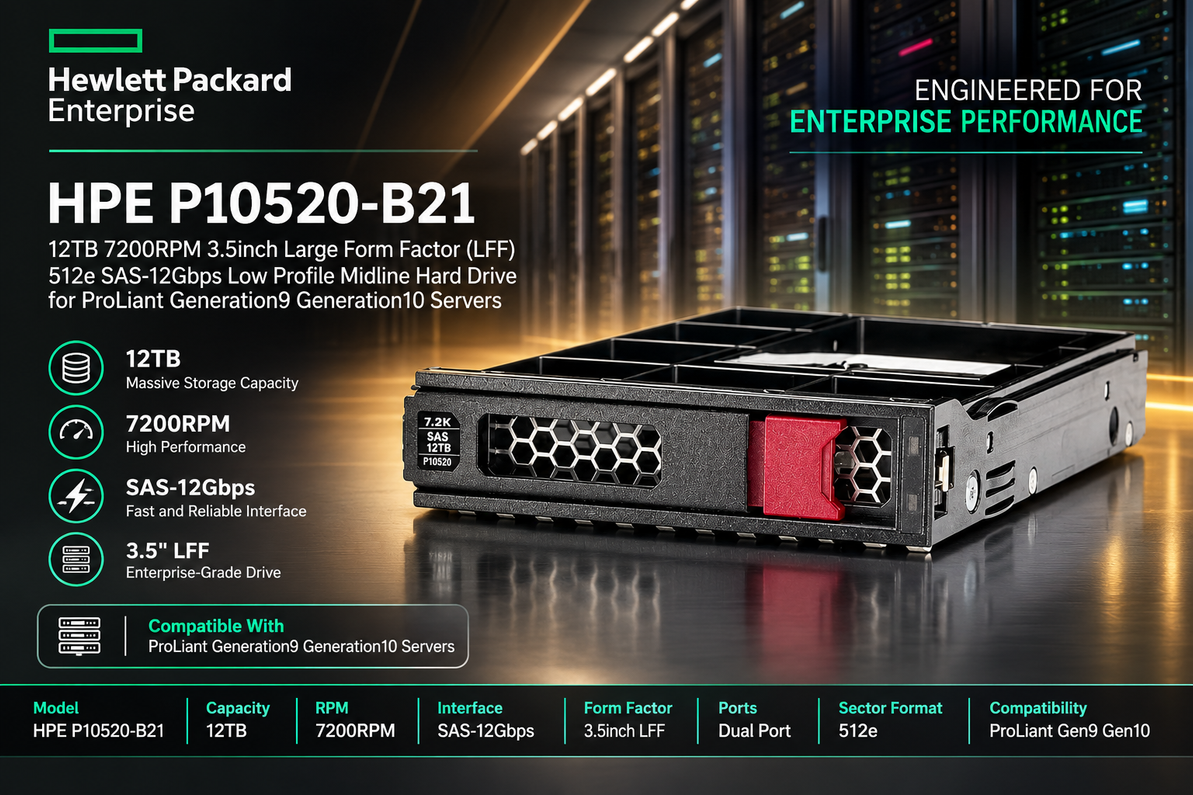
The HPE P10520-B21 12TB 7200RPM 3.5-inch Large Form Factor SAS Hard Drive is designed for enterprise storage environments that require substantial capacity and reliable data access. Combining a 12TB storage capacity, 7200RPM rotational speed, and SAS-12Gbps interface, this drive offers a practical storage solution for compatible HPE ProLiant server configurations.
Its 3.5-inch Large Form Factor design and Low Profile carrier configuration make it suitable for server environments equipped with the corresponding drive bays. The 512-sector-format specification also makes understanding controller and operating-system compatibility particularly important when planning an installation.
For businesses looking to expand existing storage infrastructure, replace aging hard drives, or accommodate growing data requirements, the HPE P10520-B21 is a product worth considering.
HPE P10520-B21 12TB Hard Drive: Product Overview
High-Capacity Storage for Enterprise Applications
The HPE P10520-B21 provides 12TB of storage capacity, giving organizations considerable room for business information, application data, file repositories, and other enterprise storage requirements.
Large-capacity hard drives help businesses consolidate storage resources and accommodate expanding datasets without requiring an immediate increase in the number of physical drives. This can be particularly useful in server environments where rack space, available drive bays, and infrastructure costs must be carefully managed.
With 12TB available in a single drive, organizations can allocate storage for different business purposes, including departmental file storage, application repositories, shared resources, and backup destinations.
7200RPM Rotational Speed
The drive operates at 7200 revolutions per minute (RPM), a rotational speed commonly associated with enterprise capacity-oriented hard drives.
Rotational speed influences how quickly a mechanical hard drive positions its read/write heads over the required data locations. A 7200RPM drive offers a useful balance between storage capacity, performance, and suitability for general enterprise storage workloads.
This makes the HPE P10520-B21 relevant for applications where substantial storage capacity and consistent access to stored information are more important than the extremely low latency typically associated with solid-state drives.
SAS-12Gbps Interface
One of the important features of the HPE P10520-B21 is its Serial Attached SCSI (SAS) interface, supporting a transfer rate of up to 12Gbps.
SAS technology is widely used in enterprise server environments because it provides a storage connectivity standard designed for professional infrastructure. It supports communication between storage devices and compatible server controllers, allowing organizations to build dependable storage configurations.
The 12Gbps interface provides substantial theoretical interface bandwidth, although actual drive performance depends on mechanical limitations, workload characteristics, controller capabilities, and the surrounding storage configuration.
For organizations operating SAS-based server infrastructure, selecting a drive with the appropriate interface is essential for ensuring proper connectivity.
Key Features of the HPE P10520-B21 12TB SAS Hard Drive
1. Generous 12TB Storage Capacity
Storage requirements continue to increase as businesses collect more operational information, maintain larger application databases, and retain extensive historical records.
The 12TB capacity of the HPE P10520-B21 provides considerable room for these growing requirements. It can help organizations expand existing storage pools, increase available server capacity, and accommodate larger datasets.
For businesses managing multiple applications or departmental storage requirements, high-capacity hard drives can also simplify storage planning by reducing the number of individual drives needed to achieve a particular capacity target.
2. 7200RPM Performance for Everyday Enterprise Workloads
The 7200RPM rotational speed provides a practical performance level for capacity-focused enterprise storage.
It is suitable for environments where workloads involve storing and retrieving business files, maintaining application information, and accessing larger datasets.
While it should not be considered a replacement for high-performance enterprise SSDs in latency-sensitive applications, a 7200RPM SAS hard drive can provide a useful balance for organizations that prioritize storage capacity and conventional hard drive economics.
3. Enterprise SAS-12Gbps Connectivity
The SAS-12Gbps interface supports integration into compatible enterprise storage architectures.
SAS is commonly used in professional server environments because of its established ecosystem of controllers, storage devices, and infrastructure components.
The HPE P10520-B21's SAS connectivity makes it relevant to organizations maintaining SAS-based ProLiant server configurations. However, the interface alone does not guarantee compatibility. The installed storage controller, backplane, drive carrier, and server configuration must also support the particular drive.
4. 3.5-Inch Large Form Factor Design
The Large Form Factor (LFF) design follows the standard 3.5-inch enterprise drive format.
LFF drives are frequently selected for storage environments where capacity per drive bay is an important consideration. They allow organizations to deploy high-capacity mechanical storage within appropriately configured server chassis.
Before installation, administrators should confirm that the server has a compatible LFF drive bay and supports the required carrier configuration.
5. Low Profile Carrier Configuration
The Low Profile (LP) carrier is an important physical consideration when selecting a replacement or expansion drive.
Enterprise server drives often use manufacturer-specific carriers designed to fit particular server drive bays. Even when two hard drives share the same capacity and interface, their carriers may not be interchangeable.
The HPE P10520-B21 listing identifies a Low Profile carrier configuration. Buyers should therefore verify the carrier type and physical compatibility before ordering.
6. Sector Format Considerations
Sector format is another important specification when deploying enterprise hard drives.
The supplied product description identifies the HPE P10520-B21 as a 512e drive. However, the available reseller specification identifies it as 512n. These are different sector formats, so the distinction should not be overlooked.
A 512e drive uses 4096-byte physical sectors while presenting 512-byte logical sectors to maintain compatibility with systems designed around traditional 512-byte addressing. A 512n drive uses 512-byte physical and logical sectors.
Administrators should verify the actual drive specification before configuring storage arrays, replacing existing drives, or planning operating-system deployments.
Understanding the Benefits of SAS Technology in Enterprise Storage
Why SAS Remains Important for Enterprise Servers
Serial Attached SCSI is an established storage interface used in enterprise servers, professional storage systems, and data-center infrastructure.
Unlike consumer-oriented storage configurations, enterprise SAS environments are designed around dedicated storage controllers and compatible server components.
SAS technology provides a standardized communication method between drives and storage controllers. It also supports the development of larger storage infrastructures where multiple drives work together to provide the required capacity.
For organizations already operating SAS-based ProLiant servers, maintaining the correct SAS drive specifications can simplify storage expansion and hardware replacement.
Understanding the 12Gbps Transfer Rate
The 12Gbps specification represents the maximum theoretical signaling rate of the SAS interface.
It should not be confused with the actual sustained read and write speed of the mechanical drive.
A traditional hard drive relies on rotating magnetic platters and moving read/write heads. Its real-world performance depends on data location, rotational speed, workload patterns, caching, and other hardware characteristics.
Nevertheless, the SAS-12Gbps interface provides a suitable connectivity platform for compatible enterprise storage configurations.
Enterprise Applications and Suitable Workloads
Business File Storage
Organizations frequently require centralized storage for documents, operational records, shared files, and departmental information.
A 12TB hard drive can provide considerable storage capacity for these applications. Businesses can allocate storage resources according to departmental requirements while maintaining their existing server infrastructure.
Database Storage
Databases require dependable storage to maintain application information, transaction records, and business data.
The HPE P10520-B21 can be considered for capacity-oriented database storage environments where the workload is suitable for mechanical hard drives.
For databases with intensive random-access requirements or extremely low latency expectations, enterprise SSDs may be more appropriate.
Backup and Data Retention
Backup storage is another important application for high-capacity enterprise hard drives.
Organizations must regularly preserve business information to protect against accidental deletion, hardware failures, and operational disruptions.
A 12TB drive can provide useful capacity for backup repositories, historical records, and secondary storage destinations.
However, a single hard drive should never be treated as a complete backup strategy. Businesses should maintain additional copies of critical information and consider appropriate backup rotation, redundancy, and off-site protection.
Virtualization and Server Infrastructure
Virtualized environments depend on storage resources to maintain virtual machine files, operating-system images, and application information.
Capacity-oriented SAS hard drives can contribute to virtualization storage configurations where the performance characteristics of mechanical storage are sufficient.
The final suitability depends on the number of virtual machines, storage access patterns, controller configuration, and overall infrastructure design.
Data Archiving and Long-Term Storage
Businesses that retain large volumes of historical information may benefit from high-capacity mechanical storage.
Archived documents, completed project files, older business records, and infrequently accessed datasets can occupy substantial amounts of storage space.
The HPE P10520-B21's 12TB capacity makes it worth considering for appropriate capacity-focused storage environments.
HPE ProLiant Server Compatibility and Installation Considerations
Verify the Server Generation and Drive Support
The supplied product title references ProLiant Generation 9 and Generation 10 servers. However, compatibility should be verified using the exact server model and HPE documentation.
The available reseller listing for P10520-B21 specifically references Gen10, Gen10 Plus, Gen11, and Gen12 systems. It does not independently establish Gen9 compatibility.
Not every ProLiant server supports every SAS hard drive. Compatibility can depend on the server's storage controller, backplane, firmware, drive bay, and carrier configuration.
Before purchasing, administrators should check the applicable HPE compatibility documentation.
Check the SAS Controller
The server must have a compatible SAS storage controller to communicate with the drive.
Administrators should verify the controller model, supported SAS generation, drive capacity limitations, and firmware requirements.
A compatible physical connection alone does not guarantee that a drive will function correctly.
Confirm the Drive Carrier
The carrier must match the server's drive bay configuration.
The Low Profile carrier designation should be checked against the existing drive assembly and server documentation to avoid installation problems.
Review Firmware and Storage Configuration
Enterprise drives may require appropriate firmware and controller support to operate correctly within a particular server environment.
Before replacing an existing drive, administrators should review the current RAID configuration, storage controller settings, and firmware requirements.
These checks help reduce compatibility problems and prevent unnecessary downtime.
HPE P10520-B21 vs. Enterprise SSDs: Which Storage Option Makes Sense?
Choosing between a traditional hard drive and an enterprise SSD depends largely on the workload.
Hard drives generally offer an attractive approach to building high-capacity storage environments, while SSDs deliver significantly lower latency and faster random-access performance.
The HPE P10520-B21 is a capacity-focused mechanical storage option with 12TB of available space and a 7200RPM rotational speed.
An enterprise SSD may be more appropriate for applications involving intensive database transactions, high-frequency random reads and writes, or latency-sensitive virtualization workloads.
For organizations managing large datasets, a combination of HDDs and SSDs can provide a practical solution. SSDs can handle frequently accessed information, while mechanical hard drives provide additional capacity for larger datasets and less frequently accessed files.
This approach allows businesses to balance performance requirements and storage capacity without relying exclusively on one storage technology.
Why Choose HPE Enterprise Hard Drives?
Designed for Professional Server Environments
HPE enterprise storage products are developed for use within professional IT infrastructure. Selecting the appropriate drive helps organizations maintain consistency across their server hardware and storage configurations.
Suitable for Storage Expansion
Businesses do not always need to replace an entire server to increase available storage. When supported by the server configuration, adding or replacing drives can provide a practical way to expand existing storage resources.
Simplified Hardware Replacement
Using the appropriate drive model and carrier can help administrators maintain consistent hardware configurations when replacing failed or aging storage devices.
Support for Growing Business Data
As business information continues to expand, storage capacity remains an important consideration. A 12TB hard drive can help organizations accommodate larger datasets while making use of existing compatible server infrastructure.
Important Considerations Before Purchasing the HPE P10520-B21
Before selecting this hard drive, buyers should carefully review several technical requirements.
-
Capacity: Confirm that 12TB meets the intended storage requirement.
-
Interface: Ensure the server supports SAS-12Gbps drives.
-
Form factor: Verify that the server has compatible 3.5-inch LFF drive bays.
-
Carrier: Confirm support for the Low Profile carrier configuration.
-
Sector format: Verify whether the specific drive is 512e or 512n.
-
Server compatibility: Check the exact ProLiant server model and generation.
-
Controller support: Confirm that the installed SAS controller supports the drive.
-
Storage configuration: Review RAID requirements and existing array compatibility.
These checks are especially important when purchasing replacement drives for production servers, where incorrect hardware selection can cause unnecessary installation delays and service interruptions.
Conclusion: Expand Enterprise Storage with HPE P10520-B21
The HPE P10520-B21 12TB 7200RPM 3.5-inch SAS-12Gbps Hard Drive represents a capacity-focused storage option for compatible enterprise server environments.
With its 12TB capacity, conventional 7200RPM mechanical performance, SAS-12Gbps connectivity, and Low Profile carrier configuration, it offers a combination of storage capacity and enterprise-oriented connectivity for organizations managing growing volumes of business information.
Whether the objective is expanding existing storage, replacing an aging drive, maintaining server infrastructure, or building additional capacity for business applications, selecting the correct enterprise hard drive is an important part of maintaining a dependable IT environment.
For businesses considering this model, the most important step is confirming its exact sector format, carrier configuration, and compatibility with the intended HPE ProLiant server.
Explore the HPE P10520-B21 and other enterprise storage solutions at StoragePartsDirect to find suitable hardware for your server infrastructure.
Frequently Asked Questions (FAQs)
1. What is the storage capacity of the HPE P10520-B21?
The HPE P10520-B21 has a storage capacity of 12TB, making it suitable for capacity-focused enterprise storage requirements.
2. What is the rotational speed of the HPE P10520-B21?
The drive operates at 7200RPM, providing a balance between mechanical storage performance and high-capacity data storage.
3. Which interface does the HPE P10520-B21 use?
It uses a SAS-12Gbps interface, which requires a compatible SAS storage controller and server infrastructure.
4. What is the form factor of this hard drive?
The supplied product description identifies it as a 3.5-inch Large Form Factor (LFF) hard drive with a Low Profile carrier configuration.
5. Is the HPE P10520-B21 suitable for enterprise servers?
It is marketed for compatible HPE ProLiant server environments. However, buyers should verify the exact server model, controller, carrier, and firmware requirements before installation.
6. What does 7200RPM mean?
7200RPM means that the hard drive's magnetic platters rotate 7,200 times per minute. This rotational speed influences mechanical access performance.
7. What is the difference between SAS and SATA hard drives?
SAS and SATA are different storage interfaces. SAS is widely used in enterprise server environments, while SATA is common in consumer computers and capacity-oriented storage systems. They require compatible controllers and connections.
8. Is the HPE P10520-B21 a 512e hard drive?
The supplied product title identifies it as 512e, but an available reseller listing describes it as 512n. Buyers should verify the exact sector format using the product label and manufacturer documentation before purchasing.
9. Can this hard drive be used for backup storage?
Yes, a compatible 12TB hard drive can be used for backup repositories and secondary storage. However, important business information should always have additional protected copies.
10. What should I check before purchasing the HPE P10520-B21?
Check the 12TB capacity, SAS-12Gbps interface, LFF dimensions, carrier type, sector format, storage controller, and compatibility with your particular ProLiant server.
Recent Posts
-
HPE P10520-B21: 12TB of Enterprise Storage Power for Demanding ProLiant Server Environments
Introduction: Built for the Demands of Modern Enterprise Storage In today's data-driven business env …Nov 12th 2026 -
HPE Helium P09163-B21 14TB Hard Drive: High-Capacity Storage Meets Enterprise Security and Performance
As enterprise data continues to expand, businesses need storage solutions that deliver more than jus …Nov 11th 2026 -
HPE R0Q22A 84TB SAS Storage Bundle: Six Powerful 14TB Drives to Transform Your Enterprise Storage Infrastructure
As businesses continue to generate, collect, and retain enormous amounts of digital information, the …Nov 10th 2026