
Built for the Data Explosion: Discover the Power of the HPE P23857-B21 16TB Helium Enterprise Hard Drive
Introduction: High-Capacity Storage for a Data-Driven World
The amount of information generated by modern businesses continues to grow at an extraordinary pace. From enterprise applications and virtual machines to customer databases, digital archives, and large-scale backup systems, organizations need storage solutions that can accommodate expanding data requirements without making infrastructure management unnecessarily complicated.
For businesses operating enterprise server environments, choosing the right hard drive involves more than looking at storage capacity. Performance, connectivity, reliability, data security, and hardware compatibility all play important roles in determining whether a storage device is suitable for a particular workload.
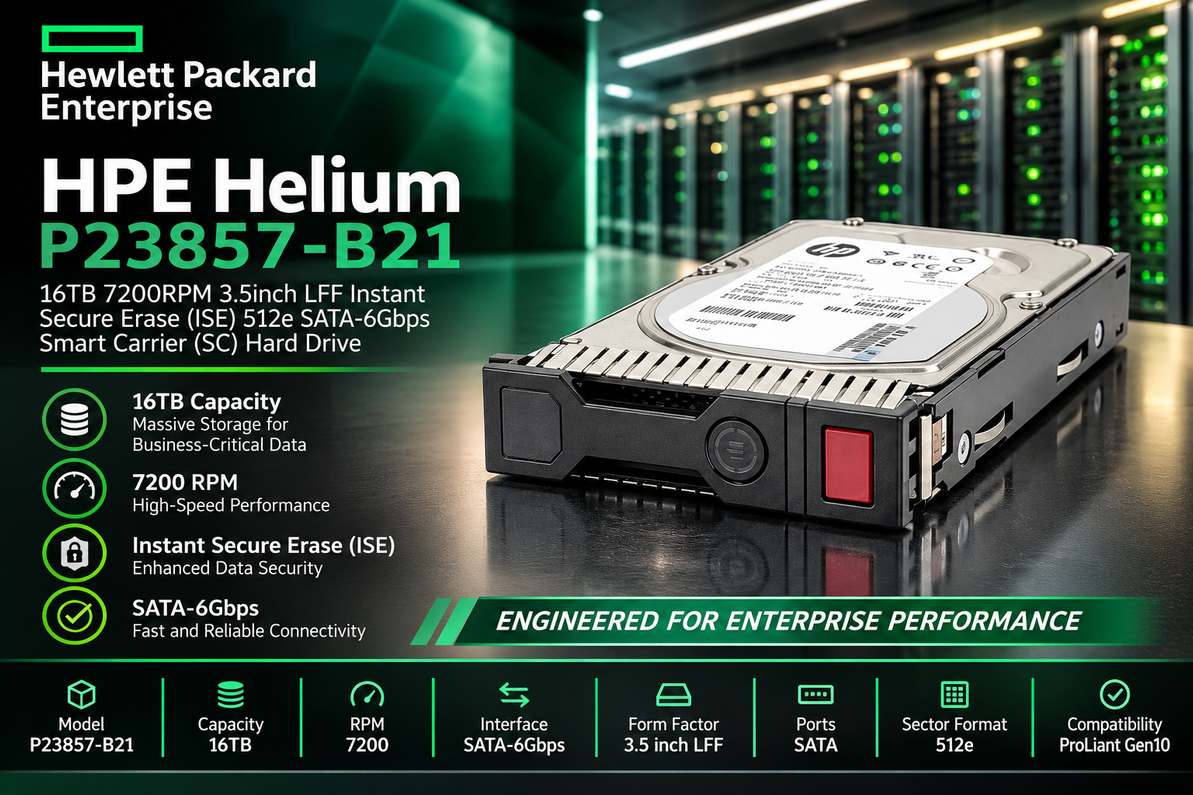
The HPE Helium P23857-B21 16TB 7200RPM 3.5-inch LFF Instant Secure Erase (ISE) 512e SATA-6Gbps Smart Carrier (SC) Business Critical Hard Drive brings together several important enterprise storage technologies in one high-capacity solution. Designed for compatible HPE ProLiant Gen10 server configurations, this drive combines 16TB of storage, helium-filled drive technology, a 7,200RPM rotational speed, and a SATA 6Gbps interface.
It also incorporates Instant Secure Erase technology, 512e sector formatting, and an HPE Smart Carrier design, making it a practical option for organizations managing large volumes of business-critical information.
Whether supporting backup repositories, centralized file storage, archival environments, or capacity-oriented enterprise applications, the P23857-B21 offers substantial storage capacity in a familiar 3.5-inch enterprise drive format.
What Makes the HPE P23857-B21 a Valuable Enterprise Storage Solution?
A Combination of Capacity and Practical Performance
The HPE P23857-B21 belongs to HPE's Business Critical hard drive category. This product category focuses on high-capacity storage for workloads such as backup, archiving, and reference data rather than the highest-intensity transactional applications.
Its 16TB capacity allows businesses to store substantial amounts of information on a single physical drive. This can help organizations expand storage resources while making better use of available server drive bays.
The 7,200RPM rotational speed provides a practical balance between mechanical performance and capacity-oriented storage requirements. Meanwhile, the SATA 6Gbps interface offers connectivity for compatible enterprise storage controllers and server configurations.
According to HPE's hard drive portfolio documentation, Business Critical drives are intended for high-capacity, high-availability storage applications, including backup and archival workloads.
Why Helium Technology Matters
One of the most interesting technologies behind the P23857-B21 is its helium-filled internal design.
Traditional mechanical hard drives generally contain air inside their sealed enclosures. Helium-filled drives use helium instead, taking advantage of its lower density to reduce internal aerodynamic resistance.
This offers several engineering benefits. Lower gas resistance helps reduce the drag experienced by spinning platters, while also allowing manufacturers to design high-capacity drives with more closely arranged internal components.
For enterprise environments, helium technology is particularly valuable because it helps support greater storage density within a conventional 3.5-inch drive form factor.
The result is a high-capacity mechanical storage device designed to accommodate the growing storage requirements of modern data centers.
Key Features of the HPE P23857-B21 16TB Hard Drive
1. Massive 16TB Storage Capacity
Storage capacity is one of the biggest advantages of the HPE P23857-B21.
With 16TB of storage space, this drive provides organizations with substantial room for business information, application files, backup repositories, virtual machine data, and large digital archives.
For data centers managing rapidly expanding datasets, higher-capacity drives can simplify storage planning. Instead of installing several smaller drives to achieve a particular raw storage capacity, administrators can use fewer high-capacity drives, provided the server configuration and redundancy requirements allow it.
This can help optimize available drive bays and simplify certain storage expansion projects.
The 16TB capacity is particularly useful for businesses that manage large quantities of relatively infrequently accessed information.
2. 7200RPM Rotational Speed for Consistent Performance
The P23857-B21 operates at 7,200 revolutions per minute.
Rotational speed determines how quickly the platters inside a mechanical hard drive spin. It influences rotational latency, which is the time required for a particular sector to move into position beneath the read/write head.
A 7,200RPM drive offers a practical performance profile for capacity-oriented enterprise applications.
Although it does not deliver the low latency of an SSD or the rotational performance of 10K and 15K RPM mechanical drives, it provides a useful balance for workloads where storage capacity is more important than extremely fast random access.
This makes the P23857-B21 a suitable consideration for backup storage, archival data, file repositories, and other compatible Business Critical applications.
3. SATA 6Gbps Interface for Enterprise Connectivity
The HPE P23857-B21 uses a SATA 6Gbps interface.
Serial ATA, commonly known as SATA, is a widely adopted storage interface used in desktop computers, workstations, servers, and enterprise storage environments.
The 6Gbps interface provides a theoretical maximum signaling rate of 6 gigabits per second. Actual drive performance depends on the mechanical media, workload characteristics, controller, and other system limitations.
One advantage of SATA technology is its widespread availability and compatibility across supported storage platforms.
For organizations operating compatible HPE ProLiant Gen10 servers, the SATA interface provides a practical connectivity option for high-capacity storage deployments.
It is important to distinguish this drive from the SAS version of the HPE 16TB Business Critical product. The P23857-B21 is specifically a SATA 6Gbps model, not a SAS 12Gbps drive.
4. Instant Secure Erase (ISE) for Data Security
Data security is an essential consideration for organizations managing sensitive business information.
Storage devices frequently move between different operational roles. A drive may be reassigned to another server, removed from an existing storage environment, or prepared for disposal when it reaches the end of its useful life.
Simply deleting files or formatting a drive does not necessarily remove all previously stored information.
The HPE P23857-B21 incorporates Instant Secure Erase (ISE), a feature designed to simplify secure drive sanitization.
ISE helps organizations prepare storage devices for reuse or retirement while reducing the complexity associated with traditional data-erasure processes.
This feature is especially valuable for data centers that manage large numbers of enterprise drives and need an efficient approach to storage-device lifecycle management.
ISE should be considered one part of a broader data protection strategy that includes appropriate access controls, encryption policies, backup procedures, and documented sanitization practices.
5. Advanced Format 512e Sector Technology
The P23857-B21 supports the 512e sector format.
The term 512e stands for 512-byte emulation. These drives typically use 4KB physical sectors while presenting 512-byte logical sectors to the operating system.
This design helps maintain compatibility with systems and applications developed around traditional 512-byte sector addressing.
Advanced Format technology can improve storage efficiency by using larger physical sectors, while 512e emulation helps support compatibility with existing infrastructure.
For businesses maintaining established server environments, this combination can make storage upgrades and replacements easier to manage.
However, administrators should always verify operating system, controller, and application compatibility before introducing a new drive into an existing configuration.
6. HPE Smart Carrier (SC) for Convenient Installation
The HPE Smart Carrier design is another important feature of the P23857-B21.
Enterprise hard drives are commonly installed inside specialized drive carriers that provide the correct physical mounting arrangement for compatible server drive bays.
The Smart Carrier helps simplify drive installation, removal, and maintenance in supported HPE server platforms.
It also incorporates drive-status indicators that can help administrators identify storage conditions during routine maintenance.
For data center technicians responsible for maintaining multiple servers, these features can make everyday hardware management more convenient.
Buyers should remember that different HPE server generations and drive configurations may use different carrier designs. Always verify the required carrier type before purchasing a replacement drive.
7. Business Critical Storage Classification
The P23857-B21 belongs to HPE's Business Critical hard drive portfolio.
This classification is intended for workloads that require substantial storage capacity and dependable availability but do not necessarily demand the highest possible random I/O performance.
Typical applications include:
-
Enterprise backup repositories.
-
Large file storage environments.
-
Data archiving systems.
-
Reference data repositories.
-
Capacity-oriented server storage.
-
Digital content storage.
Understanding the difference between Business Critical and Mission Critical drives helps IT administrators select hardware that matches their actual application requirements.
For example, a high-capacity backup repository may benefit more from a 16TB Business Critical drive than from a smaller, higher-speed Mission Critical drive.
Enterprise Applications of the HPE P23857-B21
1. Enterprise Backup and Recovery Systems
Backup infrastructure is one of the most important components of modern IT operations.
Businesses need reliable storage destinations for operating system backups, application data, databases, virtual machine images, and important organizational records.
The P23857-B21's 16TB capacity makes it a useful option for compatible enterprise backup storage configurations.
Organizations can use high-capacity HDDs to consolidate backup data and increase the amount of information stored within existing server infrastructure.
However, storage capacity alone does not guarantee backup reliability. Businesses should also maintain redundant copies, off-site backups, and regularly tested recovery procedures.
2. Large-Scale Data Archiving
Many businesses must retain information for extended periods because of operational requirements, internal policies, or regulatory obligations.
Examples include financial records, historical business documents, customer information, research datasets, and project archives.
The P23857-B21 offers substantial capacity for organizations that need to maintain large archival repositories.
Its 7,200RPM mechanical design is suitable for many capacity-oriented storage applications where data does not need to be accessed continuously.
For long-term storage environments, administrators should also implement regular data integrity checks and maintain separate backup copies.
3. Enterprise File Servers
Centralized file servers allow employees and departments to access shared documents, application resources, and business information.
As organizations grow, file repositories can expand considerably, increasing the need for additional storage capacity.
The 16TB capacity of the P23857-B21 provides an opportunity to expand compatible file-server storage without immediately moving every workload to more expensive SSD technology.
This makes it a practical option for organizations managing large collections of business documents, multimedia resources, and departmental files.
4. Virtualization Storage Environments
Virtualization enables multiple virtual machines to operate on shared physical server infrastructure.
Each virtual machine requires storage for its operating system, applications, configuration files, and associated data.
High-capacity HDDs can support virtualization environments where large storage volumes are needed and workload performance requirements are moderate.
The P23857-B21 can be considered for suitable capacity-oriented virtualization deployments.
However, workloads involving intensive database activity, heavy random I/O, or large numbers of simultaneously active virtual machines may benefit from SSD-based storage or a hybrid HDD and SSD configuration.
5. Data Center Storage Expansion
Data centers continuously balance storage capacity, hardware investment, power consumption, and physical space.
High-capacity mechanical drives offer a practical way to expand available storage while retaining existing server infrastructure.
The P23857-B21 provides 16TB of storage in a 3.5-inch LFF design, making it relevant to compatible enterprise storage expansion projects.
For organizations that already operate HPE ProLiant Gen10 servers, using appropriately supported replacement or additional drives can help simplify infrastructure upgrades.
Why Choose a 16TB SATA Enterprise Hard Drive?
High Capacity Without Unnecessary Complexity
Not every enterprise workload requires the performance of an expensive SSD or a high-speed SAS drive.
Many storage applications prioritize capacity, cost efficiency, and compatibility over extremely low latency.
Examples include backup repositories, archived information, large file collections, and reference datasets.
The P23857-B21 is designed around these capacity-oriented requirements.
Its combination of 16TB capacity and a SATA 6Gbps interface makes it suitable for supported storage environments where large amounts of information need to remain accessible without requiring the performance characteristics of flash storage.
SATA vs. SAS: Understanding the Difference
SATA and SAS are two different storage interface technologies.
SATA is commonly used in capacity-oriented storage environments, while SAS is widely associated with enterprise storage systems requiring additional interface capabilities and particular controller configurations.
The P23857-B21 uses SATA 6Gbps connectivity.
It should not be confused with the HPE P23863-B21, which is a separate 16TB SAS 12Gbps Business Critical hard drive.
Although both drives offer the same advertised capacity, rotational speed, and general form factor, their interfaces differ.
Choosing between them depends on the server's storage controller, drive-bay configuration, and intended deployment.
Compatibility with HPE ProLiant Gen10 Servers
Designed for Compatible Gen10 Storage Configurations
The HPE P23857-B21 is designed for supported HPE ProLiant Gen10 server configurations.
HPE's official documentation lists this drive among its 16TB SATA 6G Business Critical 7.2K LFF Smart Carrier options.
The HPE ProLiant DL360 Gen10 and DL380 Gen10 QuickSpecs also list the P23857-B21 in their supported 6G SATA LFF drive selections.
This makes it relevant to organizations maintaining these server platforms and looking for compatible high-capacity storage options.
Important Compatibility Checks Before Purchasing
Before ordering the P23857-B21, IT administrators should verify the following:
-
Exact HPE part number: P23857-B21.
-
Server model and generation.
-
Available 3.5-inch LFF drive bays.
-
SATA 6Gbps controller compatibility.
-
Smart Carrier requirements.
-
Firmware and system support.
-
RAID controller configuration.
-
Operating system and sector-format compatibility.
Not every ProLiant Gen10 server supports every drive configuration. Some systems are designed around 2.5-inch SFF drive bays, while others support 3.5-inch LFF drives.
Checking the appropriate HPE server QuickSpecs before purchasing is strongly recommended.
HPE P23857-B21 vs. Modern Enterprise SSDs
Understanding the Performance Differences
Enterprise SSDs use flash memory instead of spinning magnetic platters.
This allows them to deliver significantly lower access latency and faster random read/write performance than traditional mechanical hard drives.
The P23857-B21 uses conventional mechanical storage technology, making it more appropriate for capacity-oriented workloads than applications requiring extremely fast random data access.
For example, an enterprise database processing thousands of transactions per second may benefit from SSD storage, while a large backup repository may prioritize the greater capacity offered by HDDs.
Why Mechanical Hard Drives Still Matter
Despite the growing popularity of SSD technology, mechanical hard drives continue to play an important role in enterprise storage.
Their ability to provide large storage capacities makes them useful for applications where storing substantial amounts of information is more important than achieving the lowest possible latency.
The P23857-B21 offers organizations a way to expand storage capacity without requiring an immediate transition to an entirely flash-based infrastructure.
Installation and Maintenance Best Practices
Prepare the Server Before Installation
Before installing the HPE P23857-B21, confirm that the server supports its 3.5-inch LFF form factor, SATA interface, and Smart Carrier configuration.
Review the server documentation and verify that the appropriate drive bay and storage controller are available.
Always compare the replacement drive with the original hardware when performing a like-for-like replacement.
Follow Proper Hot-Swap Procedures
The P23857-B21 is supplied in an HPE Smart Carrier configuration intended for compatible hot-plug server bays.
When replacing a failed drive, follow the manufacturer's recommended procedure.
If the drive is part of a RAID array, confirm the array status and identify the correct failed drive before removing any hardware.
A replacement drive may trigger a RAID rebuild, so administrators should monitor the process until the array returns to its intended operating condition.
Monitor Drive Health and Storage Performance
Routine storage monitoring helps identify potential hardware problems before they lead to unexpected downtime.
IT administrators should regularly review:
-
Drive health and controller alerts.
-
SMART-related information where available.
-
RAID array status.
-
Storage error reports.
-
Temperature and operating conditions.
-
Backup completion and recovery tests.
Combining appropriate monitoring with tested backup procedures can help improve overall infrastructure resilience.
HPE P23857-B21 Technical Specifications
The following table summarizes the main specifications of the HPE P23857-B21 16TB Business Critical hard drive.
|
Specification |
Details |
|---|---|
|
Manufacturer |
Hewlett Packard Enterprise (HPE) |
|
Model / Part Number |
P23857-B21 |
|
Product Type |
Internal Enterprise HDD |
|
Product Category |
Business Critical |
|
Storage Capacity |
16TB |
|
Rotational Speed |
7,200RPM |
|
Form Factor |
3.5-inch LFF |
|
Interface |
SATA |
|
Interface Speed |
6Gbps |
|
Sector Format |
512e |
|
Security Feature |
Instant Secure Erase (ISE) |
|
Drive Technology |
Helium-Filled HDD |
|
Carrier Type |
Smart Carrier (SC) |
|
Installation Type |
Hot-Swap |
|
Compatibility |
Supported HPE ProLiant Gen10 configurations |
Note: HPE identifies this product as a 16TB SATA 6G Business Critical 7.2K LFF Smart Carrier drive with a one-year limited drive warranty in its product documentation. Actual server compatibility depends on the specific configuration.
Why Buy HPE Enterprise Storage Drives from StoragePartsDirect?
Selecting the right enterprise hard drive is an important part of maintaining dependable IT infrastructure.
Businesses need storage components that match their existing hardware configurations while providing the capacity and features required by their applications.
At StoragePartsDirect, IT professionals, system administrators, and businesses can explore enterprise storage components for server upgrades, hardware replacement, and infrastructure maintenance.
The HPE P23857-B21 is an excellent product to consider when looking for a high-capacity 16TB SATA 6Gbps Business Critical hard drive for compatible HPE ProLiant Gen10 servers.
Before purchasing, always confirm the exact part number, product condition, warranty coverage, carrier configuration, and server compatibility.
Choosing the correct replacement hardware can help simplify maintenance and make better use of existing enterprise infrastructure.
Final Thoughts: Building a Stronger Storage Foundation with HPE
As enterprise data continues to grow, organizations need storage solutions that offer the right balance of capacity, practical performance, and manageable infrastructure requirements.
The HPE Helium P23857-B21 16TB 7200RPM SATA 6Gbps Business Critical Hard Drive brings together high-capacity mechanical storage, helium-filled drive technology, Instant Secure Erase functionality, 512e sector formatting, and an HPE Smart Carrier design.
Its 16TB capacity makes it particularly suitable for compatible backup, archival, file storage, and other capacity-oriented enterprise applications.
For businesses operating supported HPE ProLiant Gen10 servers, the P23857-B21 offers a practical storage expansion and replacement option.
Ultimately, successful enterprise storage planning is not simply about adding more terabytes. It is about selecting the right technology for the right workload while maintaining compatibility, data protection, and long-term infrastructure efficiency.
Recent Posts
-
Built for the Data Explosion: Discover the Power of the HPE P23857-B21 16TB Helium Enterprise Hard Drive
Introduction: High-Capacity Storage for a Data-Driven World The amount of information generated by m …Nov 5th 2026 -
Beyond Capacity: Powering Enterprise Data with the HPE 16TB Helium P23863-B21 Business Critical Hard Drive
Introduction: High-Capacity Storage for the Modern Enterprise As businesses generate and manage incr …Nov 4th 2026 -
HPE AG719A 300GB 10K RPM Fibre Channel Hard Drive: Reliable Enterprise Storage Built for Demanding Data Environments
Introduction: Dependable Storage for Enterprise-Class Systems In enterprise IT environments, storage …Nov 3rd 2026