
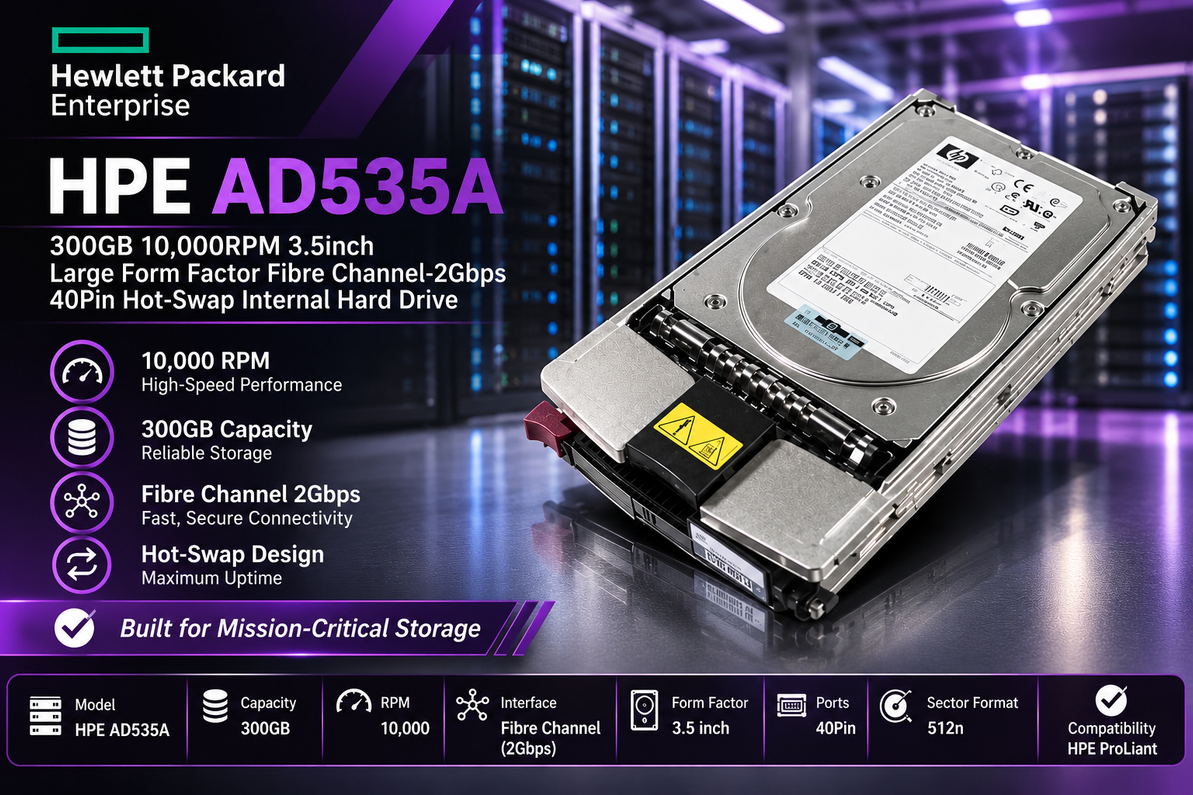
The Enterprise Storage Workhorse: Exploring the HPE AD535A 300GB Fibre Channel Drive and Its Legacy of Performance
HPE AD535A: Reviving Enterprise Storage Performance with 300GB of High-Speed Fibre Channel Power
In enterprise IT environments, dependable storage is the foundation of smooth operations, efficient data access, and business continuity. From database management and virtualization to mission-critical applications, organizations need storage hardware capable of delivering consistent performance under demanding workloads. The HPE AD535A 300GB 10000RPM 3.5-inch Large Form Factor Fibre Channel-2Gbps Hot-Swap Internal Hard Drive is designed for enterprise storage environments that rely on established Fibre Channel infrastructure and proven mechanical storage technology.
Combining a 10,000RPM rotational speed, 300GB storage capacity, 2Gbps Fibre Channel interface, and hot-swap functionality, this HPE hard drive offers a practical storage option for maintaining compatible legacy enterprise systems. Its 3.5-inch Large Form Factor design and 40-pin connection make it particularly relevant to organizations managing older storage platforms that continue to support important business applications.
Although modern storage technologies have introduced faster interfaces and higher capacities, established enterprise hardware still plays an important role in many IT infrastructures. The HPE AD535A represents this generation of dependable enterprise storage, offering organizations an opportunity to maintain compatible systems without unnecessarily replacing their existing hardware.
Understanding the HPE AD535A 300GB Enterprise Hard Drive
Designed for Established Enterprise Storage Environments
The HPE AD535A is an enterprise-class mechanical hard drive developed for compatible HPE and HP StorageWorks infrastructure. It combines traditional magnetic storage technology with a Fibre Channel Arbitrated Loop (FC-AL) interface, making it suitable for supported enterprise storage configurations that use Fibre Channel connectivity.
One of its most important characteristics is its 10,000RPM spindle speed. Unlike standard desktop hard drives, which commonly operate at lower rotational speeds, this drive is designed to provide responsive data access for enterprise applications that require frequent read and write operations.
Its 300GB capacity provides dedicated storage space for business information, application data, databases, and other operational workloads. While this capacity may appear modest compared with modern enterprise drives, it can be particularly valuable when maintaining older storage systems where hardware compatibility and consistent operation are more important than simply increasing storage capacity.
The Role of Fibre Channel Technology
Fibre Channel is a storage networking technology developed to support reliable, high-performance communication between servers and storage systems. It has traditionally been used in enterprise storage area networks (SANs), where dependable access to shared storage is essential.
The HPE AD535A uses a 2Gbps Fibre Channel interface, providing connectivity for compatible Fibre Channel storage infrastructure. Its FC-AL technology supports communication within Fibre Channel Arbitrated Loop environments, a storage architecture used in several generations of enterprise storage equipment.
This makes the AD535A particularly relevant to organizations that continue operating compatible legacy Fibre Channel environments. Rather than replacing an entire storage infrastructure, IT administrators can use appropriately matched replacement drives to maintain existing configurations.
10,000RPM Rotational Speed for Responsive Data Access
Rotational speed is an important factor in determining how quickly a mechanical hard drive can access information. The HPE AD535A operates at 10,000 revolutions per minute, allowing its magnetic platters to rotate rapidly while the read/write heads locate and retrieve stored information.
Higher rotational speeds can help reduce rotational latency, which is the time required for the desired sector of a platter to rotate into position beneath the read/write head.
For enterprise workloads involving repeated data requests, this characteristic can contribute to more responsive storage operations. It is especially relevant for applications that depend on traditional mechanical storage rather than solid-state drives.
The 10,000RPM design makes the AD535A a practical option for maintaining supported enterprise systems that were originally configured around high-speed Fibre Channel hard drives.
Key Features That Make the HPE AD535A a Valuable Storage Solution
300GB Storage Capacity for Business Applications
With 300GB of storage capacity, the HPE AD535A provides space for business-critical files, application information, database records, and operational data.
Its capacity is particularly useful for organizations maintaining older server and storage configurations where replacement drives need to match the original system requirements.
For businesses operating established infrastructure, choosing a drive with the correct capacity and interface can help simplify maintenance and reduce unnecessary hardware changes.
3.5-Inch Large Form Factor Design
The AD535A features a 3.5-inch Large Form Factor (LFF) design. This physical format is associated with enterprise storage systems that use larger drive bays and compatible hot-swap assemblies.
The LFF configuration is important because enterprise drives are not universally interchangeable. Even when two hard drives offer identical capacities and rotational speeds, differences in physical dimensions, connectors, mounting assemblies, and interface technologies can prevent compatibility.
Selecting the correct 3.5-inch drive helps ensure that the replacement hardware matches the intended storage enclosure.
40-Pin Fibre Channel Connection
The 40-pin connection is another defining characteristic of the HPE AD535A. It is designed for its corresponding Fibre Channel storage connection and compatible drive assembly.
Enterprise storage components often use specialized connectors rather than the SATA connections commonly found in desktop computers. Consequently, the AD535A should not be treated as a standard desktop SATA hard drive.
Before purchasing a replacement, administrators should verify the drive part number, connector configuration, drive carrier, and supported storage enclosure.
Hot-Swap Convenience for Easier Maintenance
Hot-swap functionality is one of the most useful features of enterprise storage hardware. It allows supported storage systems to accept drive replacement without requiring the entire system to be powered down, provided the controller, enclosure, and storage configuration support hot-swapping.
For businesses operating important applications, avoiding unnecessary downtime can make a significant difference.
The HPE AD535A's hot-swap design makes it suitable for compatible enterprise storage environments where maintenance flexibility and hardware replacement are important considerations.
IT administrators should always follow the storage system's recommended replacement procedures to avoid accidental data loss or disruption.
Performance and Reliability in Enterprise Storage Environments
Supporting Traditional Database Workloads
Databases frequently perform read and write operations as applications retrieve information, update records, and process transactions.
A 10,000RPM enterprise hard drive can provide responsive mechanical storage for database environments designed around this type of hardware.
The AD535A offers a combination of rotational speed, Fibre Channel connectivity, and dedicated storage capacity that can support compatible legacy database infrastructure.
However, actual performance depends on several factors, including storage controller capabilities, RAID configuration, workload characteristics, and the number of drives operating within the storage array.
Maintaining Established Server Infrastructure
Enterprise hardware is often expected to remain operational for many years. Replacing an entire server or storage platform simply because one component requires maintenance can be expensive and unnecessarily disruptive.
The HPE AD535A provides an option for organizations that need a compatible replacement for an existing 300GB, 10,000RPM Fibre Channel drive.
This can be particularly useful for businesses that continue using older applications, specialized software, or infrastructure that has not yet reached the end of its operational life.
Supporting Consistent Storage Operations
Storage reliability involves more than the individual hard drive. The surrounding infrastructure, including controllers, firmware, cooling, power delivery, and RAID protection, also plays an important role.
Using the correct replacement drive helps maintain the intended storage configuration.
For organizations managing important business information, regular backups, storage monitoring, and appropriate redundancy remain essential regardless of the hard drive model being used.
Where Can the HPE AD535A Be Used?
The HPE AD535A is intended for compatible Fibre Channel storage environments. Its specialized interface and physical configuration make system-level compatibility particularly important.
Enterprise Storage Systems
Fibre Channel storage arrays provide centralized storage resources for connected enterprise infrastructure. The AD535A can serve as a replacement storage component in supported systems designed for its specifications.
Its 300GB capacity and 10,000RPM speed make it relevant to older storage configurations that require matching drive characteristics.
Legacy Server Infrastructure
Businesses frequently retain older server platforms because they continue to support important applications and established operational processes.
For these environments, finding a suitable replacement hard drive can be more practical than replacing an entire system.
The AD535A can help maintain compatible legacy infrastructure when the original system supports its Fibre Channel interface and drive assembly.
Business Data and Application Storage
The drive can be used for supported enterprise workloads involving business files, application information, and structured data.
Its suitability depends on the storage system's design and workload requirements. Organizations should assess available capacity, performance expectations, and redundancy before deploying it.
Why Choose an HPE Enterprise Hard Drive Instead of a Standard Desktop Drive?
Enterprise storage environments have different requirements from ordinary desktop computers. While desktop drives are generally designed for individual users and everyday workloads, enterprise drives are intended for integration into specialized server and storage infrastructure.
The HPE AD535A offers several characteristics that make it different from conventional desktop storage.
Specialized Fibre Channel connectivity: Its 2Gbps Fibre Channel interface is intended for compatible enterprise storage infrastructure rather than ordinary SATA-based computers.
Higher rotational speed: The 10,000RPM spindle speed provides a performance-oriented mechanical storage solution compared with conventional 5,400RPM and 7,200RPM drives.
Enterprise hot-swap design: Its hot-swap configuration supports convenient replacement in compatible storage enclosures.
Purpose-built physical configuration: The 3.5-inch LFF design and 40-pin connection are intended for the corresponding enterprise drive assembly.
These characteristics make the AD535A a specialized storage component rather than a general-purpose hard drive.
Installation and Compatibility Considerations
Verify Your Existing Hardware Before Purchasing
Compatibility should always be the first consideration when selecting an enterprise replacement hard drive.
Although the AD535A is associated with HPE StorageWorks Fibre Channel storage products, not every HPE server or storage array supports this particular model.
Before purchasing, verify the following:
-
The storage enclosure supports 3.5-inch LFF Fibre Channel drives.
-
The system supports the 2Gbps Fibre Channel interface.
-
The 40-pin connector and drive assembly match.
-
The drive part number is approved for the target storage system.
-
The controller firmware and storage configuration support the replacement.
The AD535A is also associated with the AG718A and AG719A option part numbers, with additional identifiers including spare part number 366023-001 and model BD300DADFP. These identifiers can help when checking replacement requirements.
Follow Proper Installation Procedures
Installing an enterprise hard drive requires attention to the storage system's maintenance procedures.
Before replacing a drive, administrators should identify the correct drive bay, check the storage array's health status, and confirm that existing data is protected through appropriate redundancy or backups.
If the system supports hot-swapping, follow its recommended procedure for removing and inserting the drive. After installation, check whether the controller recognizes the replacement and whether any required RAID rebuilding or storage initialization takes place.
HPE AD535A vs. Modern Storage Technologies
Storage technology has evolved considerably since the introduction of 2Gbps Fibre Channel drives. Modern enterprise environments increasingly use SSDs, NVMe storage, and higher-speed Fibre Channel infrastructure.
However, newer does not automatically mean better for every replacement situation.
|
Feature |
HPE AD535A |
|---|---|
|
Storage technology |
Mechanical HDD |
|
Capacity |
300GB |
|
Rotational speed |
10,000RPM |
|
Form factor |
3.5-inch LFF |
|
Interface |
Fibre Channel 2Gbps |
|
Connection |
40-pin |
|
Installation |
Hot-swap |
|
Intended environment |
Compatible enterprise storage systems |
An SSD may offer substantially lower latency and faster random access, but replacing a legacy Fibre Channel drive with an SSD is not always straightforward. The storage controller, firmware, enclosure, interface, and supported drive types must all be considered.
For organizations maintaining older infrastructure, a compatible replacement HDD can offer a simpler maintenance solution than redesigning the storage environment.
Maximizing the Operational Life of Enterprise Hard Drives
Maintain Proper Cooling and Ventilation
Mechanical hard drives generate heat during operation. Enterprise storage enclosures should maintain appropriate airflow to prevent excessive temperatures.
Regularly checking cooling fans, ventilation paths, and enclosure temperatures can help create a more stable operating environment.
Monitor Storage Health
IT administrators should regularly monitor drive status, controller alerts, and available diagnostic information.
Early identification of storage problems can help prevent unexpected interruptions and provide more time to plan maintenance activities.
Maintain Regular Backups
Even enterprise-grade hard drives can experience mechanical or electronic failures. RAID protection can help maintain availability, but it is not a substitute for independent backups.
Businesses should maintain reliable backup procedures and periodically test their recovery processes.
Avoid Unnecessary Hardware Changes
When maintaining legacy infrastructure, using the correct replacement components is important. Unverified substitutions can introduce compatibility problems and unnecessary downtime.
Matching the original drive specifications, connector, and supported configuration helps maintain predictable storage operations.
Is the HPE AD535A 300GB 10000RPM Hard Drive Still Worth Considering?
The HPE AD535A remains a relevant option for organizations that operate compatible legacy Fibre Channel storage systems and need a matching replacement drive.
Its 300GB capacity, 10,000RPM rotational speed, 3.5-inch LFF configuration, 2Gbps Fibre Channel interface, and hot-swap design make it suitable for its intended enterprise storage environment.
It is not designed to compete with modern NVMe SSDs in terms of speed or capacity. Instead, its value comes from compatibility with established infrastructure and the ability to maintain existing storage configurations.
For businesses that depend on older HPE storage equipment, replacing a failed drive with the correct model can be a sensible way to extend the useful life of existing hardware.
Final Thoughts: Proven Storage Technology for Enterprise Continuity
Enterprise infrastructure does not always need the newest hardware to remain useful. In many organizations, established storage systems continue to support essential business applications, databases, and operational processes.
The HPE AD535A 300GB 10000RPM 3.5-inch Fibre Channel-2Gbps 40-Pin Hot-Swap Internal Hard Drive offers a specialized storage solution for compatible legacy enterprise environments.
Its 10,000RPM performance, 300GB capacity, Fibre Channel connectivity, and hot-swap design make it a practical replacement option for systems built around this generation of storage technology.
For IT administrators, data center operators, and businesses maintaining established HPE infrastructure, selecting the correct replacement hardware is an important part of keeping storage systems operational and minimizing unnecessary infrastructure changes.
When compatibility is confirmed and appropriate maintenance practices are followed, the HPE AD535A can continue serving its intended role in enterprise storage environments.
Recent Posts
-
The Enterprise Storage Workhorse: Exploring the HPE AD535A 300GB Fibre Channel Drive and Its Legacy of Performance
HPE AD535A: Reviving Enterprise Storage Performance with 300GB of High-Speed Fibre Channel Power In …Nov 2nd 2026 -
Beyond the Spin: The Hidden Power of the HPE AG718A in Legacy Enterprise Storage
Keeping Enterprise Storage in Motion: The HPE AG718A 300GB Fibre Channel Drive and Its Role in Relia …Nov 1st 2026 -
HPE 411089-B21: Reviving Enterprise Storage with 300GB of 15K RPM Ultra-320 SCSI Performance
Introduction: Reliable Storage for Demanding Enterprise Environments In enterprise IT, storage relia …Oct 29th 2026