
HPE 411089-B22: Reviving Enterprise Performance with a 300GB 15K Ultra320 SCSI Hard Drive
Introduction: Dependable Storage for Classic Enterprise Servers
Enterprise IT infrastructure depends on reliable storage to keep business applications, databases, and essential services running smoothly. Although modern servers increasingly use SSDs and high-speed SAS storage, many organizations continue to operate legacy server systems that rely on proven SCSI technology. For these environments, choosing compatible replacement hardware is essential to maintaining operational stability and extending the useful life of existing equipment.
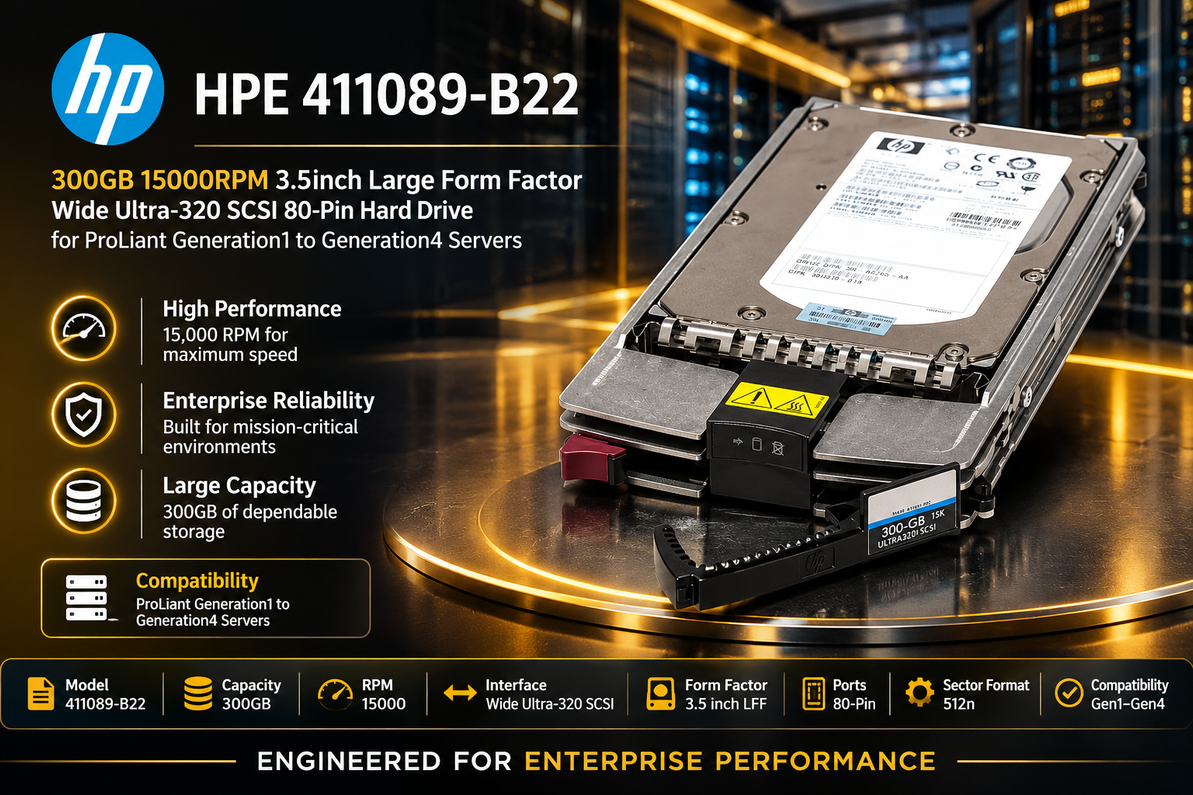
The HPE 411089-B22 300GB 15000RPM 3.5-inch Large Form Factor Wide Ultra-320 SCSI 80-Pin Hard Drive is designed for compatible legacy HP ProLiant servers that require high-speed mechanical storage. Combining a 300GB capacity, a 15,000 RPM spindle speed, and an Ultra320 SCSI interface, this enterprise hard drive offers a practical storage option for organizations maintaining Generation 1 through Generation 4 ProLiant server platforms.
Its 80-pin hot-plug configuration supports convenient drive replacement in compatible server bays, while its enterprise-oriented design makes it suitable for maintaining established storage environments without requiring an immediate migration to newer infrastructure.
Understanding the HPE 411089-B22 Hard Drive
A Purpose-Built Storage Solution for Legacy Infrastructure
The HPE 411089-B22 is a 3.5-inch enterprise hard drive built around the Ultra320 SCSI interface. It was developed for server environments where dependable disk access, compatibility with existing controllers, and straightforward maintenance are important considerations.
Unlike consumer desktop hard drives, enterprise storage drives are selected according to the requirements of their host systems, including interface compatibility, drive-bay design, controller support, and operational workload. The 411089-B22 addresses these requirements for supported legacy HP server configurations.
With 300GB of storage, the drive can accommodate operating system files, application data, departmental databases, archived business information, and other workloads appropriate for older server platforms. Its 15,000 RPM rotational speed is particularly relevant to applications that benefit from frequent access to data distributed across a mechanical disk.
Key Product Specifications
The following table summarizes the principal specifications of the HPE 411089-B22.
| Specification | Details |
|---|---|
| Manufacturer | HP / Hewlett-Packard Enterprise |
| Option Part Number | 411089-B22 |
| Storage Capacity | 300GB |
| Rotational Speed | 15,000 RPM |
| Form Factor | 3.5-inch Large Form Factor (LFF) |
| Interface | Wide Ultra320 SCSI |
| Maximum Synchronous Transfer Rate | Up to 320 MB/s |
| Connector | 80-pin SCSI |
| Drive Height | 1 inch |
| Sector Size | 512 bytes |
| Installation Type | Hot-plug, in supported configurations |
| Intended Platform | Compatible legacy HP ProLiant servers |
Actual performance depends on the controller, server configuration, workload, and condition of the drive. The interface's maximum transfer rate should not be confused with the sustained throughput of the mechanical disk.
15,000 RPM Performance for Demanding Disk Workloads
Faster Rotational Speed for Responsive Data Access
One of the most significant features of the HPE 411089-B22 is its 15,000 RPM spindle speed. Rotational speed affects how long a mechanical hard drive typically waits for the required sector to rotate beneath its read/write head.
A 15,000 RPM drive completes a full rotation in approximately four milliseconds. This helps reduce rotational latency compared with slower mechanical drives, making high-speed disks useful for workloads involving frequent, relatively small read and write operations.
Examples include legacy transaction-processing systems, application servers, and databases that repeatedly access stored records. However, overall response times also depend on seek time, controller performance, caching, queue depth, and the characteristics of the application.
Supporting Frequently Accessed Enterprise Data
For older business systems, responsive storage can make a meaningful difference to the user experience. When applications depend on repeated disk access, a high-speed mechanical drive can help reduce storage-related delays compared with slower rotational drives.
The HPE 411089-B22 provides a combination of high rotational speed and a mature enterprise interface, making it a relevant option for maintaining compatible legacy workloads. It is not a replacement for every modern storage solution, but it can serve effectively where the existing server architecture requires Ultra320 SCSI.
Ultra320 SCSI: Established Connectivity for Enterprise Servers
Understanding the Wide Ultra320 Interface
Ultra320 SCSI is a parallel SCSI interface designed to support a maximum synchronous transfer rate of 320 MB/s under appropriate conditions. It was widely used in enterprise servers and storage systems that required faster disk connectivity than earlier SCSI generations could provide.
For organizations maintaining older HP ProLiant hardware, the interface is an important part of the drive's value. Installing a newer SATA or SAS drive is not necessarily a straightforward alternative because these interfaces are electrically and logically different from parallel SCSI.
The HPE 411089-B22 is intended for compatible Ultra320 SCSI environments, allowing businesses to retain their established storage architecture when replacement or expansion is required.
What Does the 80-Pin Connector Mean?
The 80-pin connector is associated with SCSI hot-plug drive assemblies used in supported enterprise server systems. These assemblies combine the required drive connections with a compatible mounting carrier and backplane interface.
This arrangement helps simplify installation and maintenance because the drive is designed to fit into a compatible server's designated drive bay. It is important to distinguish this configuration from standard 68-pin SCSI drives, which may require different cabling and installation arrangements.
Before purchasing a replacement, verify the connector type, drive carrier, controller, and server backplane. Physical similarity alone does not guarantee electrical or firmware compatibility.
Hot-Plug Convenience for Server Maintenance
Simplifying Drive Replacement
Downtime can be costly when a server supports business applications, internal services, or essential operational records. Hot-plug storage configurations are designed to make drive replacement more convenient by allowing a compatible drive to be removed and installed without shutting down the entire server, when the system and operating conditions support this procedure.
The HPE 411089-B22 is associated with a universal hot-plug drive assembly for supported HP server platforms. Its carrier-based design helps technicians install the drive into a compatible bay without improvising mounting hardware.
Hot-plug capability does not mean that every drive can be removed safely at any time. The controller, RAID configuration, operating system, and server documentation must support the procedure. Administrators should also confirm that the drive is no longer active or that the storage system can safely tolerate its removal.
Improving Maintenance Planning
Keeping a suitable replacement drive available can help IT teams prepare for hardware failures and reduce the time required to restore a legacy server's storage capacity. For organizations that cannot immediately replace older systems, this approach can be more practical than redesigning the entire infrastructure around newer hardware.
A replacement drive should always be checked against the original part number and server configuration before installation.
Compatibility with HP ProLiant Generation 1 to Generation 4 Servers
Designed for Established HP Server Platforms
The HPE 411089-B22 is intended for compatible legacy ProLiant systems, including supported configurations from the Generation 1 through Generation 4 era. These systems may continue to perform useful roles in laboratory environments, isolated business applications, archival systems, and specialized operations that depend on older software.
The exact compatibility depends on the particular server model, SCSI controller, drive backplane, firmware, and installed drive carrier. Not every ProLiant server from these generations supports every storage configuration.
Before purchasing the drive, verify the server's official specifications and confirm that it supports Ultra320 SCSI hot-plug disks.
Extending the Useful Life of Existing Infrastructure
Replacing a failed component can be a sensible strategy when the server remains suitable for its intended purpose. Organizations may have applications, operating systems, or specialized equipment that cannot easily be migrated to a new platform.
In these situations, the HPE 411089-B22 can help preserve an existing storage environment while providing a compatible replacement option. This approach can also allow IT teams to plan infrastructure upgrades gradually rather than replacing all legacy equipment at once.
However, keeping an older server operational should be balanced against security, support, energy consumption, spare-part availability, and business continuity requirements.
300GB Capacity for Essential Business Storage
Practical Storage for Legacy Applications
A 300GB hard drive offers a useful amount of capacity for many traditional server workloads. It can store operating system files, application installations, departmental documents, database records, logs, and other business information, depending on the application's storage requirements.
For older systems, maintaining the original capacity and interface can simplify replacement planning. Administrators may be able to replace a failed drive without changing the broader storage layout, provided the replacement matches the original configuration.
The available usable capacity will be lower than the nominal capacity after accounting for formatting, filesystem overhead, and system configuration.
Capacity Planning and Data Protection
A single 300GB drive may be sufficient for a focused application or limited dataset, but capacity requirements vary significantly. Organizations should evaluate existing usage, expected growth, backup requirements, and recovery objectives before deciding whether one drive is adequate.
For critical workloads, the drive should be part of a broader storage and data-protection strategy. RAID can improve availability when correctly configured, but RAID is not a substitute for independent backups. Important business data should be backed up regularly and tested for successful recovery.
Enterprise Applications and Suitable Workloads
Legacy Database and Transaction Systems
Some older database applications rely heavily on random disk access. The 15,000 RPM rotational speed of the HPE 411089-B22 can help reduce rotational delays, although the actual benefit depends on the workload, controller, caching, and storage architecture.
Organizations maintaining compatible legacy database systems may consider this drive when replacing an existing disk or preserving an established configuration.
Application and Departmental Servers
Older ProLiant servers may support internal applications, departmental file services, testing environments, and other specialized workloads. The 411089-B22 can provide storage for these roles where the server's SCSI architecture requires a compatible drive.
Its 300GB capacity is most appropriate when the workload fits within the available storage and does not require the capacity or throughput of a modern storage platform.
Archival and Isolated Systems
Some organizations retain older systems to access historical data or run applications that are difficult to migrate. A compatible replacement drive can help maintain access to these systems.
For archival use, however, a mechanical hard drive should not be treated as a permanent or infallible storage medium. Data integrity requires additional copies, regular verification, and a documented recovery process.
HPE 411089-B22 vs. Modern Storage Drives
Understanding the Differences
Modern SATA and SAS hard drives, as well as solid-state drives, offer different interfaces, capacities, performance characteristics, and compatibility requirements. Although newer storage technology may provide substantial advantages in current server environments, it cannot automatically replace a parallel SCSI drive in an older server.
The HPE 411089-B22 is best evaluated in the context of the system it supports.
A modern SSD may offer lower latency and substantially better random-access performance, but using one would require a compatible interface or suitable controller and could involve configuration changes. Likewise, a newer SAS drive cannot simply be connected to a parallel SCSI backplane.
For legacy systems that require Ultra320 SCSI, finding the correct compatible drive is often more important than comparing specifications across incompatible interfaces.
Installation and Maintenance Best Practices
Verify the Server Configuration Before Installation
Before installing an HPE 411089-B22, check the server model, controller, backplane, supported drive interface, and carrier requirements. Confirm that the drive matches the required 80-pin hot-plug configuration.
If the server uses RAID, check the array's status and follow the controller manufacturer's replacement procedure. An incorrectly removed or installed drive can cause an avoidable outage or complicate data recovery.
Monitor Drive Health
Where supported, use the server's storage-management tools and controller diagnostics to monitor drive status and identify potential problems. Unusual noises, recurring errors, failed diagnostics, or declining performance may indicate a storage issue that needs investigation.
Monitoring should be combined with tested backups and a recovery plan. A drive's enterprise classification does not eliminate the possibility of mechanical failure.
Consider the Condition of Replacement Hardware
When purchasing legacy storage, pay attention to whether the drive is new, refurbished, or used. Check the warranty, return policy, testing process, and whether the correct carrier is included.
For refurbished equipment, ask about diagnostic testing and any available information on operating hours or drive health. Confirm that the product supplied matches the required part number and interface.
Why Choose the HPE 411089-B22?
The HPE 411089-B22 combines a 300GB storage capacity, 15,000 RPM rotational speed, Ultra320 SCSI connectivity, and an 80-pin hot-plug configuration for compatible legacy enterprise servers.
Its primary advantage is its suitability for maintaining established HP ProLiant storage environments. Rather than requiring an immediate migration to a different storage interface, organizations can use the appropriate replacement component to support existing applications and infrastructure.
For IT administrators, system integrators, maintenance providers, and businesses that still depend on older ProLiant platforms, identifying the correct drive can simplify repairs and help preserve existing investments.
The most important consideration is compatibility. Verifying the server model, interface, controller, carrier, and firmware requirements helps ensure that the replacement is appropriate for the intended system.
Conclusion: A Practical Choice for Legacy ProLiant Storage
The HPE 411089-B22 300GB 15000RPM Ultra320 SCSI hard drive remains a relevant replacement option for organizations maintaining compatible legacy HP ProLiant servers. Its high rotational speed, 300GB capacity, and 80-pin hot-plug design make it suitable for established enterprise environments that require this specific storage technology.
While modern storage devices offer different performance and capacity advantages, older systems often need components that match their original architecture. Selecting the correct replacement can help simplify maintenance, preserve application compatibility, and support a carefully managed transition toward newer infrastructure.
For businesses that continue to rely on compatible Generation 1 through Generation 4 ProLiant servers, the HPE 411089-B22 provides a targeted storage solution for maintaining existing systems.
Recent Posts
-
HPE AG690B: The 15K Storage Powerhouse Keeping Enterprise Data Within Reach
Introduction: Reliable Performance for Enterprise Storage Systems Behind every dependable enterprise …Oct 28th 2026 -
HPE AG690A: The High-Speed Storage Workhorse That Keeps Enterprise Data Moving
Introduction: Built for Demanding Enterprise Storage In enterprise storage environments, dependable …Oct 24th 2026 -
HPE 411089-B22: Reviving Enterprise Performance with a 300GB 15K Ultra320 SCSI Hard Drive
Introduction: Dependable Storage for Classic Enterprise Servers Enterprise IT infrastructure depends …Oct 23rd 2026