
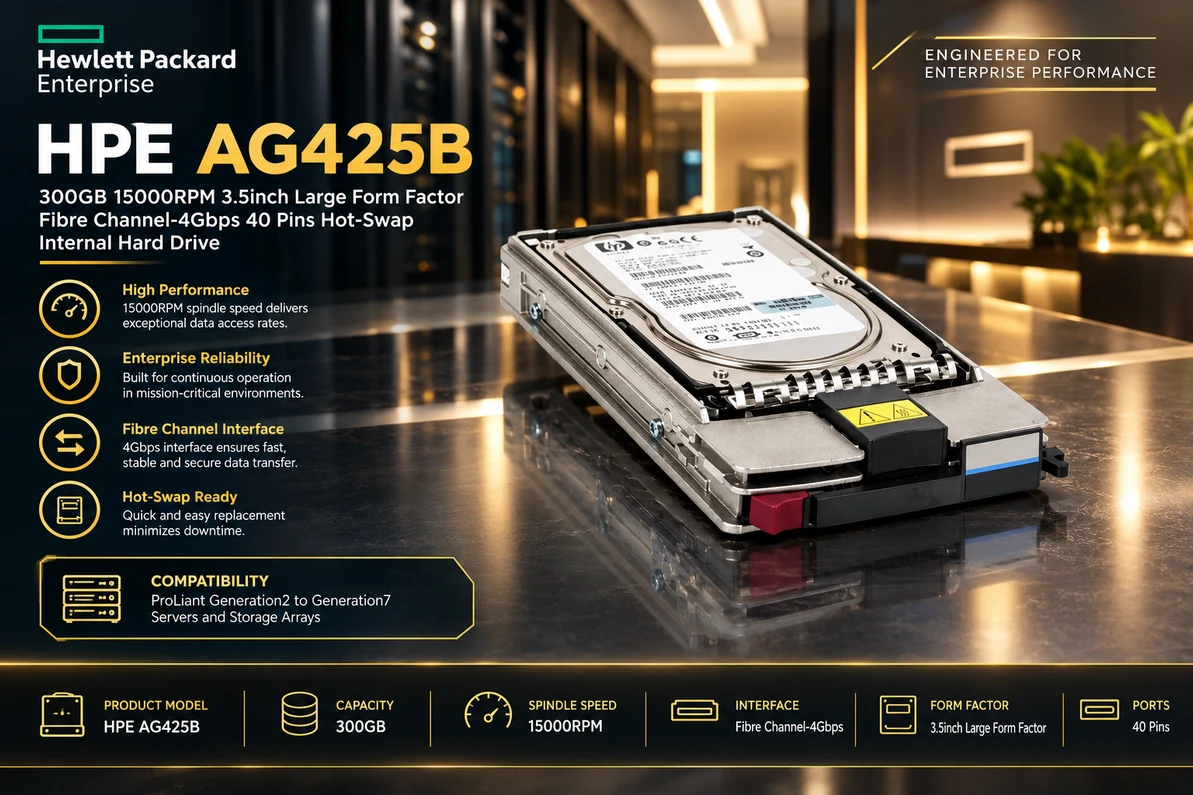
HPE AG425B 300GB 15K Fibre Channel Hard Drive: High-Speed Storage for Enterprise-Class EVA Systems
Introduction: Reliable Storage for Demanding Enterprise Environments
In enterprise IT, storage performance can directly influence application responsiveness, transaction processing, data availability, and the overall efficiency of business operations. Organizations operating legacy storage infrastructure often need dependable hardware that can maintain consistent performance while working within an established storage architecture. The HPE AG425B 300GB 15000RPM Fibre Channel Hard Drive is designed for enterprise storage environments that require high rotational speed, Fibre Channel connectivity, and hot-swap servicing.
With a 300GB storage capacity, a 15,000 RPM spindle speed, a 3.5-inch large form factor, and a Fibre Channel interface specified at up to 4Gbps for the listed configuration, this HPE StorageWorks drive is intended for compatible enterprise storage systems. Its design makes it relevant to organizations maintaining established StorageWorks Enterprise Virtual Array (EVA) infrastructure, where compatible replacement drives can help extend the useful life of existing equipment.
Rather than requiring an immediate migration to a completely different storage platform, businesses can evaluate the AG425B as a replacement or expansion option for supported legacy arrays. However, the exact drive assembly, firmware, interface speed, and enclosure compatibility should always be confirmed before installation.
HPE AG425B Hard Drive Specifications
The HPE AG425B combines enterprise-oriented storage characteristics with a compact, serviceable drive module. Understanding its specifications helps administrators determine whether it suits their existing storage configuration.
Technical Specifications at a Glance
-
Brand: HPE
-
Model: AG425B
-
Storage Capacity: 300GB
-
Spindle Speed: 15,000 RPM
-
Form Factor: 3.5-inch Large Form Factor (LFF)
-
Interface: Fibre Channel
-
Specified Interface Speed: 4Gbps for the listed configuration
-
Connector Description: 40-pin
-
Drive Type: Internal enterprise hard disk drive
-
Installation Type: Hot-swap, when used with a compatible enclosure
-
Intended Environment: Compatible HPE StorageWorks EVA storage systems
Actual specifications and compatibility can vary across associated assembly and spare part numbers. HPE documentation identifies AG425A and AG425B within its family of 300GB, 15K Fibre Channel drives. Buyers should match the complete part number against the storage system's supported-drive documentation rather than relying on the option number alone.
Understanding the 300GB Storage Capacity
Practical Capacity for Enterprise Workloads
The 300GB capacity of the HPE AG425B is suited to environments where the priority is maintaining an existing storage array rather than maximizing capacity per drive. Although modern drives offer substantially more storage, older enterprise applications and legacy SAN environments may continue to depend on established drive sizes and configurations.
This capacity can be useful for selected transactional workloads, structured business data, application volumes, and other storage requirements where the existing array has been configured around compatible 300GB disks.
For organizations replacing a failed drive, matching the capacity and supported drive type can also simplify the replacement process. Administrators should confirm the array's RAID level, available usable capacity, rebuild requirements, and existing disk configuration before adding or replacing a drive.
Supporting Legacy Storage Infrastructure
Enterprise storage equipment can remain useful long after its original purchase when it continues to meet operational requirements. Replacing a failed component with a compatible drive may help businesses avoid premature infrastructure replacement and preserve their investment in established systems.
The AG425B can be considered for this purpose when its exact assembly is supported by the target enclosure and storage controller.
15,000 RPM Performance for Responsive Storage Access
How Spindle Speed Affects Performance
One of the most notable characteristics of the HPE AG425B is its 15,000 RPM rotational speed. A traditional hard disk drive stores data on rotating magnetic platters, and its read/write heads must move to the relevant data location before performing an operation.
Higher rotational speed reduces the time a drive typically waits for the required sector to rotate beneath its head. At 15,000 RPM, one full revolution takes approximately 4 milliseconds, giving the drive an average rotational latency of approximately 2 milliseconds under idealized conditions.
This characteristic can benefit workloads that involve frequent, relatively small disk operations, although actual performance also depends on seek time, queue depth, controller behavior, interface configuration, and the number of drives operating together.
Suitable Workloads
A high-speed mechanical drive such as the AG425B may be appropriate for compatible legacy environments handling:
-
Frequently accessed application data
-
Transaction-oriented workloads
-
Structured business databases
-
Shared storage volumes
-
Established enterprise applications
-
Storage arrays requiring a supported 15K RPM replacement drive
The drive should not automatically be considered faster than every modern alternative. SSDs generally provide substantially lower access latency, while overall array performance depends on the complete storage architecture.
Fibre Channel Connectivity for Enterprise Storage
The Role of Fibre Channel
Fibre Channel is a storage networking technology designed to connect servers and storage systems through dedicated storage infrastructure. It has traditionally been used in storage area networks (SANs) that require predictable storage connectivity and centralized management.
The HPE AG425B belongs to the Fibre Channel drive family used in compatible StorageWorks environments. Its listed 4Gbps interface specification describes the interface rate, not the sustained rate at which applications will read or write data.
Actual throughput depends on the drive assembly, storage enclosure, controller, fabric or loop configuration, workload characteristics, and the capabilities of the surrounding equipment.
Why Interface Compatibility Matters
Fibre Channel drives are not interchangeable with SAS or SATA drives simply because their physical dimensions appear similar. The interface, backplane, connector arrangement, firmware requirements, and enclosure support must match.
Before purchasing an AG425B, administrators should verify the following:
-
The target storage enclosure supports the exact drive assembly.
-
The drive's interface and negotiated speed are compatible with the system.
-
The installed firmware is appropriate for the storage platform.
-
The replacement drive matches the required capacity and rotational-speed class.
-
The enclosure supports the specified hot-swap procedure.
These checks help reduce the risk of purchasing a drive that fits physically but cannot operate correctly in the intended system.
Hot-Swap Design for Easier Maintenance
Replacing Drives Without Unnecessary Downtime
Hot-swap functionality is an important feature in enterprise storage environments. In a compatible enclosure, it allows a supported drive to be removed and replaced without powering down the entire storage system.
This can simplify maintenance for businesses that rely on continuously available applications, shared data, and centralized storage services. It also allows technicians to replace a failed drive while keeping the broader infrastructure operational, provided the array is healthy and configured to tolerate the replacement procedure.
Hot-swap capability does not mean that every drive can be removed safely at any time. Administrators must follow the manufacturer's maintenance instructions and confirm that the array has correctly identified the failed or replacement disk.
Important Precautions During Replacement
Before replacing an AG425B drive, administrators should check the array's health, identify the correct drive bay, verify the status of any rebuild or synchronization operation, and confirm that the system can tolerate the maintenance action.
Removing the wrong drive or replacing a disk while an array is in a vulnerable state can increase the risk of data loss. A current backup and a verified recovery plan remain essential.
Compatibility with HPE StorageWorks EVA Systems
Why Exact Model Matching Is Essential
The AG425B is associated with HPE StorageWorks EVA enterprise storage hardware. HPE's Fibre Channel drive documentation lists the AG425A and AG425B option family among 300GB, 15K RPM Fibre Channel drives used with specified EVA configurations.
However, compatibility should not be assumed across every EVA model or enclosure. Associated part numbers may identify different assemblies, revisions, firmware configurations, or interface speeds.
For this reason, buyers should verify the target system's supported-drive list and the complete assembly or spare part number before ordering. A compatible replacement must meet the requirements of the actual enclosure, not simply share the AG425B model designation.
What to Check Before Buying
For a successful replacement, confirm the storage array model, enclosure type, existing drive assembly number, interface requirements, firmware expectations, and supported capacity. If the original drive label is available, compare its assembly and spare part numbers against the replacement listing.
This is particularly important for older enterprise storage equipment, where superficially similar drives may not be supported in the same systems.
Enterprise Reliability and Storage Management
Designed for Established Storage Environments
Enterprise storage reliability depends on more than the drive itself. The controller, enclosure, cooling system, power delivery, RAID configuration, firmware, monitoring tools, and maintenance practices all contribute to dependable operation.
The HPE AG425B is best evaluated as part of this broader system. Its high rotational speed and Fibre Channel interface make it relevant to compatible legacy storage platforms, but its present condition and remaining service life depend on the individual drive.
For refurbished drives, buyers should ask about testing procedures, health checks, warranty coverage, and return terms. These details are especially important when the drive will support business-critical applications.
Monitoring Drive Health
Storage administrators should monitor array alerts, drive status, predictive failure warnings where available, temperature, and rebuild progress. Any unusual noise, repeated drive errors, or persistent performance degradation should be investigated according to the platform's service procedures.
A replacement drive should also be checked after installation to ensure that the array recognizes it correctly and that any required initialization, reconstruction, or synchronization completes successfully.
HPE AG425B Compared with Modern Storage Options
Mechanical Hard Drives Versus SSDs
Modern enterprise SSDs offer advantages in access latency, input/output operations per second, and energy efficiency for many workloads. Higher-capacity SAS and SATA hard drives can also provide more storage per drive than older 300GB models.
Nevertheless, replacing a legacy storage system with newer technology is not always straightforward. Older applications may depend on established interfaces, certified hardware, specific enclosure designs, or existing storage-management workflows.
The AG425B may therefore be worth considering when the goal is to maintain a compatible legacy system rather than redesign the entire storage environment.
When a Replacement Drive Makes Sense
A like-for-like replacement can be practical when the current storage platform remains supported by the organization, the required drive assembly is available, and the cost of maintaining the system is justified.
By contrast, if capacity constraints, performance limitations, or reliability concerns are widespread across the infrastructure, a broader storage refresh may be a better long-term investment.
Installation and Maintenance Best Practices
Prepare the Storage System
Before installing a replacement drive, review the manufacturer's service documentation and confirm the exact part number. Check system health, backup status, redundancy, and the condition of the remaining drives.
If the array is already degraded, consult the storage administrator or qualified service technician before proceeding.
Install and Verify the Replacement
Follow the enclosure's prescribed hot-swap procedure. After insertion, confirm that the controller recognizes the drive, check for hardware or firmware alerts, and monitor the rebuild or synchronization process if one is required.
Avoid placing additional load on a degraded array until its status has been assessed. After the replacement completes, verify that the storage system has returned to its expected operational state.
Why Choose the HPE AG425B 300GB 15K Fibre Channel Hard Drive?
The HPE AG425B offers a combination of high rotational speed, enterprise storage connectivity, and hot-swap capability for compatible StorageWorks environments. Its value lies primarily in maintaining an existing storage platform with a replacement drive that matches the system's requirements.
For IT teams supporting established SAN infrastructure, the correct compatible drive can help simplify maintenance, reduce unnecessary equipment replacement, and preserve existing storage workflows.
The most important consideration is compatibility. Buyers should confirm the complete assembly number, supported enclosure, interface speed, and firmware requirements before purchasing. They should also evaluate the drive's condition and warranty when considering refurbished hardware.
Conclusion: Keeping Enterprise Storage Operational with HPE AG425B
The HPE AG425B 300GB 15000RPM Fibre Channel Hard Drive is an enterprise storage option for organizations maintaining compatible legacy HPE StorageWorks EVA systems. Its 300GB capacity, 15K RPM spindle speed, Fibre Channel connectivity, and hot-swap design make it relevant to replacement and maintenance requirements in supported storage environments.
Although modern storage technologies offer substantial advances in capacity and performance, maintaining an established system can remain a sensible decision when compatibility, operational continuity, and budget are important considerations.
Before ordering, verify the exact drive assembly and storage enclosure requirements to ensure the replacement is suitable for your infrastructure. With correct part matching, careful installation, and ongoing monitoring, the AG425B can help support the continued operation of compatible enterprise storage equipment.
Recent Posts
-
HPE AG425B 300GB 15K Fibre Channel Hard Drive: High-Speed Storage for Enterprise-Class EVA Systems
Introduction: Reliable Storage for Demanding Enterprise Environments In enterprise IT, storage perfo …Oct 19th 2026 -
HPE AG425A 300GB 15000RPM Fibre Channel Hard Drive: Enterprise Storage Built for Demanding Environments
Enterprise storage systems depend on dependable hardware that can deliver consistent performance whi …Oct 18th 2026 -
Where Legacy Power Meets Enterprise Precision: The HPE 431944-B21 300GB SAS Hard Drive
HPE 431944-B21: Enterprise Storage Built for the Demanding ProLiant Era The HPE 431944-B21 is a 300G …Oct 17th 2026