
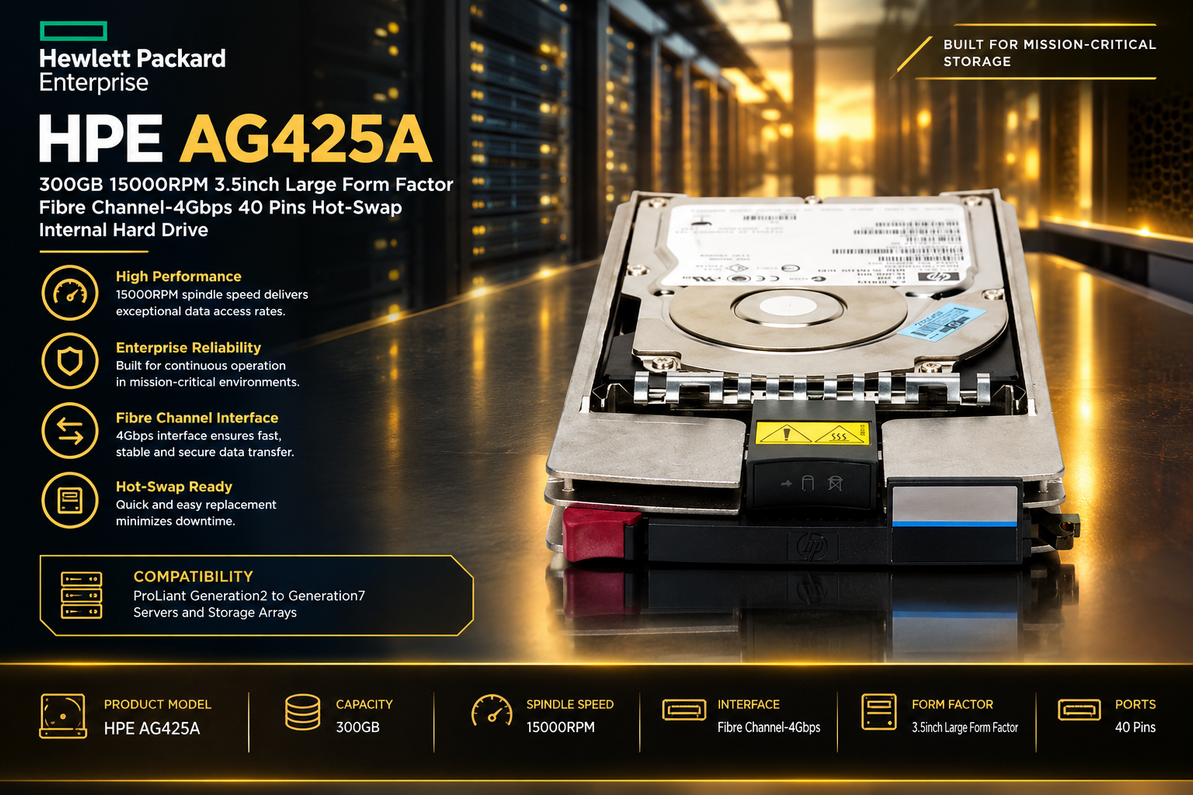
HPE AG425A 300GB 15000RPM Fibre Channel Hard Drive: Enterprise Storage Built for Demanding Environments
Enterprise storage systems depend on dependable hardware that can deliver consistent performance while fitting seamlessly into established infrastructure. The HPE AG425A 300GB 15000RPM 3.5-inch Large Form Factor Fibre Channel-4Gbps 40 Pins Hot-Swap Internal Hard Drive is designed for organizations that need a high-speed enterprise storage solution for compatible HPE environments.
With a 300GB capacity, 15,000 RPM spindle speed, 3.5-inch Large Form Factor design, and Fibre Channel 4Gbps interface, the AG425A combines performance-oriented mechanical storage with an enterprise-oriented hot-swap design. Its 40-pin configuration and internal installation format make it suitable for compatible storage architectures where reliable drive replacement and high-speed data access are important considerations.
Understanding the HPE AG425A Hard Drive
A Performance-Focused Enterprise Storage Drive
The HPE AG425A is built around a 15,000 RPM mechanical spindle, placing it in a performance-oriented class of enterprise hard drives. Higher rotational speed allows the drive to reach data stored on its platters more quickly than slower-spinning enterprise HDDs, making high-RPM drives particularly relevant to workloads where storage responsiveness matters.
For compatible Fibre Channel storage environments, this can make the AG425A a practical choice for organizations maintaining older enterprise systems that continue to depend on reliable mechanical storage.
300GB Capacity for Enterprise Workloads
The drive provides 300GB of storage capacity, offering a balance between storage space and performance-oriented operation. While modern storage environments frequently use much larger individual drives, a 300GB enterprise HDD can still be useful for maintaining legacy servers, storage arrays, and infrastructure where matching the original drive specifications is more important than maximizing capacity.
Using a drive with the appropriate capacity and interface can also simplify replacement planning and help maintain consistency across an existing storage environment.
Fibre Channel-4Gbps Interface
Designed for Fibre Channel Storage Environments
One of the defining characteristics of the HPE AG425A is its Fibre Channel-4Gbps interface. Fibre Channel was developed specifically for high-performance storage networking and has been widely used in enterprise storage area networks.
A 4Gbps Fibre Channel interface provides a dedicated storage connectivity architecture designed for dependable communication between compatible storage hardware and systems. For organizations operating legacy Fibre Channel infrastructure, using an appropriately matched drive can be an important part of maintaining the existing environment.
Why Interface Compatibility Matters
Enterprise hard drives cannot be selected based on capacity and spindle speed alone. The interface, connector configuration, drive carrier, firmware expectations, and storage-system compatibility all need to be considered.
The AG425A's Fibre Channel-4Gbps interface and 40-pin configuration are therefore important specifications when identifying a replacement drive. Before installation, administrators should verify that the existing storage system specifically supports this drive configuration.
3.5-Inch Large Form Factor Design
Built for Compatible LFF Enterprise Infrastructure
The AG425A uses a 3.5-inch Large Form Factor (LFF) design. Enterprise storage systems are commonly built around standardized physical drive dimensions, allowing compatible drives to be installed into designated bays, carriers, or storage enclosures.
The LFF format is especially relevant when replacing an existing enterprise HDD. Even if another drive offers similar capacity and interface characteristics, an incompatible physical form factor may prevent proper installation.
Physical Compatibility Is Essential
When purchasing an enterprise replacement hard drive, administrators should compare the replacement against the original drive's physical configuration. Important considerations include the drive size, carrier arrangement, mounting structure, connector placement, and supported storage enclosure.
Matching these characteristics helps reduce installation problems and makes the replacement process more predictable.
Hot-Swap Capability for Easier Drive Replacement
Minimize Disruption During Maintenance
The hot-swap design is another important characteristic of the HPE AG425A. Hot-swappable storage hardware is designed to support drive replacement without requiring the entire system to be powered down, provided that the supporting server or storage array is designed for hot-swapping.
This capability can be particularly valuable in enterprise environments where system availability is important.
Practical Advantages for IT Administrators
Hot-swap storage can simplify routine maintenance and replacement procedures. When a compatible drive needs to be replaced, administrators can potentially perform the hardware change while the surrounding infrastructure remains operational.
Actual hot-swap behavior depends on the host server, storage enclosure, controller, operating system, and configuration. The complete system should therefore be checked before performing a live drive replacement.
15000RPM Spindle Speed and Storage Performance
Designed for Responsive Mechanical Storage
The 15,000 RPM spindle speed is one of the AG425A's key performance characteristics. Traditional hard drives store data on rotating magnetic platters, and spindle speed influences how quickly the platters rotate beneath the read/write heads.
A 15K RPM drive is designed for faster mechanical access than lower-RPM enterprise HDDs. This makes high-speed HDDs suitable for certain transactional, operational, and enterprise storage workloads where mechanical storage performance remains important.
Performance Depends on the Complete Storage System
A hard drive's performance should never be evaluated in isolation. The storage controller, Fibre Channel infrastructure, cache, RAID configuration, workload characteristics, and surrounding hardware can all affect real-world results.
The AG425A can provide a high-speed mechanical storage component, but the actual performance experienced by applications will depend on the complete storage architecture.
Enterprise-Oriented Reliability
Built for Professional Infrastructure
Enterprise hard drives are designed for environments where storage is an important part of the overall IT infrastructure. The AG425A combines its high rotational speed, Fibre Channel connectivity, LFF construction, and hot-swap configuration into a drive intended for compatible enterprise storage applications.
For organizations maintaining legacy HPE storage infrastructure, retaining compatible enterprise-grade hardware can sometimes be more practical than replacing an entire storage platform.
A Practical Option for Legacy Systems
Many businesses continue operating older servers and storage arrays because the systems still meet their operational requirements. Replacing a failed component with a compatible enterprise drive can extend the useful life of existing infrastructure while avoiding unnecessary platform changes.
The AG425A can therefore be relevant to IT departments, data-center administrators, system integrators, and organizations maintaining compatible HPE environments.
Why Choose the HPE AG425A 300GB 15K HDD?
Performance-Oriented 300GB Storage
The combination of 300GB capacity and 15,000 RPM spindle speed makes the AG425A suitable for users looking for a performance-focused mechanical hard drive rather than a high-capacity archival device.
Fibre Channel Connectivity
Its 4Gbps Fibre Channel interface makes it specifically relevant to compatible Fibre Channel storage environments. This is particularly useful when replacing an existing drive with matching interface requirements.
Large Form Factor Compatibility
The 3.5-inch LFF design makes physical compatibility another major advantage when maintaining an enterprise storage system designed around LFF drives.
Hot-Swap Convenience
The hot-swap configuration can simplify maintenance in supported storage environments, helping administrators replace compatible failed drives without unnecessarily interrupting system operation.
Important Compatibility Considerations
Verify the Storage System Before Installation
Enterprise hard drives should always be matched to the exact requirements of the host system. Before purchasing or installing an HPE AG425A, verify the supported drive type, interface, physical form factor, connector configuration, drive carrier, firmware requirements, and storage controller compatibility.
The fact that a server or array accepts 3.5-inch drives does not automatically mean that every 3.5-inch Fibre Channel drive will work correctly.
Match the Original Drive Whenever Possible
For replacement projects, comparing the AG425A with the existing drive can be an effective approach. Check the original drive's capacity, rotational speed, interface, connector configuration, form factor, and carrier design.
This helps ensure that the replacement is appropriate for the specific enterprise storage environment.
Ideal Applications for the HPE AG425A
Legacy Enterprise Storage Maintenance
The AG425A can be particularly useful when maintaining compatible legacy storage equipment. Rather than replacing an entire system because of a single failed HDD, organizations may be able to use an appropriate replacement drive to keep the infrastructure operational.
Data Center Hardware Replacement
IT departments managing older enterprise equipment can use compatible replacement drives as part of their hardware maintenance strategy. Keeping suitable spare drives available can also reduce the time required to respond to storage hardware failures.
Fibre Channel Storage Environments
The drive's Fibre Channel-4Gbps interface makes it particularly relevant to compatible Fibre Channel-based storage infrastructure where maintaining the original connectivity technology is necessary.
HPE AG425A Technical Specifications
Key Specifications at a Glance
Model: HPE AG425A
Capacity: 300GB
Spindle Speed: 15,000 RPM
Form Factor: 3.5-inch Large Form Factor
Interface: Fibre Channel-4Gbps
Connector: 40 Pins
Installation: Internal
Drive Type: Enterprise Hard Drive
Hot-Swap: Yes
These specifications make the AG425A a specialized enterprise storage component rather than a general-purpose desktop hard drive.
Maintaining Compatible Enterprise Storage Infrastructure
Enterprise infrastructure often remains in service for considerably longer than consumer computing equipment. Servers, storage arrays, and Fibre Channel environments may continue supporting important workloads long after newer generations of hardware have entered the market.
For this reason, compatible replacement components remain valuable. A drive such as the HPE AG425A can help organizations maintain existing storage platforms without immediately moving to a completely different architecture.
Keeping spare compatible drives, monitoring storage health, and maintaining appropriate replacement procedures can all contribute to a more resilient hardware maintenance strategy.
Final Thoughts
The HPE AG425A 300GB 15000RPM 3.5-inch Large Form Factor Fibre Channel-4Gbps 40 Pins Hot-Swap Internal Hard Drive is a specialized enterprise HDD designed around the requirements of compatible storage infrastructure. Its 300GB capacity, high 15,000 RPM spindle speed, Fibre Channel-4Gbps interface, 3.5-inch LFF construction, 40-pin configuration, and hot-swap design make it particularly relevant for organizations maintaining compatible enterprise storage systems.
For businesses working with legacy HPE infrastructure, selecting the correct replacement component can be more important than simply choosing the newest or largest available drive. The AG425A provides a performance-oriented mechanical storage option for environments where matching the established hardware architecture is essential.
Recent Posts
-

HPE AG425B 300GB 15K Fibre Channel Hard Drive: High-Speed Storage for Enterprise-Class EVA Systems
Introduction: Reliable Storage for Demanding Enterprise Environments In enterprise IT, storage perfo …Oct 19th 2026 -

HPE AG425A 300GB 15000RPM Fibre Channel Hard Drive: Enterprise Storage Built for Demanding Environments
Enterprise storage systems depend on dependable hardware that can deliver consistent performance whi …Oct 18th 2026 -
Where Legacy Power Meets Enterprise Precision: The HPE 431944-B21 300GB SAS Hard Drive
HPE 431944-B21: Enterprise Storage Built for the Demanding ProLiant Era The HPE 431944-B21 is a 300G …Oct 17th 2026