
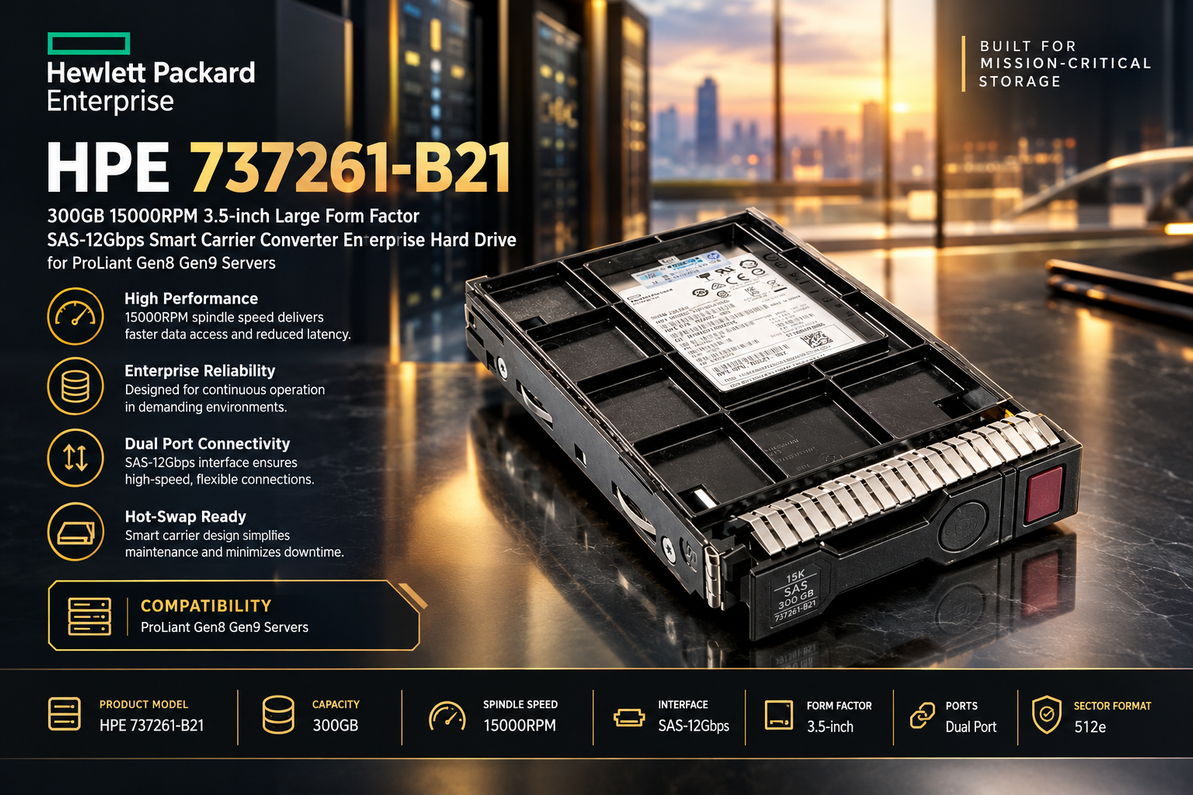
HPE 737261-B21: Unleashing 15K Enterprise Performance with 300GB SAS Storage Power
Introduction: High-Speed Storage for Demanding Enterprise Environments
In enterprise IT environments, storage performance plays a vital role in keeping applications responsive, databases accessible, and business operations running smoothly. Organizations that rely on dependable server infrastructure need storage solutions that combine fast data access, consistent performance, and compatibility with their existing hardware. The HPE 737261-B21 300GB 15000RPM 3.5-inch Large Form Factor SAS-12Gbps Smart Carrier Converter Enterprise Hard Drive is designed for enterprise storage environments where performance and reliable operation are important priorities.
Designed for use with compatible HPE ProLiant Gen8 and Gen9 servers, this enterprise hard drive combines a 300GB storage capacity with a high-speed 15,000 RPM spindle speed and a 12Gbps SAS interface. Its Smart Carrier Converter configuration supports integration into compatible server storage arrangements, making it a potential option for organizations upgrading existing systems or maintaining established enterprise infrastructure.
Whether used for application workloads, frequently accessed business data, or server storage expansion, the HPE 737261-B21 offers a traditional enterprise hard disk drive solution for businesses that require dependable, performance-oriented storage.
Understanding the HPE 737261-B21 Enterprise Hard Drive
The HPE 737261-B21 is an enterprise storage drive identified by its 300GB capacity, 15K RPM rotational speed, 3.5-inch Large Form Factor (LFF), and SAS-12Gbps interface. These specifications make it suitable for evaluating storage upgrades in supported enterprise server environments.
Unlike consumer desktop hard drives, enterprise drives are selected according to workload requirements, server compatibility, storage controller support, and operational demands. Businesses must consider these factors when selecting replacement drives or expanding their existing storage infrastructure.
Key Product Specifications
-
Manufacturer: Hewlett Packard Enterprise (HPE)
-
Model number: 737261-B21
-
Storage capacity: 300GB
-
Spindle speed: 15,000 RPM
-
Form factor: 3.5-inch Large Form Factor (LFF)
-
Interface: SAS-12Gbps
-
Carrier configuration: Smart Carrier Converter
-
Drive type: Enterprise hard disk drive
-
Server compatibility: HPE ProLiant Gen8 and Gen9, subject to the specific server configuration and supported drive-bay requirements
These specifications provide a useful starting point when determining whether the HPE 737261-B21 meets the requirements of a particular server deployment.
300GB Storage Capacity for Essential Business Workloads
Although modern enterprise storage systems often use drives with much larger capacities, a 300GB enterprise hard drive can still serve a practical purpose in established server environments. Its suitability depends on the amount of data involved, the application's performance requirements, and the broader storage architecture.
For businesses maintaining older servers, replacing a failed drive with a compatible model can be more practical than replacing an entire storage platform. A suitable replacement can help preserve existing infrastructure investments while reducing the disruption associated with a larger hardware migration.
Where 300GB Enterprise Storage Can Be Useful
A 300GB drive may be appropriate for operating system volumes, selected application installations, frequently accessed datasets, and smaller business databases. It can also serve as part of a larger storage array where individual drives contribute to a shared storage pool.
Organizations can use drives of this capacity for workloads that prioritize access performance over maximum storage density. However, available capacity should be evaluated against the operating system, application requirements, RAID configuration, and expected data growth.
For data-intensive applications or large virtual machine environments, administrators should assess whether 300GB provides sufficient usable space before selecting this model.
15,000 RPM Spindle Speed for Responsive Storage Performance
One of the defining specifications of the HPE 737261-B21 is its 15,000 RPM rotational speed. This indicates that the drive's magnetic platters rotate at 15,000 revolutions per minute, a speed associated with high-performance enterprise hard disk drives.
Higher rotational speeds can reduce rotational latency, which is the time a drive waits for the required sector to rotate into position beneath the read/write head. This can benefit workloads involving frequent, relatively small storage requests.
Why 15K RPM Matters in Enterprise Computing
In database systems, transactional applications, and other workloads that generate frequent random disk access, rotational latency can influence overall storage responsiveness. A 15K RPM drive can offer lower rotational latency than a comparable 10K RPM drive, all else being equal.
At 15,000 RPM, the average rotational latency is approximately 2 milliseconds, compared with approximately 3 milliseconds at 10,000 RPM. These figures represent theoretical averages based on rotational speed, not complete application response times.
Actual performance also depends on seek time, controller configuration, interface utilization, cache behavior, queue depth, and workload characteristics.
Supporting Business-Critical Applications
The high rotational speed makes this drive worth considering for supported legacy enterprise environments where traditional hard disk storage remains necessary. Examples may include transactional databases, application servers, and workloads with frequent random reads and writes.
However, 15K RPM does not automatically guarantee better performance than every solid-state drive or every alternative enterprise storage solution. Organizations should evaluate the complete storage workload before making purchasing decisions.
SAS-12Gbps Interface for Enterprise Connectivity
The HPE 737261-B21 features a SAS interface rated at 12Gbps. Serial Attached SCSI (SAS) is an enterprise storage interface commonly used in servers and storage arrays that require reliable connectivity and support for demanding storage workloads.
The 12Gbps designation refers to the interface's nominal signaling rate per link, not the drive's guaranteed sustained data-transfer speed. Mechanical limitations, controller capabilities, protocol overhead, and the nature of the workload all influence actual throughput.
Benefits of SAS in Server Infrastructure
SAS is widely used in enterprise environments because it supports server-oriented storage architectures and compatible enterprise storage controllers. It is commonly found in rack servers, storage enclosures, and systems that require centralized management of multiple drives.
A compatible SAS controller and backplane are essential for proper operation. Administrators should verify the supported interface, connector arrangement, drive format, and firmware requirements before installing a replacement drive.
Evaluating Interface Compatibility
The presence of a 12Gbps SAS interface does not mean that the drive will automatically operate at its maximum interface rate in every server. Negotiated link speed depends on the installed controller, backplane, cabling, and system configuration.
Before purchasing the HPE 737261-B21, check the server's documentation and confirm that the storage controller supports the intended drive configuration.
3.5-Inch Large Form Factor for Compatible Server Bays
The 3.5-inch Large Form Factor design is another important consideration when choosing the HPE 737261-B21. Enterprise servers are manufactured with different drive-bay sizes, carriers, backplanes, and storage controller arrangements. Selecting the correct physical format is essential for a successful installation.
Why Drive Form Factor Matters
A drive's form factor determines its physical dimensions and influences which server bays and carriers can accommodate it. A 3.5-inch LFF drive should not be assumed to fit a 2.5-inch Small Form Factor (SFF) bay without an explicitly supported mounting arrangement.
The carrier and converter configuration also matters. Physical fit alone does not guarantee electrical compatibility or support from the server's firmware.
Smart Carrier Converter Configuration
The Smart Carrier Converter designation identifies the drive configuration described for this product. When replacing an existing drive, administrators should compare the carrier, mounting points, connector alignment, and supported drive-bay requirements with the original hardware.
Compatibility should be confirmed for the complete assembly rather than determined solely from the model number or the appearance of the carrier.
Designed for Compatible HPE ProLiant Gen8 and Gen9 Servers
The HPE 737261-B21 is specified for HPE ProLiant Gen8 and Gen9 server environments. These server generations continue to be used by organizations that maintain established infrastructure for business applications, internal services, and specialized workloads.
Maintaining older systems can be a cost-conscious strategy when the hardware remains suitable for its intended purpose. Replacing an individual drive may allow an organization to restore storage capacity without undertaking a full server replacement.
Maintaining Existing Enterprise Infrastructure
For IT teams responsible for older ProLiant installations, sourcing compatible replacement parts is an important part of hardware lifecycle management. A suitable replacement drive can help address a failed storage component or support a planned maintenance activity.
Before installation, administrators should verify the exact server model, drive-bay configuration, controller compatibility, and applicable HPE support documentation. Compatibility can vary within a server generation, so Gen8 or Gen9 identification alone should not be treated as a universal guarantee.
Firmware and System Validation
Enterprise storage components may require supported firmware and controller configurations to operate correctly. Organizations should confirm the drive's part number, firmware requirements, and any applicable digitally signed firmware or validation requirements against official documentation where relevant.
Testing the replacement drive and confirming that the server recognizes it correctly are important steps in a controlled installation process.
Enterprise Reliability and Storage Maintenance
Enterprise storage reliability depends on more than the drive itself. Proper cooling, stable power delivery, compatible controllers, preventive maintenance, and monitoring all contribute to the overall health of a storage system.
The HPE 737261-B21 can be considered as part of a broader enterprise storage maintenance strategy when its specifications match the server's requirements.
Monitoring Drive Health
Server administrators should monitor available drive-health indicators and controller alerts for signs of degradation. Depending on the controller and management software, these may include predictive failure warnings, media errors, temperature alerts, and other storage-related events.
Proactive monitoring can help IT teams identify potential problems before they cause unexpected service interruptions. Regular review of storage health also supports better maintenance planning.
Planning Drive Replacement
Before replacing a failed or aging drive, confirm that important data is backed up and that the storage configuration is understood. If the drive belongs to a RAID array, follow the controller manufacturer's replacement procedure and verify the array's condition before and after the operation.
Never assume that removing a drive is safe simply because another drive is present. RAID configurations differ, and replacing the wrong drive or interrupting a rebuild can increase the risk of data loss.
Potential Applications of the HPE 737261-B21
The combination of 300GB capacity, 15K RPM rotational speed, and a SAS-12Gbps interface makes the HPE 737261-B21 a candidate for selected traditional enterprise storage workloads, provided the target server supports the drive.
Database and Transactional Workloads
Applications that generate frequent random reads and writes may benefit from the relatively low rotational latency of a 15K RPM mechanical drive. The extent of that benefit depends on the database engine, caching strategy, controller, and storage architecture.
For workloads requiring consistently high input/output operations per second or very low latency, administrators should compare the drive with suitable enterprise SSD alternatives.
Application and Utility Servers
Some application servers and internal business systems have moderate storage requirements and can continue operating effectively with traditional enterprise hard drives. A compatible 300GB drive may be appropriate for selected application data or system volumes, depending on the capacity and performance requirements.
Legacy Storage Arrays
Organizations operating supported legacy storage infrastructure may need replacement drives to maintain availability and extend the useful life of existing equipment. The HPE 737261-B21 may be considered for this purpose after confirming compatibility with the relevant server or storage platform.
HDD Versus SSD: Choosing the Right Enterprise Storage
Although the HPE 737261-B21 offers high rotational speed for a mechanical hard drive, enterprise SSDs have different performance characteristics that may make them preferable for some applications.
Mechanical Hard Drive Advantages
Traditional enterprise HDDs can be useful when maintaining existing HDD-based server infrastructure, matching a supported legacy configuration, or replacing a failed drive with a compatible component.
A replacement HDD can also help avoid unnecessary changes to an established storage design, provided the existing configuration remains suitable for the workload.
Enterprise SSD Advantages
SSDs have no spinning platters or mechanical read/write heads. As a result, they can deliver substantially lower access latency and stronger random I/O performance in many workloads.
However, moving from an HDD to an SSD is not always a simple component swap. Drive interfaces, carrier compatibility, controller support, endurance requirements, firmware, cost, and application behavior must all be considered.
Making an Informed Storage Decision
The right choice depends on the problem being solved. If the priority is maintaining a compatible ProLiant storage configuration, an appropriate enterprise HDD may be the sensible option. If the priority is reducing storage latency for a demanding application, an enterprise SSD may deserve closer consideration.
Evaluating the complete workload is more effective than choosing a drive based on spindle speed or interface specifications alone.
Installation and Compatibility Checklist
Before purchasing or installing the HPE 737261-B21, use the following checklist to reduce the risk of selecting an incompatible component.
Verify the Server and Drive Bay
Confirm the exact HPE ProLiant model and generation. Check whether the server has a compatible 3.5-inch LFF bay and whether the required Smart Carrier Converter arrangement is supported.
Confirm SAS Controller Support
Check that the installed storage controller and backplane support the drive's SAS interface and intended configuration. Do not assume that every SAS controller supports every drive or operates at the same link speed.
Check the Part Number and Firmware
Verify that the replacement matches the required HPE part number and any relevant firmware requirements. Where digitally signed firmware or specific validation is required, consult the applicable HPE documentation.
Review the Storage Configuration
Determine whether the drive will be used as a standalone device or as part of a RAID array. Confirm the required capacity, logical configuration, backup status, and replacement procedure before making changes.
Validate After Installation
After installation, confirm that the server detects the drive and reports its status correctly. Review any controller warnings, check the storage configuration, and verify that the system returns to its expected operating condition.
Why Choose the HPE 737261-B21 for a Compatible Server Upgrade?
Selecting the right enterprise drive involves balancing compatibility, performance, capacity, and long-term maintenance needs. The HPE 737261-B21 brings together a 300GB capacity, 15,000 RPM spindle speed, 3.5-inch LFF design, and SAS-12Gbps interface in a configuration intended for compatible enterprise server environments.
For businesses that continue to depend on supported ProLiant Gen8 and Gen9 systems, an appropriately matched replacement drive can be an important part of infrastructure maintenance. It can help address storage failures, maintain an existing configuration, and support workloads that remain well suited to traditional enterprise HDDs.
The key is to confirm compatibility before ordering. Server generation, carrier configuration, storage controller support, and firmware requirements should all be checked to ensure the selected component meets the needs of the installation.
Conclusion: A Performance-Focused Storage Option for Established ProLiant Systems
The HPE 737261-B21 300GB 15000RPM 3.5-inch Large Form Factor SAS-12Gbps Smart Carrier Converter Enterprise Hard Drive is designed for organizations evaluating high-speed mechanical storage for compatible enterprise server environments.
Its 15K RPM spindle speed supports lower rotational latency than slower-spinning HDDs, while the SAS-12Gbps interface provides an enterprise-oriented connection for supported storage systems. Its 300GB capacity and LFF configuration may also make it suitable for selected legacy server workloads and replacement requirements.
For IT professionals maintaining HPE ProLiant Gen8 and Gen9 infrastructure, this drive is worth evaluating when the required specifications match the existing server configuration. Verify the exact part number, carrier arrangement, controller support, and firmware requirements before purchasing.
With careful compatibility checks and appropriate storage maintenance practices, the right replacement drive can help organizations preserve existing infrastructure and keep essential business systems running reliably.
Recent Posts
-
HPE P04693-B21: Ignite Your Enterprise with 300GB of 15K RPM Storage Performance
In today's data-driven business environment, server storage plays a crucial role in keeping applicat …Oct 11th 2026 -
HPE 870755-B21: Unleash Enterprise Storage Power with 300GB of High-Speed 15K RPM Performance
In enterprise IT, storage performance can make a significant difference in how efficiently servers h …Oct 10th 2026 -
HPE 737261-B21: Unleashing 15K Enterprise Performance with 300GB SAS Storage Power
Introduction: High-Speed Storage for Demanding Enterprise Environments In enterprise IT environments …Oct 9th 2026