
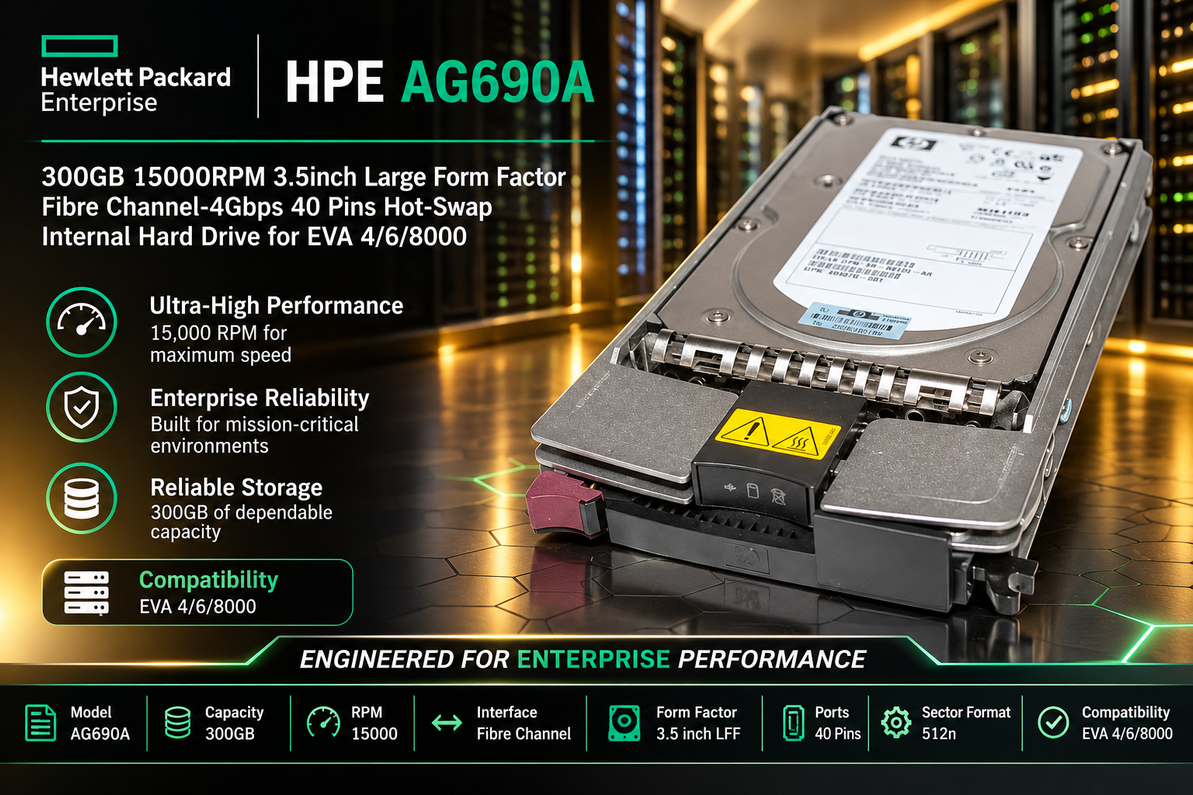
HPE AG690A: The High-Speed Storage Workhorse That Keeps Enterprise Data Moving
Introduction: Built for Demanding Enterprise Storage
In enterprise storage environments, dependable performance is essential. Business applications, databases, virtual machines, and mission-critical information all depend on storage hardware that can deliver consistent access to data. For organizations maintaining established Hewlett Packard Enterprise (HPE) StorageWorks Enterprise Virtual Array systems, choosing the right replacement hard drive is an important part of keeping existing infrastructure productive.
The HPE AG690A 300GB 15000RPM 3.5-inch Large Form Factor Fibre Channel-4Gbps 40-Pin Hot-Swap Internal Hard Drive is designed for enterprise storage environments that require fast rotational performance, Fibre Channel connectivity, and compatibility with supported HPE EVA systems. Its 15,000 RPM spindle speed helps reduce mechanical access delays, while its 300GB capacity provides dedicated space for frequently accessed business data.
Designed for use with supported HPE StorageWorks EVA 4/6/8000 storage systems, this drive is a practical option for IT teams that need to maintain existing storage infrastructure without undertaking a complete platform replacement. For businesses that depend on established storage arrays, the AG690A can help support continued operations while preserving the investment in compatible hardware.
Understanding the HPE AG690A Hard Drive
The HPE AG690A is an enterprise-class Fibre Channel hard drive option associated with HPE StorageWorks EVA storage environments. Unlike a typical desktop hard drive, which is designed primarily for individual computers, this type of drive is intended for integration into a supported enterprise storage enclosure.
Enterprise storage systems are built to serve multiple applications and users, often handling simultaneous read and write requests throughout the working day. The drive's high rotational speed and Fibre Channel connectivity make it suitable for workloads where predictable access to stored information matters.
The AG690A is particularly relevant to organizations maintaining legacy storage infrastructure. Replacing a failed or aging drive with a compatible unit can help restore storage capacity and reduce the disruption associated with replacing an entire array.
Key Product Specifications
| Specification | Details |
|---|---|
| Brand | HPE |
| Option Part Number | AG690A |
| Storage Capacity | 300GB |
| Rotational Speed | 15,000 RPM |
| Form Factor | 3.5-inch Large Form Factor (LFF) |
| Interface | Fibre Channel |
| Interface Speed | Up to 4Gbps, as specified in the product listing |
| Connector Description | 40-pin, as specified in the product title |
| Drive Type | Internal enterprise hard drive |
| Installation Type | Hot-swap, in a compatible enclosure |
| Intended Platform | Supported HPE StorageWorks EVA 4/6/8000 systems |
Important compatibility note: HPE documentation and reseller listings associate the AG690A option family with multiple drive assembly and spare part numbers. Confirm the exact drive assembly, interface generation, enclosure, and firmware requirements before purchasing a replacement.
15,000 RPM Performance for Faster Data Access
Why Rotational Speed Matters
A traditional hard disk drive stores information on rotating magnetic platters. To retrieve data, the drive positions its read/write heads over the required location and waits for the relevant portion of the platter to rotate into position. This mechanical process introduces latency that does not occur in the same way with solid-state drives.
The HPE AG690A spins its platters at 15,000 revolutions per minute, placing it in the high-speed category of traditional enterprise hard drives. Compared with slower 7,200 RPM drives, a 15K drive can offer lower rotational latency and is better suited to workloads that involve frequent, relatively small data requests.
This characteristic can be useful for database operations, transactional applications, and other workloads that repeatedly access stored information. Actual performance depends on the complete storage system, including its controllers, cache, RAID or virtualization configuration, drive population, and workload characteristics.
Supporting Transactional Workloads
Enterprise applications frequently perform many small read and write operations instead of transferring one large file at a time. Examples include database queries, inventory updates, financial transactions, and application metadata access.
For these environments, reducing mechanical delays can help improve responsiveness. The AG690A's 15,000 RPM rotational speed makes it a relevant choice for maintaining older storage configurations that were designed around high-performance mechanical disks.
However, spindle speed is only one part of storage performance. It should be evaluated alongside interface compatibility, controller behavior, workload patterns, and the condition of the overall array.
Fibre Channel Connectivity for Enterprise Storage
Designed for Storage Area Networks
Fibre Channel is a networking technology developed to provide reliable, high-performance connectivity between storage systems and the servers that access them. It is widely associated with Storage Area Networks (SANs), where storage resources can be shared across multiple systems.
The HPE AG690A is identified as a Fibre Channel drive for supported EVA storage environments. This makes it different from a conventional SATA or SAS disk intended for direct installation into an unrelated desktop or server drive bay.
A Fibre Channel drive must be compatible with the storage enclosure's backplane, drive interface, and supported configuration. The drive should therefore be selected according to the requirements of the target EVA system rather than by capacity or physical dimensions alone.
Understanding the 4Gbps Interface Specification
The product listing identifies the drive with a Fibre Channel interface rated at up to 4Gbps. This is an interface signaling rate, not a promise that every application will transfer data at that speed. Real-world throughput depends on the drive's mechanical capabilities, storage controller, protocol overhead, and the demands placed on the array.
It is also important to distinguish interface generations and drive specifications when purchasing replacement hardware. Some related HPE EVA drive assemblies are documented with different interface descriptions. Confirm the exact part number and the requirements of the existing storage enclosure before installation.
300GB Capacity for Essential Business Data
A Practical Capacity for Legacy Storage Arrays
With 300GB of storage capacity, the HPE AG690A is intended for environments where maintaining an existing array configuration is more important than maximizing capacity per drive.
Although modern drives offer substantially larger capacities, replacing an older drive with a compatible 300GB unit can be useful when an organization needs to preserve a supported array configuration, restore a failed disk, or maintain a consistent set of drives across an established storage pool.
Potential uses include business application data, frequently accessed database records, operational files, and other information managed by a compatible enterprise storage system. The amount of usable capacity available to applications will depend on the array's RAID or virtualization configuration, formatting, and storage management overhead.
Maintaining Consistency Across the Storage Pool
Enterprise storage administrators often need to consider more than the specifications of an individual drive. A replacement must also fit the existing storage design, including the array's supported drive types and configuration rules.
Using the correct replacement model helps avoid unnecessary compatibility problems and can simplify maintenance. Before changing a drive, administrators should check the storage array's status, identify the failed component, and follow the manufacturer's supported replacement procedure.
Hot-Swap Convenience for Enterprise Maintenance
Replacing a Drive Without Unnecessary Downtime
The AG690A is described as a hot-swap drive for compatible storage enclosures. Hot-swap functionality allows an eligible drive to be removed and replaced while the storage system remains powered on, provided the array and its maintenance procedures support the operation.
This feature is valuable in business environments where shutting down an entire storage platform can interrupt applications, users, and services. A properly supported hot-swap replacement can help administrators address a failed drive while limiting disruption.
Hot-swap capability does not mean every drive can be removed at any time without risk. Administrators should verify the failed drive's location, confirm array redundancy and health, and follow the system's instructions before removing hardware. Removing the wrong drive or replacing a disk when the array is already degraded can put stored data at risk.
Supporting More Manageable Maintenance
A compatible replacement drive can help simplify routine hardware maintenance by allowing teams to address individual drive failures instead of immediately replacing the complete storage enclosure.
For organizations with limited budgets or established applications that depend on older infrastructure, this can be an important advantage. Maintaining spare drives and documenting replacement procedures can also help IT teams respond more efficiently when hardware problems occur.
Compatibility with HPE StorageWorks EVA 4/6/8000
Designed for Established HPE EVA Environments
The HPE StorageWorks Enterprise Virtual Array family was developed to provide centralized storage for enterprise applications. These systems use storage virtualization and array management capabilities to present storage resources to connected hosts.
The AG690A product listing identifies the drive for EVA 4/6/8000 systems. Its intended use is therefore different from that of a general-purpose hard drive designed for a standard computer.
When replacing an existing disk, administrators should verify the exact EVA model, enclosure type, drive assembly number, interface generation, and applicable firmware requirements. HPE's documentation lists related 300GB, 15K Fibre Channel drive assemblies under several part numbers, so the AG690A option number alone may not be sufficient to establish an exact replacement match.
Why Correct Part Number Matching Matters
Enterprise drive families can contain similar-looking products that differ in firmware, connector arrangements, interface capabilities, or supported storage platforms. A drive that fits physically may still be unsuitable for a particular array.
Before ordering, compare the existing drive's label and spare or assembly number with the replacement's specifications. If the original part number is unavailable, consult the storage system's documentation or a qualified hardware supplier to verify the correct replacement.
This extra step helps reduce the risk of purchasing an incompatible component and makes the replacement process more predictable.
Where the HPE AG690A Can Be Useful
Database and Business Applications
Databases often involve repeated access to small blocks of information. In a compatible EVA environment, a high-speed mechanical drive can help support this type of activity, particularly when maintaining a storage configuration originally designed around 15K Fibre Channel disks.
Performance will depend on the database design, cache effectiveness, number of active drives, and the demands of other applications sharing the array.
Virtualized Infrastructure
Organizations running legacy virtualized environments may rely on centralized storage for virtual machine files and application data. Replacing a failed disk with a compatible AG690A assembly can help restore the storage pool to its intended configuration.
Administrators should check the array's redundancy and health before beginning maintenance, especially when multiple disks have reported errors or when the system is already operating in a degraded state.
Enterprise File and Application Storage
The drive may also be suitable for supported enterprise workloads that require reliable access to business files and application data. Its value is especially relevant when the surrounding infrastructure must remain in place for compatibility, operational, or budgetary reasons.
The most appropriate use depends on the requirements of the storage system and the organization's performance and capacity needs.
HPE AG690A Compared with Modern Storage Options
The storage market has evolved considerably since 15K Fibre Channel hard drives were common in enterprise arrays. Modern SAS drives, SATA drives, and solid-state drives can offer different combinations of capacity, cost, latency, and throughput.
An SSD generally provides much lower access latency because it has no spinning platters or moving read/write heads. Modern high-capacity disks can also provide more storage per drive than a 300GB mechanical unit.
Nevertheless, a newer drive is not automatically a suitable replacement for an older EVA system. Compatibility with the enclosure, controller, firmware, and storage configuration remains essential.
For an organization maintaining an existing EVA array, the AG690A may be appropriate when the priority is restoring a supported configuration. For a planned infrastructure refresh, comparing maintenance costs, available replacement parts, performance requirements, capacity needs, and migration options can help determine whether continued operation or a move to newer storage is the better long-term decision.
Installation and Replacement Considerations
Before installing the HPE AG690A, verify that the drive is the correct match for the target storage enclosure. Check the product label, part number, connector arrangement, and interface specification against the original component and the system documentation.
Review the array's health and redundancy status before removing a disk. If the array is degraded, or if more than one drive is reporting errors, seek qualified assistance before proceeding. Follow the manufacturer's hot-swap procedure, identify the correct drive bay, and allow the storage system to complete any required rebuild or recovery operations.
After installation, monitor the array management interface for drive recognition, warnings, rebuild progress, and overall storage health. Confirm that the replacement has been accepted by the system and that any required recovery activity completes successfully.
A hot-swap drive is a hardware component, not a substitute for backups. Maintain verified backups of important information and ensure that recovery procedures are tested.
Choosing the Right HPE AG690A Replacement
When purchasing an HPE AG690A hard drive, focus on verified compatibility and the condition of the product rather than relying on the model name alone.
Confirm the 300GB capacity, 15,000 RPM rotational speed, Fibre Channel interface, supported 4Gbps specification, form factor, and hot-swap requirements. Check whether the drive includes the appropriate carrier or assembly for the target enclosure, and verify the exact part number with the supplier.
If buying refurbished enterprise hardware, ask about testing procedures, warranty coverage, return terms, and the condition of the drive and carrier. These details can help you make a more informed purchasing decision and reduce the risk of avoidable installation issues.
For businesses maintaining older HPE EVA systems, a correctly matched replacement can be a practical way to extend the usefulness of existing storage infrastructure while planning future upgrades at a manageable pace.
Conclusion: Keep Legacy Enterprise Storage Working with Confidence
The HPE AG690A 300GB 15000RPM Fibre Channel hard drive is a specialized storage component for compatible HPE StorageWorks EVA environments. Its 15,000 RPM spindle speed, 300GB capacity, Fibre Channel connectivity, and hot-swap design make it relevant to organizations maintaining established enterprise storage systems.
For IT teams responsible for legacy infrastructure, the right replacement drive can help restore storage capacity, support business continuity, and avoid unnecessary equipment replacement. The key is to confirm exact compatibility with the target EVA system and follow the appropriate installation and maintenance procedures.
If your organization operates a supported HPE EVA 4/6/8000 configuration, the AG690A may be worth considering as part of a carefully verified replacement strategy. Match the part number to your existing hardware, check the interface requirements, and choose a supplier that can provide clear information about product condition and warranty coverage.
Recent Posts
-
HPE AG690B: The 15K Storage Powerhouse Keeping Enterprise Data Within Reach
Introduction: Reliable Performance for Enterprise Storage Systems Behind every dependable enterprise …Oct 28th 2026 -
HPE AG690A: The High-Speed Storage Workhorse That Keeps Enterprise Data Moving
Introduction: Built for Demanding Enterprise Storage In enterprise storage environments, dependable …Oct 24th 2026 -
HPE 411089-B22: Reviving Enterprise Performance with a 300GB 15K Ultra320 SCSI Hard Drive
Introduction: Dependable Storage for Classic Enterprise Servers Enterprise IT infrastructure depends …Oct 23rd 2026