
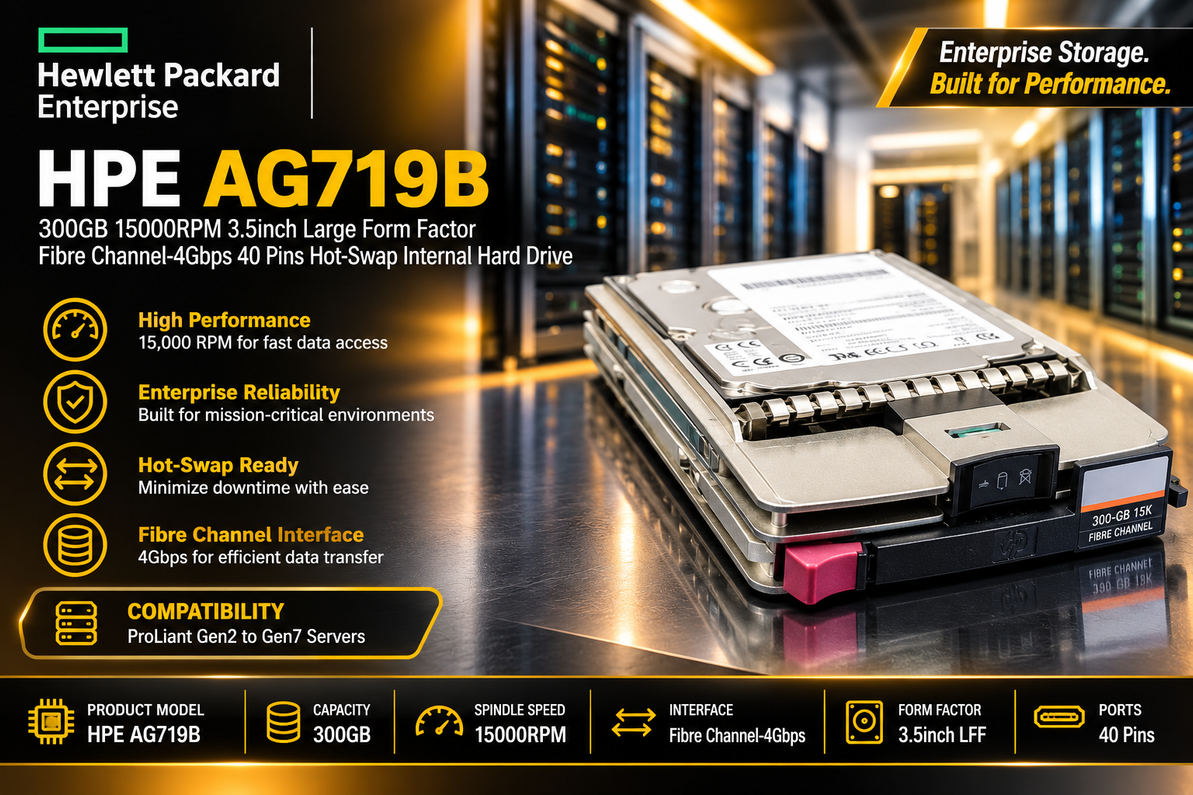
HPE AG719B: Reviving Enterprise Storage with 300GB of 15K Fibre Channel Performance
Introduction: A Proven Storage Solution for Enterprise Environments
Reliable storage remains essential for businesses that depend on consistent access to critical data, dependable application performance, and stable enterprise infrastructure. Although modern storage technologies continue to evolve, many organizations still operate established storage area networks (SANs) and legacy enterprise storage systems that require compatible, high-performance hardware to remain productive.
The HPE AG719B 300GB 15000RPM 3.5-inch Large Form Factor Fibre Channel-4Gbps 40-Pin Hot-Swap Internal Hard Drive is designed for compatible enterprise storage environments where dependable operation, fast rotational performance, and hardware compatibility are important. With a 300GB capacity, a 15,000 RPM spindle speed, and a Fibre Channel interface, this drive can serve as a replacement component for supported HPE StorageWorks Enterprise Virtual Array (EVA) systems.
For organizations maintaining established infrastructure, replacing a failed drive with an appropriately matched component can help extend the useful life of existing equipment while avoiding the expense and complexity of a complete storage platform replacement.
Understanding the HPE AG719B Hard Drive
Built for Enterprise Storage Requirements
The HPE AG719B is associated with a family of 300GB, 15K RPM Fibre Channel hard drives designed for compatible HPE EVA storage systems. Its combination of a large form factor, hot-swap capability, and enterprise-oriented Fibre Channel connectivity makes it relevant to administrators responsible for maintaining older storage arrays.
Unlike a general-purpose desktop hard drive, an enterprise storage drive must work within a specific hardware and storage architecture. The drive, its carrier, the interface, the array firmware, and the storage controller must all be suitable for the target system.
The AG719B designation appears among the related option numbers for compatible 300GB, 15K RPM HPE Fibre Channel drives. However, buyers should verify the precise spare, assembly, and option numbers before ordering, because related part numbers do not automatically guarantee compatibility with every HPE EVA enclosure.
Key Specifications at a Glance
The following specifications describe the documented drive family associated with the AG719B option number. Exact specifications and compatibility should be confirmed against the label on the drive and the documentation for the target storage system.
| Specification | Details |
|---|---|
| Brand | HPE |
| Option part number | AG719B |
| Storage capacity | 300GB |
| Spindle speed | 15,000 RPM |
| Form factor | 3.5-inch Large Form Factor (LFF) |
| Interface | Fibre Channel |
| Interface generation | 4Gbps Fibre Channel family |
| Connector description | 40-pin, as specified in the product listing |
| Installation | Hot-swap or hot-plug, when supported by the target enclosure |
| Interface protocol listed for the drive family | FC-AL-2 |
| Related spare part number | 416728-001 |
| Potential platform family | Compatible HPE StorageWorks EVA systems |
The related part numbers and specifications above are useful for identification, but they should not replace a compatibility check for the exact EVA model and enclosure.
300GB Capacity for Established Enterprise Workloads
Practical Storage for Legacy Systems
The HPE AG719B offers 300GB of storage capacity, making it suitable for replacement or maintenance scenarios involving supported enterprise storage arrays. Although 300GB is modest compared with the capacities available from modern hard drives and SSDs, capacity alone does not determine whether a component is useful.
Many established IT environments depend on carefully configured storage arrays that support business applications, historical records, internal services, and other workloads. Replacing a failed drive with a compatible component can help preserve the existing configuration and minimize disruption.
For organizations with legacy infrastructure, maintaining a supply of compatible drives can also simplify repairs. Administrators may be able to replace a failed component without redesigning the storage environment or migrating every workload to a new platform.
Capacity Planning Still Matters
A 300GB drive should be evaluated according to the storage requirements of the intended system. Before replacement, administrators should review the array's usable capacity, RAID or protection configuration, existing drive sizes, and available expansion options.
The usable capacity of a storage array is not necessarily equal to the sum of its installed drive capacities. Redundancy, system metadata, formatting, and storage architecture can reduce the space available to applications. For that reason, the AG719B is best selected as part of a planned maintenance or replacement strategy rather than as a capacity upgrade without further evaluation.
15,000 RPM Performance for Responsive Storage Access
How Rotational Speed Affects Hard Drive Performance
One of the defining characteristics of the HPE AG719B drive family is its 15,000 RPM spindle speed. Rotational speed affects how quickly a mechanical hard drive can position its platters to access requested data.
Compared with slower enterprise HDDs, a 15K RPM drive can reduce rotational latency. This can be valuable for workloads involving frequent small reads and writes, where the time spent waiting for the correct sector to rotate into position contributes to overall response time.
The actual performance of a storage system depends on several factors, including the controller, the number of active drives, workload characteristics, cache configuration, RAID level, and the condition of the hardware. A 15K RPM rating therefore indicates a performance characteristic, not a guarantee of a particular application response time.
Supporting Transaction-Oriented Workloads
High rotational speed can be beneficial in established environments that perform frequent data access operations. Depending on the storage architecture, potential applications may include transactional databases, business applications, shared enterprise files, and virtualized workloads that continue to run on supported legacy infrastructure.
The drive should not be considered a universal solution for every performance requirement. Modern SSDs generally provide substantially lower access latency, but they may require a different budget, storage architecture, or migration plan. For a compatible legacy array, a matching 15K RPM HDD can be a practical maintenance choice.
Fibre Channel Connectivity for Enterprise Storage
Understanding the 4Gbps Fibre Channel Interface
Fibre Channel is a storage networking technology commonly used to connect servers and storage systems through a storage area network. It is designed for structured communication between storage devices and the systems that access them.
The AG719B is associated with a 4Gbps Fibre Channel drive family. The interface provides a communication pathway between the drive and a compatible storage enclosure, allowing the array to manage data access through its supported storage architecture.
The advertised 4Gbps figure refers to the interface signaling rate, not guaranteed application throughput. Real-world data transfer performance depends on the drive mechanics, controller capabilities, system configuration, and workload.
Why Interface Compatibility Is Essential
A Fibre Channel drive should not be selected based only on its capacity and spindle speed. The storage array must support the relevant interface generation, drive type, firmware, and physical installation format.
Administrators should verify the enclosure model and supported drive options before installing a replacement. A drive that looks physically similar to an existing component may still be unsuitable because of firmware requirements, connector differences, enclosure generation, or platform-specific limitations.
3.5-Inch Large Form Factor Design
Physical Fit and Enclosure Requirements
The HPE AG719B drive family uses a 3.5-inch Large Form Factor design. This form factor is associated with larger drive bays and storage enclosures built to accept compatible LFF modules.
Physical size is only one part of the compatibility process. The drive must also have the correct mounting arrangement, carrier, connector placement, and supported interface. An LFF drive cannot automatically replace a 2.5-inch Small Form Factor drive, and not every 3.5-inch drive is compatible with every LFF enclosure.
Before purchasing, compare the existing drive's label, spare part number, assembly number, and carrier with the replacement listing. If the current drive is installed in a specialized HPE EVA enclosure, use the system's service documentation to confirm the appropriate replacement.
The Importance of the Correct Carrier
Enterprise drives may be supplied with carriers or mounting assemblies designed for a particular storage enclosure. These components help secure the drive and align its connectors correctly.
When purchasing the AG719B, check whether the listing includes the required carrier and whether that carrier is intended for the target array. A bare drive may not be a direct replacement for a complete hot-swap module if the original mounting hardware must be reused or sourced separately.
Hot-Swap Convenience for Maintenance
Replacing Drives with Less Downtime
Hot-swap functionality allows a compatible storage system to support drive replacement without requiring the entire system to be powered down. This can simplify maintenance in environments where continuous access to data is important.
However, hot-swap capability depends on the complete system, not just the drive. The enclosure must support the feature, the drive must be approved for the system, and the replacement procedure must follow the manufacturer's instructions.
Administrators should never assume that a drive can safely be removed while powered merely because a product listing describes it as hot-swap compatible.
Follow the Correct Replacement Procedure
Before replacing a drive, review the storage array's status and identify the correct physical bay. Confirm which drive has failed or requires maintenance, and check the array's redundancy and rebuild status.
After installation, monitor the array to verify that it recognizes the replacement and completes any required recovery or rebuild process. Rebuilding can affect performance and may take considerable time, depending on capacity, workload, and array configuration.
Always maintain current backups and follow the system's supported service procedures. Hot-swap capability can simplify hardware maintenance, but it does not eliminate the risks associated with incorrect drive removal or degraded storage protection.
HPE AG719B Compatibility and Part Number Verification
Confirm the Exact Storage Platform
The AG719B option number appears in product listings for a family of 300GB, 15K RPM Fibre Channel drives associated with HPE StorageWorks EVA systems. HPE's drive documentation also distinguishes related assembly and spare part numbers according to the platform and enclosure. This makes careful verification particularly important when replacing a drive in an older array.
Before purchasing, identify the exact storage system model and enclosure. Then compare the installed drive's part number with the proposed replacement and consult the relevant HPE compatibility documentation.
Do not assume that compatibility with one EVA generation means compatibility with all EVA systems. Some drive families and carriers are intended for particular enclosures, and similar model descriptions can conceal important differences.
Related Part Numbers
The AG719B option number is associated in product listings with the following related identifiers:
-
416728-001: A related spare part number.
-
404394-003: An associated assembly number.
-
404395-003: An associated assembly number.
-
404396-002: An associated assembly number.
-
447186-002: An associated assembly number.
These identifiers help with cross-referencing, but they should not be treated as universally interchangeable. Confirm the precise spare part and enclosure compatibility before placing an order.
Common Applications for the HPE AG719B
Legacy Storage Array Maintenance
One of the most practical uses for the AG719B is replacing a failed or aging drive in a compatible legacy HPE storage array. Maintaining matching components can help administrators preserve the existing storage configuration while planning a longer-term hardware refresh.
Business Data and Internal Applications
Where the supported storage system remains in service, the drive may contribute to storage pools used by internal applications, shared data, and other established business workloads. Suitability depends on the workload's capacity, performance, reliability, and availability requirements.
Infrastructure Support and Spare Inventory
IT teams responsible for older infrastructure may keep compatible drives available as maintenance spares. Having the correct part number on hand can reduce the time spent sourcing replacement hardware after a drive failure.
A spare inventory strategy should be based on the organization's risk assessment, system importance, replacement lead times, and plans for retiring the legacy platform.
Benefits of Choosing a Compatible HPE Enterprise Drive
Maintain Existing Investments
Replacing a failed drive with a compatible component can help organizations continue using a functioning storage platform. This may be particularly useful when a full migration would require additional hardware, software changes, application testing, and planned downtime.
Simplify Hardware Replacement
A verified replacement reduces the uncertainty involved in sourcing parts for older storage systems. Matching the correct option and spare part numbers helps maintenance teams avoid unnecessary installation delays.
Balance Performance and Practicality
The combination of 15,000 RPM rotational speed and Fibre Channel connectivity makes this drive family relevant to supported legacy enterprise storage environments. For organizations that need to preserve existing infrastructure, compatibility and predictable maintenance can be more important than choosing the newest available technology.
What to Check Before Buying the HPE AG719B
Before ordering, review the following points to help ensure the drive matches your requirements:
-
Confirm the exact HPE EVA model and enclosure.
-
Verify that AG719B or the proposed related part number is supported by the target system.
-
Match the drive's capacity, rotational speed, interface, and physical form factor.
-
Check whether the correct carrier is included.
-
Confirm the drive's condition, testing status, and warranty terms with the seller.
-
Review the seller's return policy in case the part number or compatibility does not match the system.
-
Make sure the existing storage array is healthy enough to accept and rebuild the replacement drive.
These checks are particularly important when sourcing parts for legacy enterprise hardware, where similar-looking drives may have different platform requirements.
Frequently Asked Questions About the HPE AG719B
What is the storage capacity of the HPE AG719B?
The AG719B option number is associated with a 300GB enterprise Fibre Channel hard drive family. Verify the exact model and part number on the product label before purchasing.
What is the spindle speed of the HPE AG719B?
The drive family is rated at 15,000 RPM. This high rotational speed can help reduce rotational latency compared with slower mechanical hard drives.
Does the HPE AG719B support hot-swap replacement?
The associated drive family is listed as hot-swap or hot-plug. Safe replacement still depends on the target storage enclosure and following the manufacturer's supported procedure.
Which interface does the HPE AG719B use?
It is associated with a 4Gbps Fibre Channel drive family and FC-AL-2 interface specifications. Check the exact product label and system documentation to verify the interface for the specific drive being purchased.
Is the HPE AG719B compatible with every HPE server?
No. The AG719B should not be assumed to work in every HPE server or storage array. Confirm the exact model, enclosure, supported drive options, and spare part number before installation.
Is the HPE AG719B suitable for modern storage upgrades?
It can be a practical replacement option for compatible legacy systems that remain in service. For a new storage deployment, compare current HDD and SSD technologies, interface requirements, performance needs, capacity goals, and long-term support considerations.
Conclusion: A Targeted Replacement for Established Enterprise Storage
The HPE AG719B 300GB 15000RPM 3.5-inch Large Form Factor Fibre Channel Hard Drive is associated with an established family of enterprise drives designed for compatible HPE EVA storage environments. Its 300GB capacity, 15K RPM spindle speed, Fibre Channel connectivity, and hot-swap design make it relevant to organizations maintaining supported legacy storage infrastructure.
The most important purchasing consideration is compatibility. Confirm the exact storage array, enclosure, drive assembly, spare part number, and carrier requirements before ordering. With the correct verification and installation procedure, a suitable replacement drive can help IT teams maintain existing storage investments and keep essential infrastructure operating while they plan future upgrades.
Recent Posts
-
HPE AG719B: Reviving Enterprise Storage with 300GB of 15K Fibre Channel Performance
Introduction: A Proven Storage Solution for Enterprise Environments Reliable storage remains essenti …Oct 22nd 2026 -
HPE AG718B: The 15K Fibre Channel Powerhouse Keeping Enterprise Storage Running Strong
In the world of enterprise IT, dependable storage hardware remains essential for keeping business ap …Oct 21st 2026 -
HPE AG425-64201: The Enterprise Storage Workhorse That Keeps Legacy Infrastructure Moving
In enterprise IT, storage performance is about much more than capacity. Mission-critical systems nee …Oct 20th 2026