
HPE 411089-B21: Reviving Enterprise Storage with 300GB of 15K RPM Ultra-320 SCSI Performance
Introduction: Reliable Storage for Demanding Enterprise Environments
In enterprise IT, storage reliability, predictable performance, and hardware compatibility remain essential for keeping critical systems running smoothly. Although modern storage technologies offer significantly higher capacities and faster interfaces, legacy enterprise environments continue to depend on proven hardware to maintain established applications, support older server platforms, and extend the useful life of existing infrastructure.
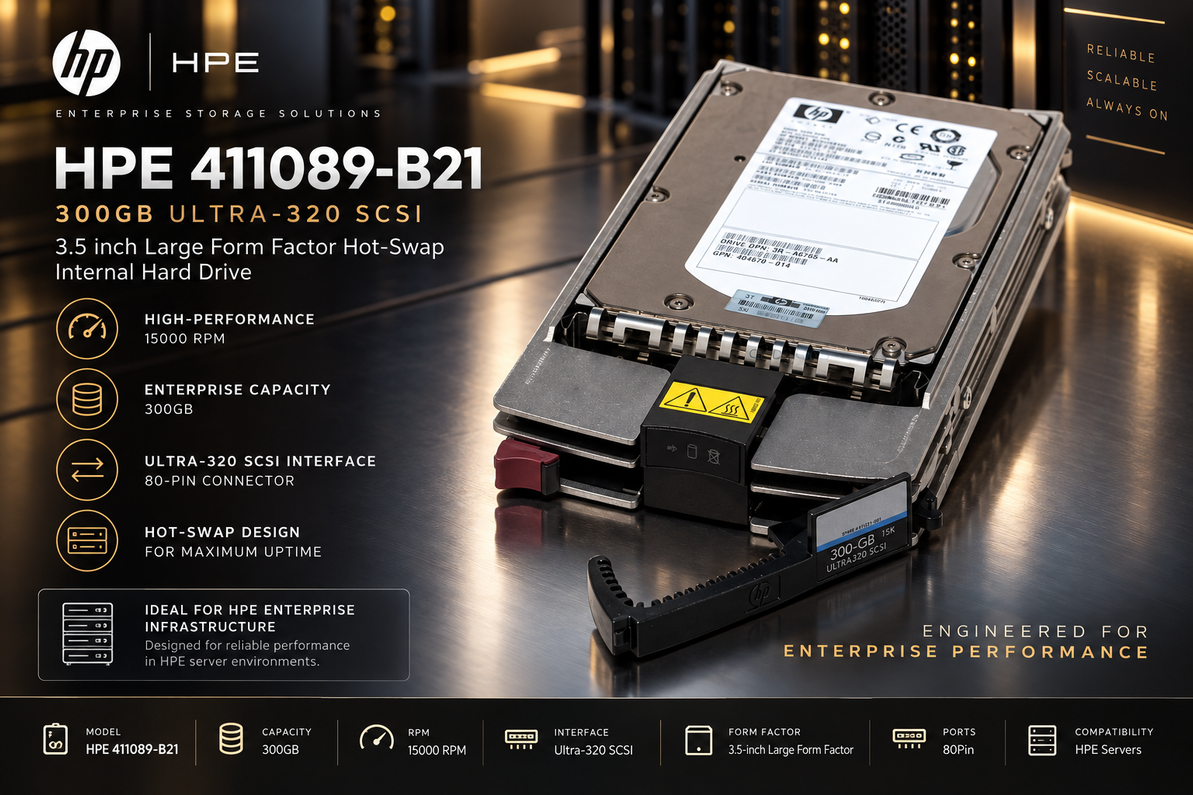
The HPE 411089-B21 300GB 15000RPM 3.5-inch Large Form Factor Ultra-320 SCSI 80-Pin Hot-Swap Internal Hard Drive is a storage component designed for environments that require traditional enterprise hard disk technology. With its 300GB capacity, 15,000 RPM rotational speed, Ultra-320 SCSI interface, and 80-pin connection, this drive represents a practical option for maintaining compatible legacy storage systems.
For IT administrators, data center technicians, and businesses operating older infrastructure, selecting the correct replacement hard drive can help reduce unnecessary hardware upgrades and preserve established storage configurations. Understanding the specifications, intended use cases, and compatibility requirements of the HPE 411089-B21 is essential before integrating it into an existing system.
Understanding the HPE 411089-B21 Hard Drive
The HPE 411089-B21 is identified by its 300GB storage capacity, 15,000 RPM rotational speed, 3.5-inch Large Form Factor design, Ultra-320 SCSI interface, and 80-pin connection. These specifications distinguish it from newer SAS and SATA drives, which use different interfaces and connection standards.
Product Specifications at a Glance
|
Specification |
Details |
|---|---|
|
Manufacturer |
HPE |
|
Part number |
411089-B21 |
|
Storage capacity |
300GB |
|
Rotational speed |
15,000 RPM |
|
Form factor |
3.5-inch Large Form Factor (LFF) |
|
Interface |
Ultra-320 SCSI |
|
Connector |
80-pin |
|
Drive type |
Internal hard disk drive (HDD) |
|
Installation type |
Hot-swap, subject to compatible system support |
These specifications provide a starting point for identifying the drive and comparing it with an existing storage component. Before purchasing a replacement, administrators should verify the original drive's part number, connector, mounting arrangement, and system requirements.
300GB Capacity: Practical Storage for Established Workloads
Supporting Legacy Applications and Business Data
The 300GB capacity of the HPE 411089-B21 is suited to specific legacy enterprise storage requirements. While modern applications may demand several terabytes of capacity, older operating systems, specialized business applications, and established storage arrays may not require such large individual drives.
A compatible 300GB hard drive can support application data, frequently accessed business files, legacy databases, and other workloads where the storage architecture was designed around smaller drive capacities.
For businesses maintaining older servers, replacing a failed drive with a component that closely matches the original configuration may also simplify maintenance. It can help avoid unnecessary changes to existing storage layouts, provided that the replacement is supported by the host system.
A Sensible Choice for Targeted Replacement Projects
Replacing one failed drive does not always require rebuilding an entire storage environment. In some cases, an appropriately matched replacement can help restore an existing configuration while allowing the organization to plan a larger migration separately.
The HPE 411089-B21 may therefore be relevant to organizations that need to maintain specific legacy equipment, provided its compatibility has been confirmed.
15,000 RPM Rotational Speed: Designed for Responsive Disk Access
How Rotational Speed Affects Performance
One of the defining characteristics of the HPE 411089-B21 is its 15,000 RPM spindle speed. Traditional hard disk drives store data on rotating magnetic platters, and the time required for a platter to rotate into position influences how quickly the drive can access requested information.
A higher rotational speed generally reduces rotational latency, which can benefit workloads involving frequent random read and write operations.
At 15,000 RPM, the drive offers a nominal average rotational latency of approximately 2 milliseconds, excluding seek time, controller processing, and other system delays. This characteristic made 15K RPM drives useful in enterprise environments where responsive access to frequently requested data was important.
Where 15K RPM Drives Can Be Useful
High rotational speed can be beneficial for certain transaction-oriented applications, older database workloads, and established business systems that perform numerous small disk operations.
However, actual performance depends on more than spindle speed. Controller capabilities, disk condition, workload patterns, queue depth, and the surrounding storage architecture all influence overall results.
It is also important to recognize that a 15,000 RPM mechanical hard drive does not offer the same access characteristics as a modern solid-state drive. For new systems requiring consistently low latency, an SSD may be a more appropriate option. For compatible legacy infrastructure, however, matching the original drive technology can remain a practical maintenance decision.
Ultra-320 SCSI Interface: Maintaining Legacy Enterprise Connectivity
What Is Ultra-320 SCSI?
Ultra-320 SCSI is a parallel Small Computer System Interface standard developed for high-performance storage and peripheral connectivity. It supports a nominal maximum signaling rate of 320MB/s on the SCSI bus under appropriate conditions.
This interface belongs to an earlier generation of enterprise storage technology, preceding the widespread adoption of SAS and SATA connections in many server environments.
The HPE 411089-B21's Ultra-320 SCSI interface is therefore an important compatibility consideration. A drive with this interface cannot be assumed to work in a server or storage enclosure designed exclusively for SAS or SATA drives.
Why Interface Compatibility Matters
When replacing a legacy hard drive, the interface must match the requirements of the host controller and storage enclosure. Even when two drives share the same physical dimensions, their electrical interfaces and communication protocols may differ.
Before installing the HPE 411089-B21, confirm that the existing SCSI controller supports the appropriate Ultra-320 standard and that the system's backplane, cabling, and firmware support the intended drive.
The 320MB/s figure describes the nominal interface rate, not the guaranteed sustained transfer speed of the mechanical drive. Actual data throughput depends on the drive itself, the controller, the workload, and other devices sharing the bus.
3.5-Inch Large Form Factor Design: Built for Compatible Storage Bays
Understanding the LFF Form Factor
The 3.5-inch Large Form Factor designation identifies the drive's general physical size category. LFF drives are commonly associated with larger drive bays than 2.5-inch Small Form Factor drives.
For legacy enterprise systems, maintaining the correct form factor is important because the drive must fit the intended mounting assembly and align with the system's connection mechanism.
The HPE 411089-B21's 3.5-inch format makes physical compatibility an important part of the replacement process. Administrators should compare the drive with the existing unit, including the carrier, mounting points, and connector arrangement.
Why the Carrier and Installation Assembly Matter
Enterprise hard drives may be supplied with a specific carrier or tray that helps secure the drive inside a server or storage enclosure. These assemblies can vary between product families and hardware generations.
A drive that appears physically similar to the original may still require a different carrier or may not align correctly with the system's backplane.
For this reason, buyers should verify whether the HPE 411089-B21 listing includes the required hot-swap carrier and whether that carrier is appropriate for their specific hardware. The part number and physical appearance alone should not be treated as proof of compatibility with every HPE server.
80-Pin Connection and Hot-Swap Installation
Understanding the 80-Pin Connector
The 80-pin connection is a defining detail of this drive's interface configuration. In traditional enterprise SCSI systems, an 80-pin connector is associated with Single Connector Attachment (SCA), which combines the drive's data and power connections in one interface.
This arrangement simplifies installation in compatible drive bays by allowing the drive to connect through a suitable backplane rather than requiring separate data and power cables at the drive itself.
Because SCSI implementations differ, the exact connector and mounting arrangement should be checked against the original hardware before ordering a replacement.
What Hot-Swap Capability Means
Hot-swap storage allows a supported drive to be removed and replaced while the host system remains powered on, without requiring a complete system shutdown. This capability can be particularly valuable in enterprise environments where downtime affects business operations.
However, hot-swapping is not determined by the drive alone. It depends on the server or storage enclosure, its backplane, controller, firmware, operating system, and supported maintenance procedures.
Before removing or inserting the HPE 411089-B21, administrators should confirm that the host supports hot-swap operation and follow the manufacturer's instructions. In redundant storage configurations, the system should also be checked for degraded-array status, rebuild activity, and other conditions that could affect data availability.
Enterprise Applications for the HPE 411089-B21
The HPE 411089-B21 is most relevant to organizations that need to preserve compatible legacy storage infrastructure rather than build a new storage platform around older technology.
Legacy Server Maintenance
Organizations sometimes continue to use older servers because they run specialized software, support established business processes, or depend on hardware that cannot be replaced immediately.
In these environments, a compatible replacement drive can help maintain service continuity while the organization evaluates future infrastructure requirements.
Older Database and Transaction Systems
Some legacy database applications were developed and optimized around mechanical SCSI storage. The 15,000 RPM rotational speed of the HPE 411089-B21 may be relevant to systems that rely on responsive random disk access.
Actual suitability depends on the application's I/O requirements, controller configuration, and the performance characteristics of the complete storage subsystem.
Specialized Business Applications
Manufacturing systems, laboratory equipment, older financial applications, and other specialized installations may depend on established server platforms that are difficult to migrate quickly.
For these applications, maintaining the original storage interface and physical configuration can be more important than choosing the newest available technology.
Legacy Storage Infrastructure
The drive may also be considered for compatible older storage systems where the existing architecture requires an Ultra-320 SCSI device with an appropriate 80-pin connection.
System-level support must be verified before purchase. Compatibility should never be inferred solely from the HPE brand or 3.5-inch dimensions.
Key Benefits of the HPE 411089-B21
High Rotational Speed
The 15,000 RPM spindle speed provides lower rotational latency than slower mechanical drives, making it a relevant specification for certain legacy workloads requiring frequent disk access.
Established SCSI Connectivity
Ultra-320 SCSI provides a defined interface standard for compatible older enterprise systems. Matching this interface can help avoid unnecessary changes to a legacy storage architecture.
Practical Capacity for Targeted Replacements
The 300GB capacity may suit existing systems with relatively modest per-drive storage requirements, especially when preserving the original configuration is the priority.
Hot-Swap Design for Supported Systems
When installed in a compatible hot-swap enclosure, the drive can support replacement procedures that help reduce the need for complete system shutdowns.
A Potentially Cost-Effective Maintenance Option
For organizations that must continue operating older hardware, a compatible replacement drive may be more economical in the short term than replacing an entire server or storage platform.
The financial benefit depends on the drive's condition, price, availability, and the remaining useful life of the system. For critical applications, organizations should also account for the risks associated with maintaining aging hardware.
What to Check Before Buying the HPE 411089-B21
Selecting an enterprise hard drive requires more than matching its capacity and physical size. The following checks can help reduce compatibility problems.
Verify the Exact Part Number
Confirm that the required component is HPE 411089-B21 and compare it with the part number on the existing drive or the system's official documentation. Similar-looking drives can use different interfaces or carrier configurations.
Confirm Controller and Backplane Support
Check that the server or storage enclosure supports Ultra-320 SCSI and the drive's 80-pin connection. Do not assume compatibility with SAS or SATA systems.
Check the Carrier and Physical Configuration
Verify whether the required carrier is included and whether it fits the target drive bay. The carrier, connector alignment, and mounting assembly should match the intended system.
Review Drive Condition and Testing
When purchasing refurbished or used enterprise hardware, ask about testing procedures, health checks, warranty coverage, and return policies. A drive's age and previous workload can influence its remaining service life.
Where possible, review available drive diagnostics and error information before placing the device into production.
Plan for Backup and Data Protection
A replacement drive is not a substitute for a reliable backup strategy. Before servicing an existing system, confirm that important data is backed up and that the recovery process has been tested.
If the drive will be used in a RAID array, verify the array's health and follow the controller manufacturer's replacement and rebuild procedures.
HPE 411089-B21 vs. Modern Storage Technologies
The HPE 411089-B21 belongs to a legacy storage category, so its suitability depends on the requirements of the system it will serve.
|
Feature |
HPE 411089-B21 |
Modern SATA or SAS SSD |
|---|---|---|
|
Storage technology |
Mechanical HDD |
Solid-state flash |
|
Capacity |
300GB |
Varies by model |
|
Rotational speed |
15,000 RPM |
Not applicable |
|
Interface |
Ultra-320 SCSI |
SATA or SAS, depending on model |
|
Mechanical latency |
Present |
No mechanical seek or rotational latency |
|
Best-fit scenario |
Compatible legacy infrastructure |
Supported modern systems and workloads |
An SSD will generally offer substantially lower access latency than a mechanical hard drive. Nevertheless, a modern SSD is not automatically a drop-in replacement for an Ultra-320 SCSI drive. Differences in interface, backplane, controller support, firmware, and physical configuration can prevent direct installation.
The most appropriate choice depends on whether the priority is preserving existing hardware, improving performance, increasing capacity, or modernizing the entire storage platform.
Installation and Maintenance Best Practices
Follow the System's Service Procedures
Before replacing a drive, consult the documentation for the specific server or storage enclosure. Identify the correct bay and confirm that the system supports hot-swap operation.
Use appropriate electrostatic discharge precautions when handling the drive and its carrier.
Monitor Drive and Array Health
After installation, check the controller's status indicators and system management utilities. Confirm that the drive is recognized and that any associated storage array returns to its expected state.
If a rebuild is required, monitor its progress and avoid unnecessary interruptions.
Maintain Environmental Conditions
Enterprise hard drives depend on appropriate operating temperatures, airflow, and vibration control. Ensure that the server's cooling system is functioning correctly and that the drive is installed securely.
Establish a Replacement Strategy
Legacy hardware can become increasingly difficult to source as it ages. Organizations that rely on older SCSI systems should evaluate spare-drive availability, backup procedures, support requirements, and migration timelines before an unexpected failure occurs.
A planned transition is generally easier to manage than an emergency replacement after a critical component fails.
Is the HPE 411089-B21 the Right Hard Drive for Your System?
The HPE 411089-B21 is worth considering when an existing system specifically requires a 300GB, 15,000 RPM, 3.5-inch Ultra-320 SCSI hard drive with an 80-pin connection.
Its most compelling advantage is its relevance to compatible legacy infrastructure. It may help administrators maintain established systems, support older business applications, and replace failed storage components without immediately redesigning the entire environment.
However, it is not a universal enterprise hard drive. Its SCSI interface limits its use in modern systems, and the correct carrier and host compatibility must be verified before purchase.
For new infrastructure, organizations should generally evaluate modern SAS or SATA hard drives and SSDs according to their performance, capacity, reliability, and support requirements. For existing legacy systems, matching the original interface and configuration may be the most practical choice.
Conclusion: Keeping Legacy Enterprise Storage Working
Enterprise infrastructure does not always advance at the same pace as technology. Some systems must remain operational long after newer storage standards become commonplace, making compatible replacement components essential for maintenance and continuity.
The HPE 411089-B21 300GB 15000RPM 3.5-inch Large Form Factor Ultra-320 SCSI 80-Pin Hot-Swap Internal Hard Drive offers a combination of 300GB capacity, high rotational speed, traditional SCSI connectivity, and a hot-swap-oriented installation design for supported systems.
For IT professionals maintaining compatible legacy servers and storage environments, it can be a relevant replacement option when the exact interface, connector, carrier, and host requirements are satisfied. Careful compatibility checks, routine monitoring, and reliable backups remain essential to ensuring that older storage infrastructure continues to meet business needs.
Whether you are replacing a failed drive or maintaining a specialized legacy platform, choosing the correct hardware helps protect the value of your existing IT investment while giving you time to plan future upgrades.
Recent Posts
-
HPE 411089-B21: Reviving Enterprise Storage with 300GB of 15K RPM Ultra-320 SCSI Performance
Introduction: Reliable Storage for Demanding Enterprise Environments In enterprise IT, storage relia …Oct 29th 2026 -
HPE AG690B: The 15K Storage Powerhouse Keeping Enterprise Data Within Reach
Introduction: Reliable Performance for Enterprise Storage Systems Behind every dependable enterprise …Oct 28th 2026 -
HPE AG690A: The High-Speed Storage Workhorse That Keeps Enterprise Data Moving
Introduction: Built for Demanding Enterprise Storage In enterprise storage environments, dependable …Oct 24th 2026