
Beyond the Spin: The Hidden Power of the HPE AG718A in Legacy Enterprise Storage
Keeping Enterprise Storage in Motion: The HPE AG718A 300GB Fibre Channel Drive and Its Role in Reliable Data Infrastructure
Enterprise storage is more than simply having enough space to save information. It requires dependable hardware, consistent data access, and components that work seamlessly within a carefully designed infrastructure. From business databases and application servers to established storage area networks, organizations depend on storage devices that can support their operational requirements without introducing unnecessary complexity.
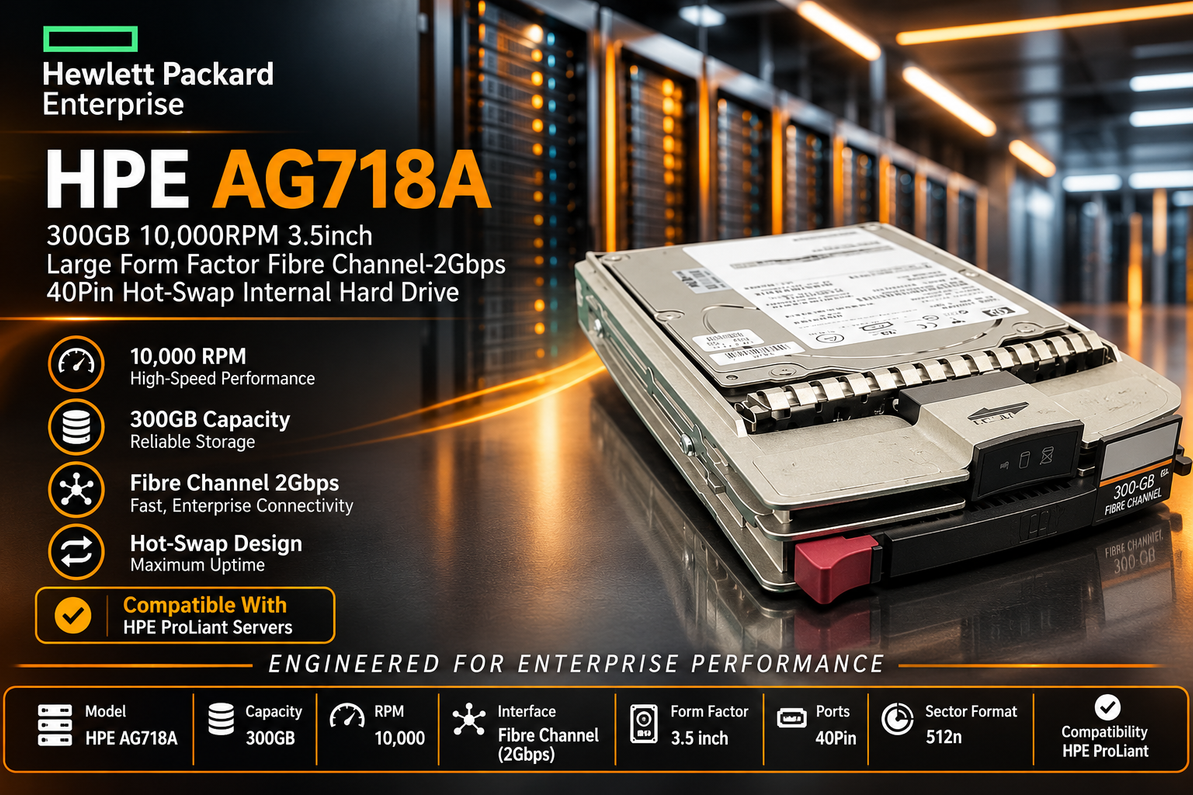
The HPE AG718A 300GB 10000RPM 3.5-inch Large Form Factor Fibre Channel-2Gbps 40-Pin Hot-Swap Internal Hard Drive is designed for compatible enterprise storage environments that rely on traditional Fibre Channel technology. Combining a 300GB storage capacity with a 10,000RPM rotational speed, this drive provides a specialized storage option for organizations maintaining established HPE infrastructure.
Its 3.5-inch Large Form Factor design, 2Gbps Fibre Channel interface, and hot-swap configuration make it particularly relevant to legacy enterprise storage systems where component compatibility is essential. Rather than replacing an entire storage platform, businesses can use appropriately matched replacement hardware to maintain their existing infrastructure.
Although modern SSDs and high-speed NVMe devices dominate discussions about storage performance, traditional enterprise hard drives continue to serve an important purpose. For organizations operating compatible older systems, the HPE AG718A represents a practical way to preserve existing storage investments while keeping essential applications and services running.
Understanding the HPE AG718A 300GB Fibre Channel Hard Drive
A Storage Solution Designed for Enterprise Infrastructure
The HPE AG718A is a 300GB enterprise hard drive featuring a 10,000RPM spindle speed and a Fibre Channel-2Gbps interface. Unlike conventional desktop hard drives, which generally use SATA connections, this model is intended for compatible enterprise storage configurations built around Fibre Channel technology.
Fibre Channel has historically been an important part of enterprise storage architecture. It allows servers and storage systems to communicate through dedicated storage networks, providing an organized approach to managing business information across multiple systems.
The AG718A combines this connectivity with a traditional mechanical hard drive architecture. Its purpose is not simply to provide additional storage capacity but to serve as a compatible component within an established enterprise environment.
Why 300GB Capacity Still Matters
A 300GB hard drive might seem relatively small compared with today's multi-terabyte storage devices. However, capacity requirements depend heavily on the intended application and the infrastructure in which a drive operates.
Many established enterprise systems were designed around specific drive capacities, interfaces, and physical configurations. Replacing an existing drive with a compatible 300GB model can be more practical than introducing an entirely different storage technology.
The HPE AG718A can provide dedicated storage for compatible business applications, operational information, databases, and other workloads where its capacity meets the system requirements.
For organizations maintaining older storage arrays, matching the original drive specifications can be more important than selecting a drive with the largest available capacity.
Key Features That Make the HPE AG718A a Specialized Enterprise Drive
10,000RPM Rotational Speed for Responsive Storage
One of the defining features of the HPE AG718A is its 10,000RPM rotational speed. Mechanical hard drives store information on rotating magnetic platters, and the speed at which these platters rotate influences how quickly the drive can locate requested data.
At 10,000 revolutions per minute, the AG718A is designed to provide faster rotational access than conventional 5,400RPM and 7,200RPM desktop hard drives.
This characteristic can be useful in enterprise environments where applications regularly retrieve information, update database records, and perform repeated read and write operations.
Higher rotational speed helps reduce rotational latency, although actual storage performance also depends on seek time, controller capabilities, workload patterns, and the overall storage configuration.
For businesses maintaining traditional mechanical storage infrastructure, a 10,000RPM drive offers a performance-oriented option suited to its intended environment.
2Gbps Fibre Channel Interface for Enterprise Connectivity
Fibre Channel is a storage networking technology widely adopted in traditional enterprise data centers. It was developed to provide dedicated communication between servers and storage devices, making it particularly useful for storage area network environments.
The HPE AG718A features a 2Gbps Fibre Channel interface, designed for compatible storage systems using this generation of Fibre Channel connectivity.
Unlike standard SATA drives, Fibre Channel drives operate within specialized storage architectures. This distinction is important when selecting replacement hardware because the interface, controller, drive enclosure, and firmware must support the same configuration.
For businesses operating older Fibre Channel infrastructure, the AG718A provides a matching interface option where system compatibility is confirmed.
3.5-Inch Large Form Factor for Compatible Storage Enclosures
The 3.5-inch Large Form Factor design makes the AG718A suitable for compatible enterprise storage enclosures built around LFF drive assemblies.
Physical compatibility is an important consideration in enterprise hardware purchasing. Two hard drives can have identical capacities and rotational speeds while using completely different connectors, mounting systems, and interface technologies.
The AG718A is designed for its corresponding 3.5-inch drive configuration. Organizations should verify the enclosure and drive carrier requirements before selecting it as a replacement.
40-Pin Connection for Specialized Storage Hardware
Another important characteristic is its 40-pin connection.
Enterprise Fibre Channel hardware often uses specialized connectors and drive assemblies that differ from the interfaces found in ordinary desktop computers.
This means the AG718A should not be treated as a standard SATA hard drive. Its 40-pin configuration must match the intended storage system and associated hardware.
Checking the connector and original drive part number before purchasing can help prevent installation problems and unnecessary returns.
Hot-Swap Design for Convenient Maintenance
Enterprise storage systems are expected to support maintenance with minimal disruption. Hot-swap functionality helps achieve this by allowing compatible drives to be removed and replaced while the storage system remains powered on.
The HPE AG718A's hot-swap configuration makes it suitable for supported storage environments where drive replacement is part of routine maintenance.
This can be particularly useful for organizations operating business-critical applications that cannot afford unnecessary system shutdowns.
Hot-swapping must always be performed according to the storage enclosure's procedures, and the system must support the specific replacement configuration.
How the HPE AG718A Supports Enterprise Storage Performance
Supporting Business Databases and Applications
Databases are among the most storage-intensive components of many business environments. They continuously process information, retrieve records, update files, and respond to application requests.
The HPE AG718A's 10,000RPM rotational speed makes it a suitable consideration for compatible legacy database infrastructure designed around mechanical enterprise drives.
Its Fibre Channel interface also makes it relevant to storage environments where information is accessed through dedicated storage networking infrastructure.
Actual database performance will depend on the number of drives, RAID configuration, controller capabilities, cache, and application workload.
Maintaining Traditional Storage Area Networks
Storage area networks allow multiple servers to access centralized storage resources. This architecture has been widely used in enterprise data centers because it separates storage resources from individual server configurations.
Fibre Channel has played a significant role in these environments, particularly where organizations require dedicated storage connectivity.
The AG718A's 2Gbps interface is intended for compatible Fibre Channel infrastructure. It can serve as a replacement component in supported configurations where maintaining the original interface and drive specifications is important.
Helping Extend the Life of Existing IT Infrastructure
Replacing enterprise infrastructure can require substantial financial investment, planning, and migration work.
For organizations operating older HPE storage platforms, replacing an individual failed hard drive may be more economical than upgrading an entire storage environment.
The AG718A offers an option for maintaining compatible systems that continue to perform their intended functions.
This approach can help businesses postpone unnecessary infrastructure changes while planning a more comprehensive hardware upgrade when the time is appropriate.
Practical Applications of the HPE AG718A Hard Drive
Legacy Enterprise Storage Systems
Older enterprise storage systems often depend on specific drive models and interface technologies. Replacing a failed component with a compatible drive helps preserve the original system configuration.
The HPE AG718A is particularly relevant to this type of maintenance requirement.
Before purchasing, organizations should confirm that their particular storage array supports the AG718A and its 2Gbps Fibre Channel connection.
Business Data Storage
Enterprise applications generate different types of information, including customer records, operational documents, application files, and transaction data.
The AG718A can provide storage capacity for compatible workloads where 300GB is sufficient.
Its suitability depends on the requirements of the application and the storage architecture rather than capacity alone.
Established Server and Storage Environments
Many businesses continue to operate older IT equipment because their existing applications and business processes depend on it.
In these environments, hardware compatibility can be a major purchasing consideration.
The AG718A provides a specialized replacement option for supported enterprise storage configurations rather than serving as a universal hard drive for modern servers.
HPE AG718A vs. Modern Enterprise Storage Technologies
Enterprise storage has changed significantly over the years. Modern systems increasingly rely on solid-state drives, NVMe technology, and faster storage networking interfaces.
However, traditional Fibre Channel hard drives still have a place in organizations maintaining compatible legacy infrastructure.
|
Feature |
HPE AG718A |
|---|---|
|
Storage technology |
Mechanical HDD |
|
Capacity |
300GB |
|
Rotational speed |
10,000RPM |
|
Form factor |
3.5-inch LFF |
|
Interface |
Fibre Channel |
|
Interface speed |
2Gbps |
|
Connection |
40-pin |
|
Installation type |
Hot-swap |
|
Intended application |
Compatible enterprise storage systems |
Traditional HDD vs. Enterprise SSD
Enterprise SSDs offer substantially lower access latency and faster random data access than mechanical hard drives. They are particularly attractive for virtualization, demanding databases, and high-performance applications.
However, upgrading an older Fibre Channel storage system to SSD technology is not always a straightforward process.
The controller, firmware, enclosure, interface, and supported drive types must all be considered.
For organizations that simply need to replace an existing compatible mechanical drive, the AG718A can offer a more straightforward maintenance option.
Why Compatibility Can Be More Important Than Capacity
A larger storage device is not necessarily a better replacement.
Enterprise storage systems may depend on specific drive characteristics, supported firmware, physical assemblies, and interface configurations. Installing an incompatible drive can result in recognition problems or operational issues.
Matching the original hardware requirements helps maintain predictable storage behavior.
For this reason, organizations should prioritize compatibility before considering alternative capacities or newer storage technologies.
Important Considerations Before Purchasing the HPE AG718A
Verify the Exact Drive Model
Enterprise hard drives can have similar specifications while using different part numbers and connectors.
Always compare the existing drive label with the replacement model. Confirm that the AG718A is supported by the intended storage system.
Check the Fibre Channel Compatibility
The 2Gbps Fibre Channel interface is an essential part of this drive's specification.
Make sure the target enclosure and controller support the required Fibre Channel configuration. A standard SATA or SAS connection cannot be assumed to work as a substitute.
Confirm the Drive Carrier and Physical Configuration
The 3.5-inch LFF form factor and 40-pin connection should match the intended drive bay and assembly.
Checking these details before ordering can help avoid compatibility issues.
Consider the Condition of the Replacement Drive
When purchasing older enterprise hard drives, condition matters.
Buyers should check whether the drive is new, refurbished, or used, and request appropriate testing or condition information. It is also sensible to verify the seller's warranty and return policy.
For important business workloads, appropriate backups and storage redundancy should remain in place regardless of the replacement drive's condition.
Best Practices for Maintaining Enterprise Hard Drives
Maintain Proper Cooling
Mechanical drives generate heat during operation. Adequate airflow within the storage enclosure helps maintain suitable operating temperatures.
Keep ventilation paths clear and ensure that the cooling system is functioning correctly.
Monitor Drive Health
Regular monitoring helps administrators identify potential storage problems before they cause major interruptions.
Check available controller alerts, drive status information, and diagnostic reports as part of routine maintenance.
Use RAID and Backup Protection
RAID configurations can help maintain storage availability when individual drives fail, depending on the selected RAID level.
However, RAID is not a replacement for backups. Businesses should maintain independent backup copies and periodically test their recovery procedures.
Follow Manufacturer Maintenance Procedures
Drive replacement should follow the recommended procedures for the specific storage enclosure.
This is particularly important when working with older Fibre Channel systems, where drive initialization, rebuild procedures, and controller compatibility may differ between platforms.
Is the HPE AG718A 300GB 10000RPM Hard Drive Still a Worthwhile Choice?
The HPE AG718A remains worth considering for businesses and IT professionals who need to maintain compatible legacy Fibre Channel storage systems.
Its 300GB capacity, 10,000RPM rotational speed, 2Gbps Fibre Channel connectivity, and hot-swap design make it a specialized component for older enterprise storage infrastructure.
It is not intended to compete with modern NVMe SSDs in terms of speed or storage density. Its real value lies in providing a compatible replacement option for systems designed around traditional Fibre Channel hard drives.
For data centers, IT maintenance teams, and businesses operating established HPE storage equipment, sourcing the correct replacement drive can help avoid unnecessary infrastructure changes and extend the useful life of existing hardware.
Final Thoughts: Keeping Enterprise Storage Reliable, One Drive at a Time
Enterprise technology is constantly evolving, but older hardware does not automatically lose its usefulness when newer products arrive. Many organizations continue to depend on established storage infrastructure because it supports applications and business processes that remain essential.
The HPE AG718A 300GB 10000RPM 3.5-inch Large Form Factor Fibre Channel-2Gbps 40-Pin Hot-Swap Internal Hard Drive represents a generation of enterprise storage technology built around dedicated connectivity, mechanical performance, and convenient hardware maintenance.
With its 10,000RPM rotational speed, 300GB capacity, specialized Fibre Channel interface, and hot-swap configuration, it offers a practical replacement option for compatible legacy storage systems.
For organizations looking to maintain existing infrastructure, the AG718A is a reminder that dependable IT operations are not always about adopting the newest technology. Sometimes, the right component is simply the one that keeps an established system performing as intended.
Recent Posts
-
The Enterprise Storage Workhorse: Exploring the HPE AD535A 300GB Fibre Channel Drive and Its Legacy of Performance
HPE AD535A: Reviving Enterprise Storage Performance with 300GB of High-Speed Fibre Channel Power In …Nov 2nd 2026 -
Beyond the Spin: The Hidden Power of the HPE AG718A in Legacy Enterprise Storage
Keeping Enterprise Storage in Motion: The HPE AG718A 300GB Fibre Channel Drive and Its Role in Relia …Nov 1st 2026 -
HPE 411089-B21: Reviving Enterprise Storage with 300GB of 15K RPM Ultra-320 SCSI Performance
Introduction: Reliable Storage for Demanding Enterprise Environments In enterprise IT, storage relia …Oct 29th 2026