
HPE R0Q21A 14TB 7200RPM SAS Hard Drive: Unlocking Massive Storage Capacity for Modern Enterprise SAN Environments
Modern businesses generate enormous volumes of data, making dependable, high-capacity storage an essential part of enterprise IT infrastructure. From virtualization platforms and business applications to backup repositories and large-scale databases, organizations need storage devices that can accommodate growing workloads without compromising reliability or performance.
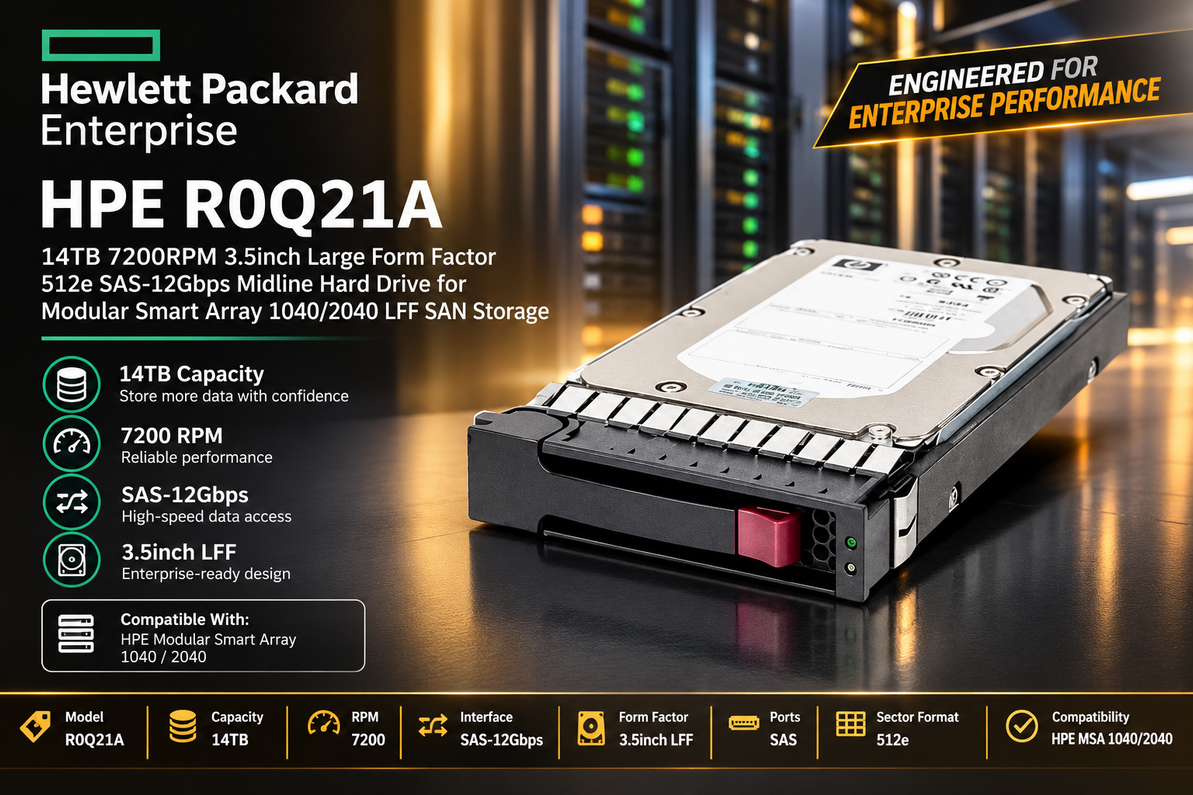
The HPE R0Q21A 14TB 7200RPM 3.5-inch Large Form Factor (LFF) 512e SAS-12Gbps Midline Hard Drive is designed for enterprise storage environments that require substantial capacity and dependable data access. Built for compatible HPE Modular Smart Array (MSA) storage platforms, including the MSA 1040 and MSA 2040 LFF SAN systems, this drive offers a high-capacity storage option for organizations looking to expand their existing infrastructure.
With 14TB of storage capacity, a 7200RPM rotational speed, and a 12Gbps SAS interface, the HPE R0Q21A provides an attractive combination of storage density, connectivity, and enterprise-oriented functionality. It can help businesses consolidate large datasets, expand storage pools, and support capacity-focused workloads while making better use of their existing SAN investment.
Whether an organization is expanding its data center, upgrading an existing storage array, or planning additional capacity for growing business requirements, understanding the capabilities of this HPE drive can help IT professionals make informed infrastructure decisions.
HPE R0Q21A 14TB Hard Drive: Key Specifications and Features
The HPE R0Q21A combines high storage capacity with a SAS interface designed for enterprise storage infrastructure. Its 3.5-inch LFF design makes it suitable for compatible storage enclosures that support large-form-factor drives, while its Midline classification makes it particularly relevant to capacity-oriented storage applications.
Here is an overview of its primary specifications.
|
Specification |
Details |
|---|---|
|
Manufacturer |
HPE (Hewlett Packard Enterprise) |
|
Option Part Number |
R0Q21A |
|
Spare Part Number |
P11785-001 |
|
Storage Capacity |
14TB |
|
Drive Type |
Midline HDD |
|
Form Factor |
3.5-inch LFF |
|
Rotational Speed |
7200RPM |
|
Interface |
SAS |
|
Interface Speed |
12Gbps |
|
Sector Format |
512e |
|
Drive Technology |
Helium-filled |
|
Drive Features |
Dual Port, Advanced Format |
|
Hot-Swap |
Hot-pluggable |
|
Carrier |
Standard HPE MSA Carrier |
14TB Storage Capacity for Growing Data Requirements
One of the biggest advantages of the HPE R0Q21A is its impressive 14TB storage capacity. Enterprise environments often need to retain years of business records, application data, virtual machine files, backups, and archived information. As these requirements grow, adding storage capacity becomes an important part of infrastructure planning.
With 14TB available on a single drive, organizations can expand their storage resources while reducing the number of individual disks required to achieve a particular capacity target. This can help simplify storage expansion, improve rack-space utilization, and reduce the complexity associated with managing numerous lower-capacity drives.
For example, a six-drive configuration provides 84TB of raw capacity before RAID overhead, formatting, and other storage reservations. This makes high-capacity drives particularly attractive for businesses building or expanding large storage pools.
7200RPM Rotational Speed for Consistent Storage Performance
The HPE R0Q21A operates at 7200 revolutions per minute (RPM), providing a practical balance between performance, capacity, and operating efficiency.
Although it does not offer the rotational speed of 10K or 15K enterprise HDDs, a 7200RPM drive is well suited to workloads that prioritize storage capacity over extremely low access latency.
Typical applications include backup repositories, file storage, document management, archived business information, and capacity-oriented SAN environments.
For organizations managing large amounts of relatively infrequently accessed information, choosing 7200RPM Midline drives can be a sensible way to expand storage without automatically investing in more expensive performance-oriented disks.
SAS-12Gbps Interface for Enterprise Connectivity
Connectivity is another important feature of the HPE R0Q21A. Its SAS-12Gbps interface supports a theoretical interface signaling rate of up to 12 gigabits per second.
Serial Attached SCSI (SAS) is widely used in enterprise storage environments because it offers features designed for professional storage infrastructure, including robust device communication and support for dual-port configurations.
The 12Gbps interface provides substantial bandwidth between the drive and a compatible storage controller. However, actual application performance depends on several factors, including the drive's mechanical characteristics, controller capabilities, RAID configuration, and workload.
For businesses operating shared storage systems, SAS connectivity offers a familiar foundation for integrating additional capacity into supported enterprise storage environments.
Understanding 512e Advanced Format Technology
The HPE R0Q21A uses the 512e sector format, an important consideration when integrating high-capacity storage into existing enterprise infrastructure.
512e stands for 512-byte emulation. The drive uses 4K physical sectors while presenting 512-byte logical sectors to the host system. This approach helps maintain compatibility with operating systems and applications designed around traditional 512-byte logical sectors.
The technology also supports more efficient physical sector organization compared with older native 512-byte recording formats.
However, correct alignment is important. Applications that perform poorly aligned writes may experience additional read-modify-write operations, potentially affecting performance.
Before deployment, IT administrators should verify that the operating system, storage controller, and array firmware properly support 512e drives.
Large Form Factor Design for Compatible HPE Storage Systems
The 3.5-inch Large Form Factor design makes the HPE R0Q21A suitable for storage enclosures equipped with compatible LFF drive bays.
LFF drives are frequently used in capacity-focused enterprise storage systems because their physical design accommodates high-capacity HDD configurations.
The drive is supplied with an HPE MSA carrier, helping simplify installation into supported storage enclosures. Its hot-pluggable design also supports drive replacement and maintenance without requiring a complete system shutdown, provided the host storage platform supports hot-swap operation and the appropriate maintenance procedures are followed.
For organizations expanding an existing SAN, maintaining the correct drive form factor and carrier compatibility is essential.
Why Choose the HPE R0Q21A 14TB Midline Hard Drive?
Choosing an enterprise hard drive involves more than comparing capacity and interface speeds. Businesses must consider compatibility, workload requirements, storage efficiency, maintenance, and long-term infrastructure planning.
The HPE R0Q21A offers several advantages for organizations looking to increase storage capacity.
High-Capacity Storage in a Single Drive
With 14TB of available capacity, this drive provides an effective option for organizations managing large datasets. Fewer drives may be needed to achieve a particular raw storage target, potentially simplifying storage expansion and reducing the number of drive bays required.
Enterprise SAS Connectivity
The SAS-12Gbps interface is designed for compatible enterprise storage controllers and enclosures. Its dual-port capability also supports storage architectures that use redundant SAS paths, where supported by the surrounding infrastructure.
Practical Midline Storage Architecture
Midline HDDs are designed with capacity-oriented applications in mind. They provide a useful alternative for workloads that need substantial storage space but do not require the performance characteristics of high-speed enterprise SSDs or 15K HDDs.
Convenient Hot-Swap Maintenance
Hot-pluggable functionality can help simplify drive replacement and routine storage maintenance. In supported storage arrays, administrators can replace a failed drive without shutting down the entire storage system.
Support for Storage Expansion
The HPE R0Q21A can be considered when planning additional storage capacity for compatible HPE MSA infrastructure. Its large capacity makes it particularly useful for organizations seeking to extend existing storage resources rather than immediately replacing their entire storage platform.
Ideal Applications of the HPE R0Q21A 14TB SAS Hard Drive
Not every enterprise workload requires the same storage characteristics. While SSDs and high-performance SAS drives are often preferred for latency-sensitive applications, high-capacity Midline HDDs remain useful for many business storage requirements.
The HPE R0Q21A is particularly relevant to the following applications.
Enterprise Backup and Recovery
Backup environments require considerable storage capacity because businesses regularly create copies of databases, virtual machines, operating systems, and application data.
A 14TB HDD can provide substantial space for backup repositories and scheduled backup operations. Organizations can use compatible storage arrays to consolidate backup data and maintain additional recovery points.
For businesses following a structured backup strategy, high-capacity drives can help accommodate growing retention requirements.
Data Archiving and Long-Term Retention
Many organizations must retain information for operational, regulatory, or historical purposes. Such data may not require frequent access, but it still needs to remain available when requested.
The HPE R0Q21A's Midline design makes it worth considering for capacity-oriented archival storage, including historical business records, completed projects, document collections, and older application datasets.
File Sharing and Centralized Storage
Businesses with multiple departments often depend on centralized storage for shared documents, media files, project resources, and operational information.
High-capacity SAS drives can help expand shared storage pools and provide additional room for growing file collections.
Virtualization Storage Repositories
Virtualized environments can generate substantial storage requirements as organizations deploy more virtual machines, retain snapshots, and maintain application data.
The HPE R0Q21A may be appropriate for capacity-focused virtualization repositories and less latency-sensitive virtual machine workloads, depending on the storage architecture and performance requirements.
For heavily utilized production virtual machines, administrators should carefully assess IOPS, latency, and workload characteristics before selecting Midline HDD storage.
Media and Large Dataset Storage
Organizations working with large images, video files, engineering documents, research datasets, and other data-intensive content often require substantial storage capacity.
A 14TB drive can help consolidate these files into larger storage pools, making capacity planning and data management more straightforward.
Compatibility with HPE Modular Smart Array Storage Systems
Compatibility is one of the most important considerations when selecting a replacement or expansion drive for an existing SAN environment.
The HPE R0Q21A belongs to the HPE MSA 14TB SAS Midline drive family. HPE's storage documentation identifies this part number within its MSA drive portfolio. However, administrators should verify the exact array generation, controller configuration, drive firmware, and supported capacity before installation.
HPE MSA 1040 and MSA 2040 Considerations
Although the product may be listed for MSA 1040 and MSA 2040 LFF configurations by some resellers, the original HPE QuickSpecs for these platforms do not establish 14TB R0Q21A support.
HPE documentation specifically identifies firmware requirements for 512e drives on these older platforms. Therefore, do not assume that the R0Q21A will work simply because an enclosure has a compatible 3.5-inch bay.
HPE's published storage information also identifies the R0Q21A in its MSA 2050 and 2052 drive portfolio. Checking the official compatibility documentation before purchasing is strongly recommended.
Controller and Firmware Requirements
Before installing the drive, administrators should check the following:
-
Whether the storage controller supports 12Gbps SAS drives.
-
Whether the storage array supports the 14TB drive capacity.
-
Whether the installed firmware supports 512e sector formatting.
-
Whether the drive carrier matches the enclosure requirements.
-
Whether the drive firmware is approved for the intended HPE storage platform.
These checks can help prevent compatibility problems, unsupported configurations, and unnecessary downtime.
Understanding Midline HDDs Versus Enterprise Performance Drives
Enterprise storage environments commonly use different categories of hard drives depending on workload requirements.
Midline HDDs, such as the HPE R0Q21A, prioritize high storage capacity and economical data storage. Performance-oriented enterprise drives, on the other hand, are designed for applications requiring more responsive data access and higher random I/O performance.
A 7200RPM Midline HDD can be an excellent choice for backup storage, archiving, and large datasets. However, it may not be the best option for heavily utilized transactional databases or latency-sensitive applications.
For many businesses, combining different storage technologies provides a more balanced infrastructure. Frequently accessed application data can reside on SSDs or faster enterprise HDDs, while less frequently accessed information can be maintained on high-capacity Midline drives.
This tiered storage approach allows organizations to allocate resources according to actual workload requirements rather than treating every dataset equally.
Installation and Maintenance Recommendations
Getting the best results from an enterprise hard drive requires proper installation, configuration, and ongoing monitoring.
Verify the Drive and Carrier
Before installation, check the part number, drive capacity, SAS interface, sector format, and carrier type. Confirm that the complete drive assembly is suitable for the intended HPE storage enclosure.
Follow Proper Hot-Swap Procedures
If the storage platform supports hot-swap functionality, administrators should follow the manufacturer's recommended drive replacement procedures.
When replacing a failed drive in a RAID group, confirm that the array has sufficient redundancy and that no other drives are experiencing problems. Rebuild operations should be monitored carefully to minimize the risk of additional failures.
Configure RAID According to Workload Requirements
RAID configuration has a significant influence on storage performance, usable capacity, and fault tolerance.
Depending on the storage controller and array capabilities, organizations may consider RAID 5, RAID 6, or RAID 10 configurations.
For example, RAID 6 can provide protection against two simultaneous drive failures within a supported RAID group, making it a consideration for large-capacity HDD environments.
The appropriate configuration depends on the number of drives, required redundancy, performance expectations, and available usable capacity.
Monitor Drive Health
Regular monitoring helps administrators identify potential storage problems before they become major disruptions.
Use supported HPE storage management tools to monitor drive status, temperature, error information, predictive failure alerts, and array health.
Maintaining regular backups remains essential, even when RAID protection is enabled.
Is the HPE R0Q21A 14TB Hard Drive a Good Choice for Your Business?
The HPE R0Q21A is worth considering for organizations that need substantial storage capacity in a compatible HPE MSA environment.
Its 14TB capacity makes it useful for expanding storage pools, maintaining backup repositories, consolidating large datasets, and supporting archival workloads. The 7200RPM rotational speed and SAS-12Gbps interface provide a practical combination for capacity-focused enterprise storage applications.
However, choosing the right drive means looking beyond its specifications. Compatibility with the storage array, firmware support, sector formatting, and workload requirements should all be evaluated before deployment.
For businesses already operating supported HPE MSA infrastructure, the R0Q21A offers an opportunity to add significant storage capacity while continuing to use their existing storage architecture.
Buy HPE R0Q21A 14TB 7200RPM SAS-12Gbps Midline Hard Drive from StoragePartsDirect
Finding the right enterprise storage component is essential for maintaining dependable IT infrastructure. StoragePartsDirect provides enterprise hardware solutions for businesses, data centers, IT administrators, and organizations looking to expand or maintain their existing storage environments.
The HPE R0Q21A 14TB 7200RPM 3.5-inch LFF 512e SAS-12Gbps Midline Hard Drive is an option for organizations seeking high-capacity storage for compatible HPE MSA systems.
Whether you are expanding an existing SAN, replacing a drive, or planning additional storage capacity, choosing the correct HPE part number is an important step toward maintaining a reliable storage environment.
Explore enterprise storage solutions at StoragePartsDirect and find the hardware your infrastructure needs to keep growing.
Recent Posts
-
HPE Helium P09163-B21 14TB Hard Drive: High-Capacity Storage Meets Enterprise Security and Performance
As enterprise data continues to expand, businesses need storage solutions that deliver more than jus …Nov 11th 2026 -
HPE R0Q22A 84TB SAS Storage Bundle: Six Powerful 14TB Drives to Transform Your Enterprise Storage Infrastructure
As businesses continue to generate, collect, and retain enormous amounts of digital information, the …Nov 10th 2026 -
HPE R0Q21A 14TB 7200RPM SAS Hard Drive: Unlocking Massive Storage Capacity for Modern Enterprise SAN Environments
Modern businesses generate enormous volumes of data, making dependable, high-capacity storage an ess …Nov 9th 2026