
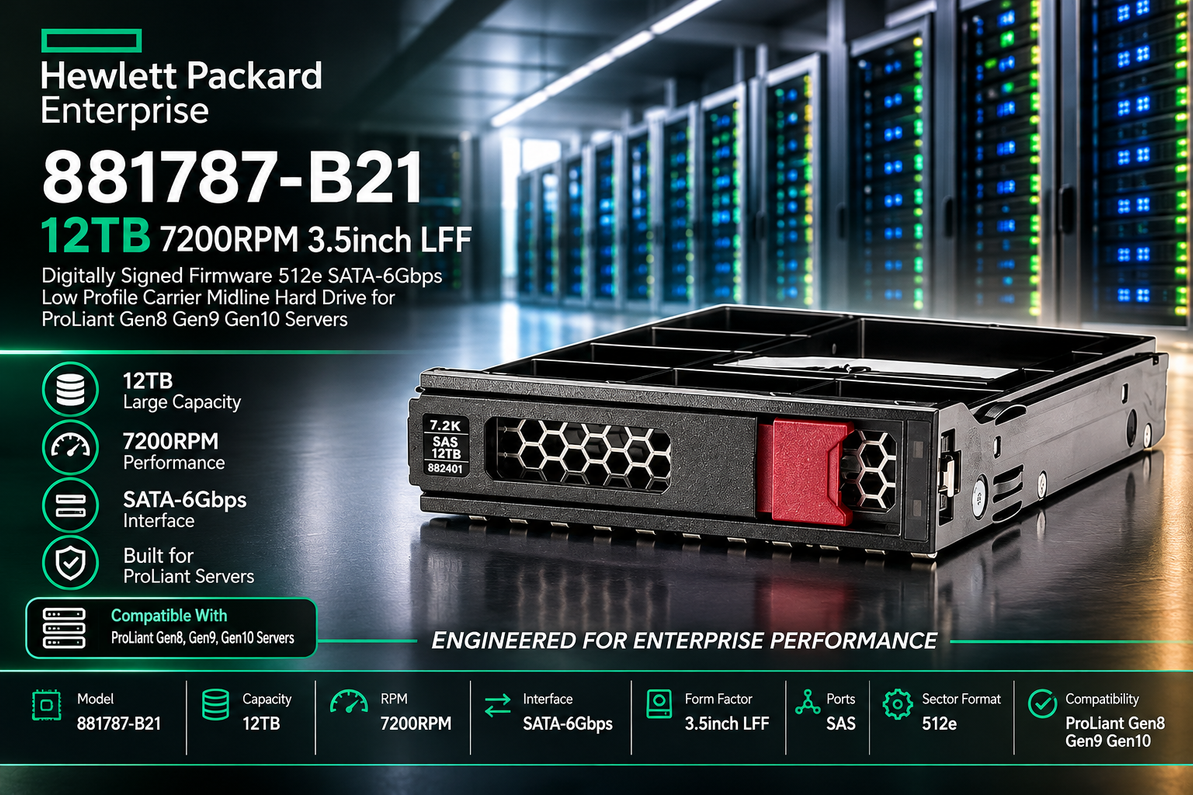
HPE Helium 881787-B21: Unlock 12TB of Enterprise Storage Power with Reliable, High-Capacity Performance
Introduction: More Storage, Greater Possibilities for Enterprise Servers
As businesses generate, process, and store increasingly large volumes of digital information, dependable enterprise storage has become more important than ever. From virtualization environments and business-critical applications to databases, backups, and long-term data archiving, modern server infrastructures require storage solutions that combine generous capacity, consistent performance, and dependable data protection. The HPE Helium 881787-B21 12TB 7200RPM SATA-6Gbps Midline Hard Drive is designed to address these demanding storage requirements while offering the capacity and compatibility needed by enterprise server environments.
Featuring a spacious 12TB capacity, a 7200RPM rotational speed, a 3.5-inch Large Form Factor (LFF) design, and a SATA-6Gbps interface, this HPE hard drive provides an attractive storage option for organizations looking to expand their existing infrastructure. Its helium-filled drive technology, 512e sector format, digitally signed firmware, and low-profile carrier make it a compelling choice for compatible HPE ProLiant Gen8, Gen9, and Gen10 server configurations.
Whether an organization needs additional room for business applications, centralized file storage, backup repositories, or large datasets, the HPE 881787-B21 offers a practical combination of storage density and enterprise-oriented features.
HPE 881787-B21: An Overview of Its Enterprise Storage Capabilities
The HPE 881787-B21 is a 12TB enterprise hard drive built for compatible HPE ProLiant server platforms. It combines conventional magnetic recording technology with helium-filled drive construction to deliver substantial storage capacity within a standard 3.5-inch drive format.
Its 7200RPM rotational speed provides a balance between storage capacity, responsiveness, and operational efficiency. Meanwhile, the SATA-6Gbps interface supports connectivity with compatible server storage controllers and backplanes.
One of its notable features is digitally signed firmware, which contributes to the integrity and authenticity of the drive's firmware environment. This is particularly important in enterprise infrastructures where hardware validation, platform compatibility, and system security are essential considerations.
The low-profile carrier also supports integration into compatible HPE server drive bays, helping administrators expand storage without unnecessarily complicating existing server configurations.
Key Specifications of HPE Helium 881787-B21
|
Specification |
Details |
|---|---|
|
Manufacturer |
Hewlett Packard Enterprise (HPE) |
|
Model Number |
881787-B21 |
|
Storage Capacity |
12TB |
|
Drive Type |
Enterprise Hard Disk Drive |
|
Rotational Speed |
7200RPM |
|
Form Factor |
3.5-inch LFF |
|
Recording Technology |
Helium-filled HDD |
|
Sector Format |
512e |
|
Interface |
SATA-6Gbps |
|
Firmware |
Digitally Signed Firmware |
|
Carrier Type |
Low Profile Carrier |
|
Product Category |
Midline |
|
Compatible Platforms |
HPE ProLiant Gen8, Gen9, and Gen10 servers, subject to configuration compatibility |
12TB Storage Capacity: Built for Growing Enterprise Data Requirements
Storage requirements rarely remain constant. As businesses expand their operations, their servers must accommodate growing databases, application files, virtual machine images, backups, archived documents, and other valuable digital assets.
The HPE 881787-B21 addresses this challenge with 12TB of storage capacity in a single 3.5-inch hard drive. This substantial capacity allows organizations to increase available storage while making efficient use of their existing server drive bays.
Simplifying Large-Scale Storage Expansion
Adding high-capacity drives can help administrators expand storage without installing a large number of lower-capacity disks. Fewer drives may also simplify certain aspects of storage planning, including drive-bay allocation, cabling, and hardware management.
For businesses operating storage-intensive applications, this additional capacity can be particularly useful for:
-
Centralized file servers and shared business documents.
-
Database storage and application data.
-
Backup repositories and disaster recovery environments.
-
Media libraries and large digital archives.
-
Virtualization infrastructure and supporting datasets.
-
Long-term business record retention.
By providing substantial storage capacity in a familiar enterprise form factor, the HPE 881787-B21 helps organizations accommodate increasing data requirements while maintaining a practical server infrastructure.
Helium-Filled Technology: Maximizing Storage Density
One of the defining characteristics of this drive is its helium-filled construction. Helium technology has become an important development in high-capacity hard disk engineering because helium is significantly less dense than the air traditionally found inside conventional hard drives.
This lower-density internal environment reduces aerodynamic resistance as the drive's platters rotate. It also allows manufacturers to engineer high-capacity drive mechanisms with closely controlled internal operating conditions.
Why Helium Matters in Enterprise Storage
Traditional air-filled hard drives experience aerodynamic drag as their platters spin. Helium reduces this resistance, allowing drive manufacturers to optimize the internal mechanical design.
Helium-filled drives can offer several engineering advantages:
-
Reduced internal aerodynamic turbulence.
-
Improved mechanical efficiency.
-
Support for higher storage density.
-
Better opportunities for multi-platter drive designs.
-
Potential improvements in power efficiency compared with equivalent air-filled designs.
For enterprise environments where storage density matters, these characteristics make helium technology particularly valuable. Organizations can benefit from substantial storage capacity without requiring an unusually large physical drive enclosure.
7200RPM Rotational Speed: A Practical Balance of Performance and Capacity
Rotational speed is an important consideration when choosing a mechanical hard drive. The HPE 881787-B21 operates at 7200 revolutions per minute, making it suitable for many general-purpose enterprise storage workloads.
Although it does not offer the rotational speed of 10K or 15K enterprise performance drives, 7200RPM provides a practical balance between storage capacity, performance, and operational efficiency.
Supporting Everyday Enterprise Workloads
A 7200RPM hard drive can support a wide range of storage-intensive activities, particularly when applications prioritize capacity over extremely low access latency.
Typical workloads include:
-
File sharing and network-attached storage.
-
Backup and recovery operations.
-
Large sequential data transfers.
-
Media and document repositories.
-
General-purpose business data storage.
-
Archival and secondary storage environments.
For organizations that need to retain large quantities of information without investing exclusively in higher-performance storage, this rotational speed offers a sensible middle ground.
It is worth remembering that actual performance depends on several factors, including controller configuration, workload characteristics, RAID settings, drive health, and server architecture.
SATA-6Gbps Interface: Reliable Connectivity for Enterprise Storage
The HPE 881787-B21 uses a SATA-6Gbps interface, providing a maximum theoretical interface bandwidth of 6 gigabits per second. This connection standard is widely used in enterprise storage environments and offers compatibility with numerous SATA-based server storage controllers.
Advantages of SATA Connectivity
SATA technology provides a straightforward and cost-effective approach to expanding server storage. Its widespread adoption makes it a practical option for organizations maintaining established server infrastructures.
Key advantages include:
-
6Gbps Interface Bandwidth: Supports high-speed communication between the drive and compatible storage controllers.
-
Broad Infrastructure Support: SATA connectivity is available across many enterprise server platforms.
-
Cost-Effective Storage Expansion: Offers an economical alternative for capacity-focused workloads.
-
Simplified Integration: Works with compatible SATA backplanes and storage controllers.
For organizations prioritizing large storage capacity over the exceptionally low latency of enterprise SSDs, SATA-based Midline hard drives remain a useful storage solution.
512e Advanced Format: Modern Storage with Legacy Compatibility
Another important feature of the HPE 881787-B21 is its 512e sector format, also known as 512-byte emulation.
Modern hard drives commonly use physical sectors measuring 4096 bytes, while certain operating systems and applications continue to expect traditional 512-byte logical sectors. The 512e format bridges this difference by presenting 512-byte logical sectors while using 4096-byte physical sectors internally.
Why 512e Technology Matters
The 512e format helps organizations deploy modern, high-capacity storage devices within infrastructure that relies on traditional logical sector addressing.
Its advantages include:
-
Compatibility with many existing operating systems and applications.
-
Support for modern high-capacity hard drive technology.
-
Improved storage density through advanced sector formatting.
-
Easier integration into established enterprise storage environments.
However, applications and storage controllers should be properly configured for 512e drives to avoid potential performance penalties associated with misaligned writes.
Digitally Signed Firmware: An Additional Layer of Storage Security
Data security is a fundamental requirement for modern enterprise infrastructure. Storage devices frequently contain confidential business information, customer records, financial documents, and other valuable digital assets.
The HPE 881787-B21 incorporates digitally signed firmware, a feature designed to help protect the integrity of the drive's firmware.
Understanding Digitally Signed Firmware
Firmware controls important aspects of a hard drive's operation, including communication with the storage controller and management of internal drive functions.
Digitally signed firmware helps establish that firmware originates from an authorized source and has not been improperly modified. This strengthens the platform's ability to maintain a trusted hardware environment.
For organizations managing multiple servers, this feature provides an additional security consideration when selecting enterprise storage components.
It is particularly relevant for businesses that prioritize hardware authenticity, firmware integrity, and controlled IT infrastructure management.
Low Profile Carrier: Designed for Convenient Server Integration
The HPE 881787-B21 comes with a Low Profile (LP) carrier designed for compatible HPE 3.5-inch LFF server drive bays.
A proper drive carrier is essential because enterprise server storage systems rely on specific mounting mechanisms to secure drives and establish connections with the server's storage backplane.
Benefits of the Low Profile Carrier
The low-profile carrier provides several practical advantages:
-
Supports installation in compatible HPE LFF drive bays.
-
Provides a suitable mounting arrangement for the hard drive.
-
Helps simplify drive replacement and storage expansion.
-
Supports hot-plug operation in appropriately configured server bays.
Its carrier design is particularly useful for IT administrators who need to maintain existing server configurations while expanding available storage capacity.
Important: Always verify the carrier generation, backplane, controller, and server configuration before purchasing. Physical fit alone does not guarantee compatibility.
Midline Storage: An Economical Choice for Capacity-Driven Workloads
Enterprise hard drives are designed for different workloads and performance requirements. The HPE 881787-B21 belongs to HPE's Midline or Business Critical storage category.
Midline drives are generally intended for environments where storage capacity and cost efficiency are more important than the lowest possible response times.
Where Midline Drives Make the Most Sense
The HPE 881787-B21 is particularly suitable for applications that require substantial storage capacity and consistent access to large volumes of information.
Common deployment scenarios include:
-
Secondary storage environments.
-
Backup and recovery repositories.
-
Large-scale file storage.
-
Business document archives.
-
Media and content libraries.
-
Reference data and historical records.
For applications requiring intensive random I/O operations, extremely low latency, or demanding transactional performance, enterprise SSDs or higher-performance HDDs may be more appropriate.
The strength of the 881787-B21 lies in providing substantial storage capacity for workloads that do not require premium performance storage.
HPE ProLiant Compatibility: Supporting Established Enterprise Infrastructure
One of the major considerations when purchasing enterprise storage is compatibility with the existing server environment.
The HPE 881787-B21 is associated with HPE ProLiant server infrastructure, but compatibility depends on the particular server model, drive bay, storage controller, firmware, and supported drive configuration.
Compatibility Considerations for Gen8, Gen9, and Gen10 Servers
Although the product is marketed for use across established ProLiant generations, not every Gen8, Gen9, or Gen10 server supports this specific 12TB SATA drive.
HPE's documentation identifies the drive for supported HPE Compute Mainstream platforms, with compatibility determined through the relevant server QuickSpecs.
Before installation, administrators should check:
-
Whether the server supports 12TB hard drives.
-
Whether the system has compatible 3.5-inch LFF drive bays.
-
Whether the storage controller supports SATA-6Gbps drives.
-
Whether the low-profile carrier matches the server generation.
-
Whether the installed firmware supports the drive configuration.
For businesses operating mixed-generation ProLiant infrastructure, checking these details beforehand can help prevent installation problems and unnecessary hardware expenses.
Enterprise Applications: Where Can the HPE 881787-B21 Be Used?
A 12TB enterprise hard drive offers considerable flexibility across different storage environments. Its combination of capacity, SATA connectivity, and helium technology makes it particularly useful for businesses managing large datasets.
1. Backup and Disaster Recovery
Backup infrastructure requires substantial storage capacity to maintain multiple copies of business information. The HPE 881787-B21 can provide additional space for backup repositories, scheduled backup jobs, and long-term retention.
When deployed in an appropriately configured RAID or backup system, multiple drives can support larger storage pools and help organizations improve their data protection strategies.
2. File and Document Storage
Businesses often maintain extensive collections of documents, spreadsheets, project files, images, and other digital resources.
The 12TB capacity provides an opportunity to consolidate large collections of business information within compatible server storage systems.
3. Database Storage
Databases used for business intelligence, reporting, historical records, and less latency-sensitive applications can benefit from high-capacity storage.
Although the drive is not intended to replace high-performance database SSDs, it can provide useful additional capacity for supporting data and archival workloads.
4. Virtualization Infrastructure
Virtualization platforms generate substantial amounts of storage data through virtual machine files, templates, snapshots, and supporting resources.
The HPE 881787-B21 can contribute additional storage capacity to suitable virtualization environments, particularly where capacity requirements outweigh the need for extremely fast random access.
5. Media and Content Archiving
Organizations working with video, photography, digital publishing, and multimedia production frequently need large storage repositories.
A 12TB drive provides room for substantial collections of digital content, making it useful for secondary storage and archival applications.
Why Choose the HPE 881787-B21 for Your Server Infrastructure?
Selecting enterprise storage is about more than comparing capacity figures. Organizations must consider performance, security, compatibility, operating costs, and future expansion requirements.
The HPE 881787-B21 brings several useful characteristics together in one storage solution.
High Storage Density: Its 12TB capacity allows organizations to expand their storage resources without relying entirely on numerous smaller-capacity drives.
Helium Technology: Its helium-filled construction supports high-capacity mechanical drive engineering while reducing internal aerodynamic resistance.
Practical Performance: The 7200RPM rotational speed provides a sensible balance for capacity-oriented business workloads.
SATA-6Gbps Connectivity: Its widely adopted interface makes it suitable for compatible SATA-based server configurations.
Digitally Signed Firmware: Firmware authentication helps strengthen the integrity of the storage device.
512e Sector Format: Advanced sector formatting supports deployment in many established storage environments.
Low Profile Carrier: The included carrier facilitates installation in compatible HPE LFF drive bays.
Enterprise Storage Applications: Its Midline classification makes it a practical option for backup, archival, and general-purpose capacity-focused storage.
HPE 881787-B21 vs. High-Performance Enterprise Storage
Not every enterprise application requires the same type of storage device. Understanding the difference between Midline hard drives, performance HDDs, and SSDs can help businesses make better purchasing decisions.
|
Feature |
HPE 881787-B21 |
Enterprise Performance HDD |
Enterprise SSD |
|---|---|---|---|
|
Storage Technology |
Mechanical HDD |
Mechanical HDD |
Flash Memory |
|
Rotational Speed |
7200RPM |
Often 10K or 15K |
Not applicable |
|
Capacity Focus |
High |
Moderate to high |
Varies |
|
Access Latency |
Mechanical |
Mechanical |
Very low |
|
Random I/O |
Moderate |
Higher |
Very high |
|
Best Application |
Bulk storage |
Performance-oriented HDD workloads |
Latency-sensitive applications |
The HPE 881787-B21 is an excellent consideration when storage capacity and cost efficiency are the primary objectives. However, applications requiring exceptionally high IOPS and minimal latency will generally benefit more from SSD-based storage.
Installation and Maintenance Recommendations
Proper installation and maintenance help enterprise storage devices deliver dependable service throughout their operational lifecycle.
Before installing the HPE 881787-B21, administrators should confirm that the server supports the drive's capacity, interface, sector format, and carrier.
Check Server Compatibility
Review the server's official HPE QuickSpecs and confirm that the selected configuration supports the 12TB SATA drive.
Inspect the Drive Carrier
Make sure the low-profile carrier is appropriate for the target server's drive bay. Incorrect carrier types can prevent proper installation or connection.
Configure the Storage Controller
Verify that the controller supports the drive and its 512e sector format. Configure RAID or other storage arrangements according to the intended workload.
Monitor Drive Health
Use supported HPE management utilities to monitor drive status, predictive failure notifications, and storage subsystem health.
Maintain Reliable Backups
RAID configurations can help maintain availability during certain drive failures, but RAID is not a replacement for independent backups. Organizations should maintain appropriate backup and recovery procedures.
Is the HPE Helium 881787-B21 the Right Storage Upgrade?
For organizations looking to expand storage capacity without moving entirely to more expensive flash-based solutions, the HPE 881787-B21 deserves consideration.
Its 12TB capacity provides substantial room for business information, while its 7200RPM rotational speed makes it suitable for a wide range of general-purpose enterprise storage applications.
The combination of helium technology, 512e formatting, digitally signed firmware, and a low-profile carrier makes it a practical option for compatible HPE server environments.
It is especially attractive for businesses that need additional space for backups, archives, shared files, and other capacity-intensive workloads.
However, buyers should remember that Midline storage is not designed to replace high-performance enterprise SSDs or specialized performance HDDs. Selecting the right storage device ultimately depends on application requirements, expected workload intensity, and server compatibility.
Conclusion: Give Your Enterprise Infrastructure the Storage Capacity It Deserves
The HPE Helium 881787-B21 12TB 7200RPM SATA-6Gbps Hard Drive combines generous storage capacity with practical enterprise features to support the growing information requirements of modern businesses.
Its helium-filled construction, 512e sector format, digitally signed firmware, and low-profile carrier make it a compelling storage option for compatible HPE ProLiant environments.
Whether expanding backup repositories, maintaining extensive business archives, consolidating digital content, or increasing available server storage, this 12TB Midline hard drive offers a balanced approach to enterprise capacity expansion.
For organizations seeking dependable, high-capacity mechanical storage, the HPE 881787-B21 represents a practical investment in building a more spacious and scalable storage infrastructure.
Recent Posts
-
HPE Helium 881787-B21: Unlock 12TB of Enterprise Storage Power with Reliable, High-Capacity Performance
Introduction: More Storage, Greater Possibilities for Enterprise Servers As businesses generate, pro …Nov 19th 2026 -
Beyond 12TB: The Enterprise Storage Beast Powering HPE's Next Generation of SAN Performance
HPE Q2R42A: Inside the 12TB Storage Powerhouse Built for Enterprise SAN Performance As enterprise da …Nov 18th 2026 -
HPE R0P92A: Unlock 72TB of Enterprise Storage Power with Six High-Capacity SAS Hard Drives
In today's data-driven business environment, storage capacity is more than a technical requirement. …Nov 17th 2026