
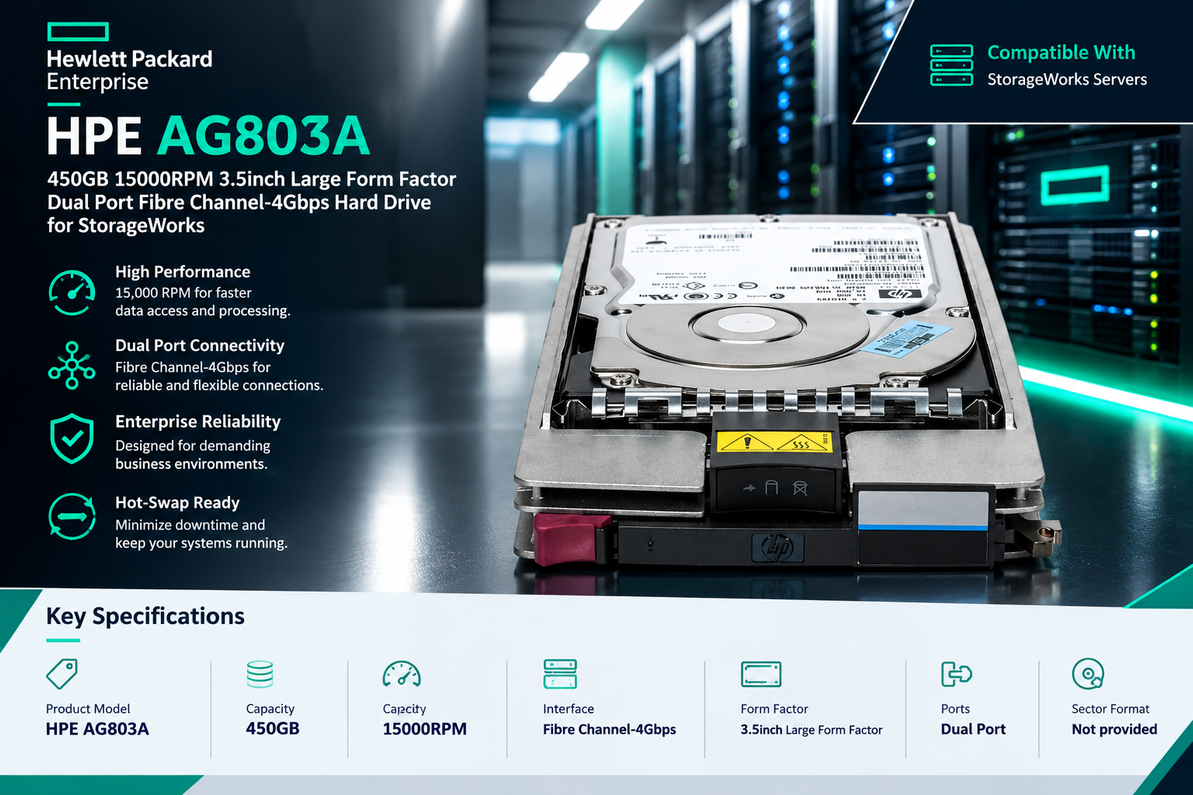
The StorageWorks Powerhouse: Exploring the HPE AG803A 450GB 15K Drive
HPE AG803A 450GB 15000RPM Fibre Channel Hard Drive: Enterprise Storage Performance for StorageWorks
The HPE AG803A 450GB 15000RPM 3.5-inch Large Form Factor Dual Port Fibre Channel-4Gbps Hard Drive is an enterprise-class storage drive designed for compatible HPE StorageWorks environments. Combining a 450GB capacity with a high-speed 15,000RPM spindle, dual-port Fibre Channel connectivity, and a 3.5-inch Large Form Factor design, the AG803A was built for storage infrastructures where performance, availability, and dependable enterprise operation were important priorities.
Unlike conventional desktop hard drives, the HPE AG803A belongs to a generation of storage hardware developed specifically for enterprise Storage Area Network environments. Its Fibre Channel interface allows it to operate within centralized storage architectures, while its dual-port design supports redundant connectivity in appropriately configured systems.
For businesses maintaining legacy HPE StorageWorks infrastructure, the AG803A can be useful as a replacement or expansion drive when the existing storage platform specifically supports this model and its specifications. Because enterprise storage arrays often have strict compatibility requirements, administrators should always verify the exact array, enclosure, controller, firmware, and drive configuration before installation.
Understanding the HPE AG803A
450GB enterprise storage capacity
The 450GB capacity gives the HPE AG803A a useful balance between storage space and performance. Although modern enterprise drives can provide several terabytes of capacity, 450GB was well suited to the enterprise storage systems of the Fibre Channel era for which this drive was designed.
When several AG803A drives are installed in a supported storage array, the individual capacities can be combined through RAID technology. This allows organizations to create larger logical storage volumes while potentially adding redundancy and improving aggregate storage performance.
The practical amount of usable capacity depends on the RAID level, number of drives, array configuration, formatting, and storage-management architecture.
15,000RPM rotational speed
One of the most important features of the AG803A is its 15,000RPM rotational speed.
Mechanical hard drives use spinning platters and read/write heads to access data. Increasing spindle speed reduces rotational latency because the required portion of the platter reaches the drive head more quickly.
A 15K RPM drive can therefore provide significantly better mechanical responsiveness than many 7,200RPM hard drives, particularly when handling random I/O.
This made 15K enterprise HDDs popular for workloads where storage latency mattered, including transactional applications, databases, virtualization, and other frequently accessed enterprise data.
4Gbps Fibre Channel Connectivity
Designed for SAN environments
The HPE AG803A uses a 4Gbps Fibre Channel interface, placing it firmly within the enterprise SAN storage ecosystem.
Fibre Channel was designed to provide high-speed, reliable connectivity between servers and centralized storage. Instead of attaching the drive directly to a conventional computer motherboard, Fibre Channel storage normally operates as part of a larger storage array containing controllers, enclosures, switches, host bus adapters, and management software.
The 4Gbps specification represents the interface's theoretical signaling rate. Actual storage throughput is influenced by the mechanical performance of the hard disk, protocol overhead, controllers, RAID processing, workload characteristics, and the overall SAN infrastructure.
Fibre Channel versus conventional interfaces
Fibre Channel differs from interfaces such as SATA because it is designed around enterprise storage networking and centralized storage architectures.
SATA is widely used for desktop computers, laptops, workstations, and various server applications. Fibre Channel, on the other hand, has traditionally been associated with SAN environments where multiple servers can access centralized storage resources.
The AG803A therefore should not be viewed simply as a conventional 450GB hard drive. Its value comes from how its Fibre Channel interface integrates with compatible enterprise storage infrastructure.
Dual-Port Fibre Channel Architecture
Supporting redundant paths
The dual-port design is an important feature for enterprise storage environments.
A dual-port Fibre Channel drive can provide two connectivity paths when installed in a compatible storage architecture. This can support redundant storage designs in which separate paths connect the storage system to the drive.
Redundant paths can help reduce the impact of a failed cable, connection, controller path, or other component.
High availability considerations
Enterprise storage systems are often designed around the principle that individual components can fail without taking the entire storage environment offline.
A dual-port drive can contribute to this architecture, but it does not independently provide high availability. Controllers, Fibre Channel switches, host bus adapters, multipathing software, power supplies, cabling, RAID configurations, and storage-management software all contribute to the overall availability of the system.
3.5-Inch Large Form Factor Design
LFF storage compatibility
The HPE AG803A uses a 3.5-inch Large Form Factor (LFF) design.
LFF drives were widely used in enterprise storage systems where the enclosure was designed to accommodate larger drive assemblies. This is different from the 2.5-inch Small Form Factor commonly found in many modern rack servers and storage systems.
Physical size alone is not enough to establish compatibility. The storage enclosure must support the appropriate LFF drive, connector arrangement, carrier, interface, firmware, and drive family.
Importance of the correct drive carrier
Enterprise storage drives are frequently installed in dedicated carriers or trays. The carrier helps position the drive correctly within the enclosure and provides the required physical connection to the backplane.
When purchasing a replacement AG803A, administrators should therefore determine whether the drive is supplied with the correct HPE carrier or whether an existing compatible carrier needs to be reused.
HPE StorageWorks Compatibility
Built for enterprise StorageWorks infrastructure
The AG803A belongs to the HPE StorageWorks ecosystem, making compatibility particularly important.
StorageWorks included numerous storage products and configurations, and not every Fibre Channel drive is automatically compatible with every StorageWorks array.
The exact storage system may impose requirements concerning drive capacity, interface generation, rotational speed, firmware, enclosure type, carrier, controller generation, and supported drive models.
Verify before installation
Before purchasing an AG803A, it is recommended to identify the exact StorageWorks model and consult its supported hardware configuration.
This is especially important for older enterprise storage equipment because a drive can have the correct physical form factor and Fibre Channel interface but still fail to operate correctly if it is not supported by the array.
Performance Characteristics of the AG803A
High-speed mechanical storage
The 15,000RPM spindle speed gives the AG803A a performance advantage over slower mechanical HDDs.
The faster rotation reduces average rotational latency, which can improve responsiveness during random read and write operations.
This was particularly valuable during the period when enterprise storage relied heavily on mechanical disks. A 15K HDD offered an attractive compromise between capacity, cost, and performance.
Random I/O performance
Random I/O is one of the areas where a 15K mechanical drive can show its advantages over slower HDDs.
Database servers, transactional applications, and virtualization platforms can generate many small disk requests that are scattered across the storage volume. Faster spindle rotation can reduce the amount of time spent waiting for the required sector to rotate into position.
Modern SSDs are vastly faster for these workloads, but the AG803A remains relevant when supporting compatible legacy Fibre Channel infrastructure.
RAID and the HPE AG803A
Combining multiple drives
The AG803A can be deployed in RAID configurations when supported by the target StorageWorks system.
RAID allows multiple physical drives to operate as a logical storage resource. Depending on the RAID level, organizations can prioritize performance, usable capacity, or fault tolerance.
RAID 10 combines striping and mirroring for strong performance and redundancy. RAID 5 uses distributed parity to provide protection against a single drive failure, while RAID 6 adds additional parity protection.
The appropriate RAID configuration depends on workload requirements and the capabilities of the storage controller.
Replacing a failed drive
One of the practical applications for an AG803A is replacing a failed disk in an existing storage array.
When a RAID array reports a failed drive, installing a compatible replacement can allow the system to rebuild the affected data, assuming the array remains recoverable and the storage controller supports the replacement process.
Administrators should always follow the manufacturer's procedures for drive replacement and RAID rebuilding.
Enterprise Applications
Database workloads
Databases often generate a mixture of random reads, writes, and transactional operations.
The 15K RPM design of the AG803A can provide better mechanical responsiveness than slower enterprise hard drives, making this class of drive suitable for legacy database storage environments.
Actual database performance also depends heavily on caching, RAID configuration, controller performance, database design, memory, and application behavior.
Virtualization storage
Virtualization environments can place significant demands on shared storage because multiple virtual machines may access the same storage system simultaneously.
Fibre Channel SANs were widely used to provide centralized storage for virtualized server environments.
An array using 15K Fibre Channel HDDs such as the AG803A can therefore provide a practical storage platform for compatible legacy virtualization infrastructure.
Enterprise application servers
Business-critical applications often require centralized storage with reliable access and predictable performance.
ERP applications, enterprise databases, application servers, and other transactional systems can use SAN storage to separate compute resources from storage resources.
The AG803A's Fibre Channel connectivity and dual-port architecture make it suited to this type of infrastructure when supported by the storage platform.
Storage Area Networks
The AG803A is especially relevant to Storage Area Network environments.
SANs allow storage resources to be centrally managed and presented to multiple servers. Fibre Channel provides the dedicated connectivity layer between hosts and storage infrastructure.
This architecture can simplify storage management while supporting features such as centralized provisioning, multipathing, RAID, and redundant connectivity.
HPE AG803A vs SATA Hard Drives
Enterprise connectivity
A SATA hard drive can offer excellent value for high-capacity storage, but it is not a direct substitute for a Fibre Channel drive in a Fibre Channel storage array.
The AG803A is designed to communicate through Fibre Channel storage infrastructure, while SATA drives are generally connected through SATA controllers or storage systems designed specifically to support SATA.
Performance differences
The 15K spindle speed also gives the AG803A an advantage over typical 7,200RPM SATA HDDs in mechanical access performance.
However, a modern high-capacity SATA HDD may offer significantly greater storage capacity at a lower cost per gigabyte.
The right choice therefore depends on whether the requirement is maintaining a legacy SAN or building a modern high-capacity storage platform.
HPE AG803A vs SAS Hard Drives
Different enterprise storage technologies
SAS and Fibre Channel are both enterprise storage technologies, but they are designed for different types of infrastructure.
SAS is commonly used for direct-attached enterprise storage and storage arrays, whereas Fibre Channel is strongly associated with SAN environments.
The AG803A's 4Gbps Fibre Channel interface means that a SAS drive should not automatically be considered a replacement.
Administrators should always match the interface and supported drive type to the storage system.
HPE AG803A vs Modern SSDs
Mechanical HDD technology
The AG803A uses conventional magnetic disk technology. It contains spinning platters and mechanical heads, which means its latency is inherently higher than that of flash-based storage.
Modern enterprise SSDs can provide substantially higher IOPS, dramatically lower latency, and faster application response.
Nevertheless, SSDs are not always practical replacements for older Fibre Channel HDDs. The storage array must support the new drive technology, and migration to a new storage platform can involve considerable cost and operational complexity.
For organizations that need to keep an older StorageWorks environment running, a compatible AG803A can be a more straightforward solution.
Reliability and Maintenance
Monitor storage health
Enterprise storage administrators should regularly monitor drive and array health.
Warning signs can include increasing read or write errors, predictive failure alerts, degraded RAID status, controller warnings, or unusual storage behavior.
If the storage system identifies the AG803A or another disk as failing, administrators should replace it according to the system's documented maintenance procedures.
Maintain adequate cooling
15K RPM hard drives generate more heat than many slower mechanical drives.
Proper airflow is therefore important for storage arrays using this class of drive. Storage enclosures should have functioning cooling systems and unobstructed airflow paths.
Keeping the storage environment within the manufacturer's recommended operating conditions can help improve long-term hardware reliability.
Buying a Used or Refurbished HPE AG803A
Check drive health
Because the AG803A belongs to an older Fibre Channel generation, it may commonly be available through used, refurbished, or surplus enterprise hardware channels.
When buying a used drive, buyers should check available information about operating hours, error history, testing, and overall drive health.
A professionally tested refurbished drive can be a practical option for maintaining legacy infrastructure, but it should still be monitored after installation.
Verify the exact part number
The exact AG803A part number should be confirmed before purchasing.
Enterprise storage products frequently have similar part numbers covering different capacities, interfaces, form factors, or platform generations. A visually similar drive may not provide the required compatibility.
Matching the part number with the storage system's supported drive list is therefore an important step.
HPE AG803A Technical Specifications
Key specifications
| Specification | HPE AG803A |
|---|---|
| Manufacturer | HPE |
| Part Number | AG803A |
| Storage Capacity | 450GB |
| Drive Type | Enterprise Hard Disk Drive |
| Rotational Speed | 15,000RPM |
| Interface | Fibre Channel |
| Interface Speed | 4Gbps |
| Port Configuration | Dual Port |
| Form Factor | 3.5-inch Large Form Factor |
| Intended Platform | HPE StorageWorks |
| Storage Architecture | Enterprise SAN |
| Storage Technology | Magnetic HDD |
These specifications make the AG803A a specialized enterprise storage component rather than a general-purpose desktop hard drive.
Why Choose the HPE AG803A?
A practical solution for legacy StorageWorks systems
The biggest advantage of the AG803A is its ability to fit into an existing compatible enterprise storage environment.
Replacing an entire SAN simply because one hard drive has failed can be unnecessary and expensive. If the existing StorageWorks system remains suitable for the organization's applications, installing a compatible replacement drive can extend the useful life of the infrastructure.
A balance of speed and enterprise connectivity
The AG803A combines several characteristics that were valuable in enterprise storage:
450GB capacity provides useful storage space, while 15,000RPM performance improves mechanical access times. 4Gbps Fibre Channel provides connectivity to SAN infrastructure, and dual-port architecture supports redundant connectivity in compatible systems.
Together, these features make the drive well suited to the enterprise storage environments for which it was designed.
Final Verdict
The HPE AG803A 450GB 15000RPM 3.5-inch Large Form Factor Dual Port Fibre Channel-4Gbps Hard Drive is a specialized enterprise HDD designed for compatible HPE StorageWorks storage environments.
Its combination of 450GB capacity, 15,000RPM rotational speed, 4Gbps Fibre Channel connectivity, dual-port architecture, and 3.5-inch LFF design makes it particularly relevant to organizations maintaining legacy Fibre Channel SAN infrastructure.
The 15K spindle provides faster mechanical access than conventional 7,200RPM hard drives, while Fibre Channel allows the drive to operate within centralized enterprise storage architectures. Dual-port connectivity can also contribute to redundant storage designs when supported by the complete SAN configuration.
Although modern enterprise SSDs offer dramatically better performance, the AG803A still has a practical role in maintaining compatible legacy StorageWorks systems. It can serve as a replacement for a failed drive, help restore RAID arrays, or provide additional storage capacity where the existing infrastructure continues to meet business requirements.
Before purchasing or installing an AG803A, always verify the exact HPE StorageWorks model, enclosure compatibility, Fibre Channel support, drive carrier, firmware requirements, and supported drive list. When properly matched to the storage platform, the HPE AG803A can provide a reliable way to extend the operational life of an established enterprise SAN while retaining the high-speed mechanical storage characteristics of a 15K Fibre Channel drive.
- #3.5 inch LFF Fibre Channel drive
- #450GB 15000RPM hard drive
- #4Gbps Fibre Channel hard drive
- #AG803A hard drive
- #dual port Fibre Channel HDD
- #enterprise SAN storage
- #HPE 15K RPM HDD
- #HPE 450GB Fibre Channel hard drive
- #HPE AG803A
- #HPE enterprise hard drive
- #HPE StorageWorks drive
- #HPE StorageWorks SAN
Recent Posts
-

HPE AG425B 300GB 15K Fibre Channel Hard Drive: High-Speed Storage for Enterprise-Class EVA Systems
Introduction: Reliable Storage for Demanding Enterprise Environments In enterprise IT, storage perfo …Oct 19th 2026 Mike Anderson -

HPE AG425A 300GB 15000RPM Fibre Channel Hard Drive: Enterprise Storage Built for Demanding Environments
Enterprise storage systems depend on dependable hardware that can deliver consistent performance whi …Oct 18th 2026 Mike Anderson -
Where Legacy Power Meets Enterprise Precision: The HPE 431944-B21 300GB SAS Hard Drive
HPE 431944-B21: Enterprise Storage Built for the Demanding ProLiant Era The HPE 431944-B21 is a 300G …Oct 17th 2026 Mike Anderson