
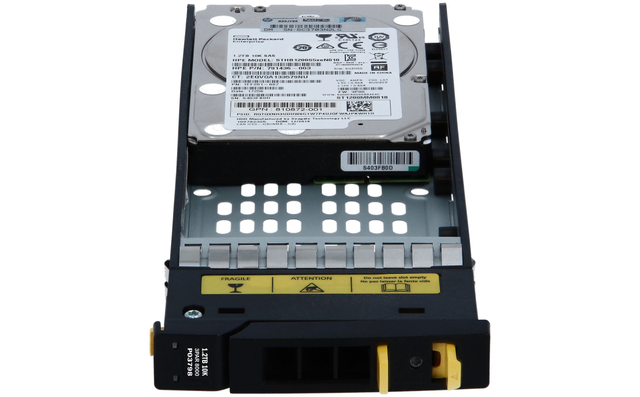
The Quiet Beast Beneath Your Data Center Floor: Why the HPE K2P93B Is the Drive Your Enterprise Can't Afford to Overlook
HPE K2P93B 1.2TB 10K RPM SAS 12Gbps 2.5" Hard Drive: The Unsung Hero of Enterprise Storage
If you've ever been the person responsible for keeping a data center humming along at 2 AM while everyone else is asleep, you know that the components you trust with your data aren't just hardware — they're peace of mind in a metal chassis. Enter the HPE K2P93B, a 1.2TB, 10,000 RPM, 2.5-inch SAS hard drive built specifically for HPE 3PAR StoreServ 8000 Series Enclosures. It's not glamorous. It doesn't have RGB lighting. But oh boy, does it deliver.
Whether you're a storage architect spec'ing out a new deployment, an IT admin trying to replace a failed drive without breaking a sweat, or just a tech enthusiast who genuinely loves reading about enterprise storage (we don't judge), this article is for you. Let's dig into everything the HPE K2P93B has to offer — from its blazing SAS interface to its hot-swap convenience — and find out why this little drive punches well above its weight class.
What Exactly Is the HPE K2P93B?
Before we start throwing around specs like confetti at a New Year's party, let's get the basics out of the way. The HPE K2P93B is a 2.5-inch Small Form Factor (SFF) enterprise hard disk drive designed and validated by Hewlett Packard Enterprise for use in HPE 3PAR StoreServ 8000 Series storage enclosures.
It's not your average desktop drive. This is a purpose-built, mission-critical storage component engineered to run continuously, handle heavy workloads, and survive the demanding environment of a modern enterprise data center.
The Full Spec Breakdown
Here's a quick rundown of the key specs that make the HPE K2P93B worth talking about:
- Part Number: K2P93B
- Capacity: 1.2TB
- Spindle Speed: 10,000 RPM
- Form Factor: 2.5-inch Small Form Factor (SFF)
- Interface: SAS 12Gbps (Dual Port)
- Hot-Swap: Yes
- Designed For: HPE 3PAR StoreServ 8000 Series Enclosures
- Drive Type: HDD (Hard Disk Drive)
Simple enough on paper. But the story of what these specs actually mean for your storage environment? That's where it gets fun.
Breaking Down the Key Features of the HPE K2P93B
1.2TB of Reliable Enterprise Capacity
Let's start with the big number: 1.2 terabytes. In the world of consumer storage, 1.2TB might not turn any heads — after all, you can stuff a $60 USB drive with that much space these days. But in enterprise storage, capacity is just one piece of the puzzle.
What matters here is that this 1.2TB is backed by HPE's rigorous qualification process. Every bit of that capacity is tested and validated for use in mission-critical environments where data integrity isn't optional — it's the whole point. You're not just getting storage space; you're getting storage assurance.
For workloads like virtual machine datastores, database transaction logs, OLTP systems, and high-frequency file serving, 1.2TB per drive in a tiered or RAID configuration within the StoreServ 8000 gives you the density-to-performance balance that makes architects smile.
10,000 RPM: Speed That Keeps Up With Your Ambitions
Ten thousand revolutions per minute. Just say that out loud for a second. That's the drive's spinning platters completing 166 full rotations every single second. This isn't a casual Sunday afternoon drive; this is a Formula 1 car on a closed circuit.
The 10K RPM spindle speed directly impacts two critical performance metrics: seek time and rotational latency. Faster spins mean the read/write heads spend less time waiting for the right sector to rotate into position, and they can locate and read data more quickly. The result? Lower latency for random I/O operations and better throughput for sequential workloads.
For enterprise applications that depend on consistent, low-latency storage — think SQL Server databases, Oracle environments, virtualization clusters running VMware vSphere — the 10K RPM SAS drive still holds a special place in the hearts of storage architects, even in an era increasingly dominated by SSDs. The economics often favor spinning media at this performance tier, especially for warm or mixed-tier workloads.
SAS 12Gbps Dual Port: Because One Path Is Never Enough
Here's where the HPE K2P93B really shows its enterprise DNA. The drive uses a Serial Attached SCSI (SAS) interface running at 12 gigabits per second, and it's a Dual Port design. Let's unpack why both of those things matter enormously.
SAS vs. SATA — A Quick Reality Check
While SATA drives are perfectly fine for desktop PCs and secondary storage, SAS was built from the ground up for enterprise workloads. SAS supports full-duplex communication (sending and receiving data simultaneously), higher command queue depths, and significantly better error recovery. It also supports much higher duty cycles — meaning it's designed to spin and serve data 24 hours a day, 7 days a week, 365 days a year without complaint.
What Does 12Gbps Mean in Practice?
The SAS 12Gbps interface means the drive can communicate with the storage controller at up to 12 gigabits per second — that's 1.2 gigabytes per second of raw interface bandwidth. Of course, the spinning platter inside has its own physical throughput ceiling, but having a high-bandwidth interface ensures the drive never becomes a bottleneck at the connection point. It's like building a six-lane highway to a fast-food drive-through — you want the path to be wider than what the kitchen can produce.
Dual Port: Your Safety Net in Disguise
The dual-port design is one of those features that feels unremarkable until the moment it saves your bacon. Each SAS drive has two independent ports, each capable of full-speed communication with the storage controller. In a properly configured dual-path environment, your system can access the drive through either port independently.
Why does this matter? Because it enables multipathing — a configuration where the same drive is accessible via two separate physical paths through the storage fabric. If one path fails (a cable goes bad, an HBA dies, a switch port flakes out), your data remains fully accessible through the other path without any interruption. In a world where downtime costs real money, dual-port SAS is basically free insurance that you'd be silly not to use.
Hot-Swap: Swap Drives Like a Pro, Not a Surgeon
One of the most underrated features of the HPE K2P93B is its hot-swap capability. And if you've ever had to schedule a maintenance window at 3 AM just to replace a failed drive, you already understand exactly how wonderful hot-swap truly is.
Hot-swap means you can physically remove a failed drive and insert a replacement while the system continues to run — no powering down, no service interruption, no apologetic emails to the entire company explaining why the shared file server was unavailable for two hours on a Tuesday afternoon.
In an HPE 3PAR StoreServ 8000 environment with proper RAID or RAID-like protection (HPE uses its own RAID-MP and Autonomic Groups technologies), swapping out a failed K2P93B is almost anticlimactic. You pull the old drive, slide the new one in, and the system automatically begins rebuilding the data. You could theoretically be drinking your morning coffee while it happens. That's enterprise engineering at its finest.
2.5-Inch Small Form Factor: Big Performance, Compact Footprint
The 2.5-inch SFF form factor might seem like a minor detail, but it has meaningful implications for data center density. Compared to the older 3.5-inch Large Form Factor (LFF) drives, 2.5-inch drives allow you to pack significantly more spindles into the same enclosure footprint.
More spindles in a given rack unit means more aggregate IOPS, more parallel I/O operations, and better overall throughput when drives are striped together. For HPE 3PAR StoreServ 8000 enclosures, which are designed around 2.5-inch SFF drives, the K2P93B fits perfectly into the system's architectural vision: high-density, high-performance, enterprise-grade spinning storage.
The HPE 3PAR StoreServ 8000 Series: The Home That Makes This Drive Shine
You can't fully appreciate the HPE K2P93B without understanding the ecosystem it was built for. The HPE 3PAR StoreServ 8000 Series is an all-flash and hybrid storage platform designed for mid-range to enterprise workloads. It's known for its:
- Multi-tenant architecture supporting mixed workloads
- Always-On QoS for guaranteed performance tiers
- Built-in deduplication and compression
- Thin provisioning and automated tiering (Adaptive Optimization)
- Massive scalability from a handful of drives to hundreds
Why the K2P93B Belongs in StoreServ 8000 Enclosures
HPE qualifies specific drives for each platform and enclosure type — and for good reason. A drive installed in a StoreServ 8000 enclosure needs to be firmware-compatible, electrically validated, thermally tested, and performance-characterized for that specific environment. The K2P93B carries HPE's own part number and qualification badge, which means it has been through that full gauntlet.
Using non-HPE or non-validated drives in a 3PAR StoreServ 8000 can lead to firmware warnings, unsupported configurations, and potential voiding of your support contract. The K2P93B eliminates all of that risk. It's literally made for this system. It's like buying OEM tires for your car — yes, you could put other tires on it, but why would you take the risk on something this important?
Where the K2P93B Sits in Tiered Storage
In a typical 3PAR StoreServ 8000 deployment, you might have multiple tiers of storage: all-flash SSDs for the hottest, most latency-sensitive data, 10K SAS drives like the K2P93B for warm-tier workloads, and potentially larger, slower drives for cold or archival data.
HPE's Adaptive Optimization (AO) technology can automatically migrate data between these tiers based on actual usage patterns. Data that gets hot gets promoted to flash. Data that cools down gets demoted to the 10K SAS tier. It's a self-managing, intelligent system — and the K2P93B is a first-class citizen in that ecosystem.
Performance Perspective: When Does the K2P93B Make Sense?
The SSD vs. HDD Question
Let's address the elephant in the room. You might be asking: "With SSDs getting cheaper by the quarter, why would anyone still spec 10K SAS HDDs?" It's a fair and honest question, and the answer is equally honest: it depends on your workload and your budget.
SSDs win on pure IOPS and latency, full stop. There's no debate there. But 10K SAS HDDs like the K2P93B still offer compelling advantages in specific contexts:
Capacity-per-dollar economics: For warm-tier data that needs reasonable performance but doesn't justify SSD pricing, 10K SAS drives offer significantly more usable capacity per dollar spent on storage.
Sequential throughput workloads: Large, sequential reads and writes — like video editing storage, backup staging, or large database scans — benefit less from flash's random I/O advantage and can be well-served by spinning media.
Tiered environments: When you're using HPE's Adaptive Optimization, having a mid-tier 10K SAS layer gives the system more granular tiering options and more cost-effective overall architecture.
Hybrid deployments: Many organizations aren't ready or able to go all-flash. The K2P93B gives them enterprise-grade performance in a cost-effective hybrid configuration.
Ideal Workloads for the HPE K2P93B
The sweet spot workloads for this drive include:
Database secondary storage — transaction log files, temp databases, and staging areas that need decent performance but can tolerate slightly higher latency than primary storage.
Virtual machine secondary datastores — development/test VM clusters or less latency-sensitive workloads in a VDI environment.
File and print services — medium to high-volume shared file servers where throughput matters more than microsecond latency.
Backup-to-disk targets — staging backups before they're moved to tape or object storage, where sequential write performance is key.
HPE K2P93B Installation and Compatibility
Supported Enclosures
The HPE K2P93B is specifically designed and validated for HPE 3PAR StoreServ 8000 Series Enclosures. This includes configurations in the StoreServ 8200, 8400, 8440, and 8450 platforms. Before purchasing and deploying any drive, it's always smart to verify compatibility with your specific enclosure generation using HPE's Single Point of Connectivity Knowledge (SPOCK) tool — the authoritative source for HPE storage compatibility.
Installation: Easier Than Assembling IKEA Furniture
Thanks to the hot-swap design, installing the K2P93B doesn't require a PhD in storage engineering. The drive ships with a carrier/caddy attached (standard for HPE factory-spec drives), which slides directly into the drive bay. The system recognizes the new drive automatically, and in a 3PAR environment, the storage OS handles integration and data protection group assignment.
Best practice, of course, is to always have a replacement drive on hand before you need it — not after. Enterprise storage fails not on a schedule, but on a whim, usually at the least convenient moment imaginable. Having a spare K2P93B on the shelf is the kind of wisdom that comes from experience, or from reading articles like this one.
HPE Complete Drive Care and Warranty
HPE includes its standard drive warranty with the K2P93B, and the drive is eligible for HPE's Complete Drive Retention (CDR) option, which allows you to retain failed drives rather than return them — a critical consideration for organizations with data security and regulatory compliance obligations. In industries like healthcare, finance, or government, being able to physically destroy or audit a failed drive is non-negotiable.
SEO Spotlight: Key Search Terms This Drive Covers
For those of you searching for this drive across various contexts, here are the common ways the HPE K2P93B appears in searches and procurement databases:
- HPE K2P93B hard drive
- 1.2TB 10K RPM SAS 12Gbps 2.5-inch HPE drive
- HPE 3PAR StoreServ 8000 hard drive
- HPE SAS hard drive StoreServ 8000 enclosure
- K2P93B HPE 3PAR compatible drive
- HPE hot-swap SAS hard drive 2.5-inch
- 10000 RPM dual port SAS 12Gbps enterprise HDD
If you're sourcing this drive, make sure to verify the part number (K2P93B) and confirm with your authorized HPE reseller or directly through HPE's procurement channels.
Buying Considerations: What to Know Before You Purchase
New vs. Refurbished
The HPE K2P93B is available both new (factory-sealed, HPE-authorized) and refurbished through secondary markets. New drives come with full HPE warranty coverage and the peace of mind of knowing the drive has zero hours on it. Refurbished drives can offer significant cost savings but require careful vetting of the seller's testing standards, warranty terms, and return policy.
For production environments supporting mission-critical workloads, new drives are always the recommended path. For lab environments, dev/test systems, or budget-constrained deployments with robust protection and monitoring in place, reputable refurbished drives from certified resellers can be a reasonable option.
Quantity and Sparing Strategy
Enterprise storage is a game of preparation. When purchasing drives for a new deployment or expansion, consider your sparing strategy:
A common rule of thumb is to maintain at least one spare drive per 20-25 drives deployed, more in high-availability environments. Having a spare K2P93B on the shelf means that when a drive fails (and statistically, over a large deployment, some eventually will), you're replacing it within hours rather than waiting days for procurement and shipping.
The Bottom Line: Is the HPE K2P93B Right for You?
Let's bring this home. The HPE K2P93B 1.2TB 10,000 RPM 2.5-inch Dual Port SAS 12Gbps Hot-Swap Hard Drive is a well-engineered, purpose-built enterprise storage component that delivers exactly what it promises: reliable, consistent, high-performance spinning storage for HPE 3PAR StoreServ 8000 Series environments.
It's not trying to be an NVMe SSD. It's not chasing cloud-native headlines. It's doing the unglamorous, critically important job of storing your organization's data reliably, day in and day out, with the redundancy, hot-swap convenience, and dual-path resilience that enterprise environments demand.
If you're running HPE 3PAR StoreServ 8000 enclosures and need validated, high-performance spinning drives for your warm-tier or hybrid storage architecture — whether you're refreshing aging drives, expanding capacity, or building a new deployment — the K2P93B belongs on your shortlist.
It might not be the most exciting thing you buy this quarter. But the best storage hardware is the kind you forget about once it's installed. And with the HPE K2P93B, there's a very good chance that's exactly what will happen.
Recent Posts
-
HPE AG425B 300GB 15K Fibre Channel Hard Drive: High-Speed Storage for Enterprise-Class EVA Systems
Introduction: Reliable Storage for Demanding Enterprise Environments In enterprise IT, storage perfo …Oct 19th 2026 -
HPE AG425A 300GB 15000RPM Fibre Channel Hard Drive: Enterprise Storage Built for Demanding Environments
Enterprise storage systems depend on dependable hardware that can deliver consistent performance whi …Oct 18th 2026 -
Where Legacy Power Meets Enterprise Precision: The HPE 431944-B21 300GB SAS Hard Drive
HPE 431944-B21: Enterprise Storage Built for the Demanding ProLiant Era The HPE 431944-B21 is a 300G …Oct 17th 2026