
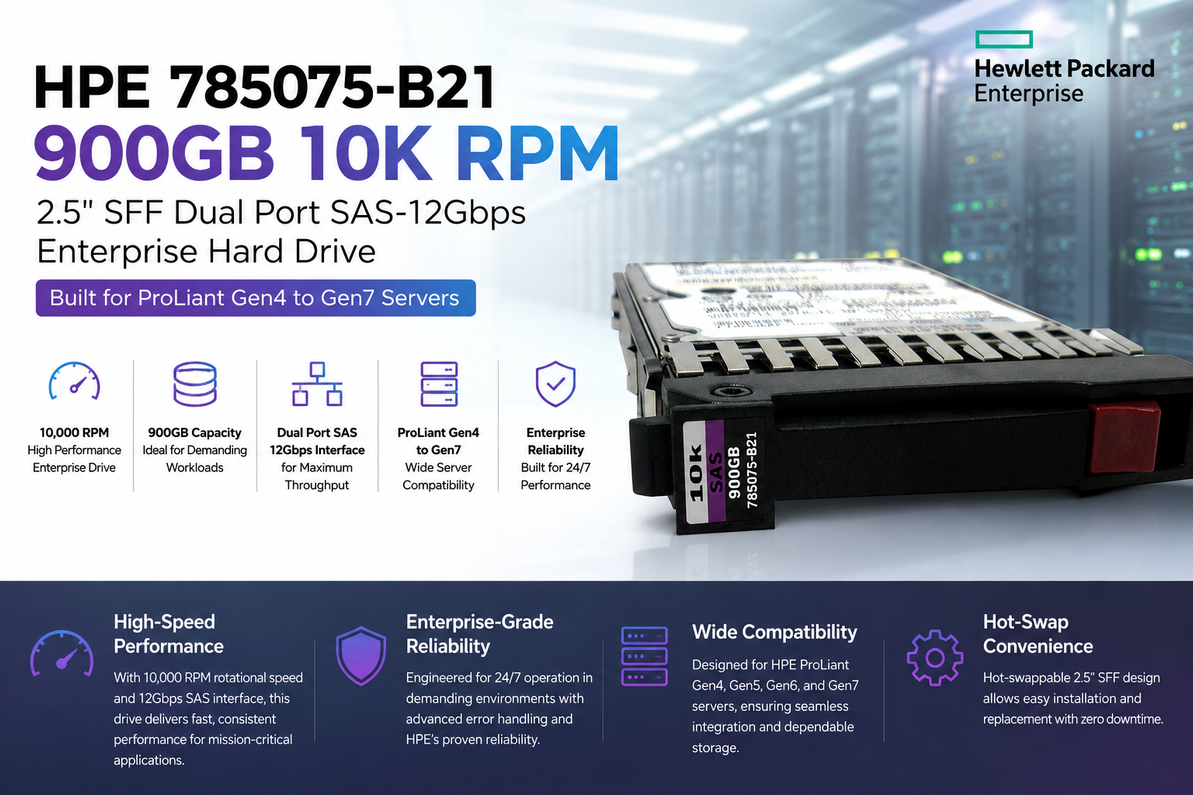
The Enterprise Workhorse: HPE 785075-B21 900GB 10K SAS Storage for ProLiant Servers
HPE 785075-B21 900GB 10K RPM SAS Hard Drive: Reliable Enterprise Storage for ProLiant Servers
Introduction
The HPE 785075-B21 900GB 10000RPM 2.5-inch Small Form Factor (SFF) Dual Port SAS-12Gbps Enterprise Hard Drive is designed for organizations that need dependable storage performance in enterprise server environments. Built around the SAS interface and a 10,000 RPM spindle speed, this drive is intended for workloads where consistent performance, reliability, and compatibility are more important than simply maximizing storage capacity.
With a 900GB capacity, 2.5-inch SFF design, dual-port SAS connectivity, and 12Gbps SAS interface, the HPE 785075-B21 can be a practical storage option for compatible HPE ProLiant server configurations. Its enterprise-oriented design makes it suitable for applications such as databases, virtualization, business applications, file services, and general server workloads where storage responsiveness matters.
For organizations maintaining older or mixed-generation server infrastructure, choosing a drive that matches the server's storage controller, drive bay, firmware requirements, and interface standards is particularly important. The HPE 785075-B21 is positioned as an enterprise hard drive solution for compatible HPE ProLiant Generation4 through Generation7 server environments.
HPE 785075-B21 Key Specifications
900GB Enterprise Storage Capacity
The HPE 785075-B21 provides 900GB of storage capacity, giving administrators a useful balance between capacity and performance. While modern storage environments often use much larger drives, 900GB can still be valuable for operating-system volumes, application data, databases, virtual machines, or RAID arrays.
In enterprise environments, storage capacity is not always the only priority. A smaller-capacity drive with enterprise performance characteristics can be useful when a server requires multiple drives in a RAID configuration. Several 900GB drives can be combined to provide redundancy, improved performance, or additional usable capacity depending on the RAID level selected.
10,000 RPM Spindle Speed
One of the defining characteristics of the HPE 785075-B21 is its 10,000 RPM rotational speed. Compared with traditional 7,200 RPM enterprise hard drives, 10K RPM drives generally offer lower rotational latency and better responsiveness for workloads involving frequent random disk access.
This characteristic can be especially useful for applications that regularly read and write relatively small blocks of data. Database applications, virtualization platforms, transactional workloads, and frequently accessed business applications can benefit from the responsiveness offered by 10K RPM enterprise HDDs.
Although SSD technology provides substantially faster access times, 10K RPM SAS drives can still provide a practical solution when organizations need cost-effective enterprise storage while continuing to use existing SAS-based infrastructure.
2.5-Inch Small Form Factor Design
The HPE 785075-B21 uses a 2.5-inch Small Form Factor (SFF) design. SFF drives are widely used in enterprise servers because they allow manufacturers to install a greater number of drives within a limited chassis footprint.
A higher drive density can be particularly useful in data centers where rack space is valuable. More physical drives within a server can also provide administrators with greater flexibility when designing RAID arrays or separating operating systems, applications, and data across different storage resources.
Before installing the HPE 785075-B21, administrators should confirm that their particular ProLiant server supports the appropriate SFF drive configuration and that the required drive carrier or caddy is available.
Dual-Port SAS Connectivity
The drive features dual-port SAS connectivity, an important characteristic of enterprise SAS storage. SAS technology is designed for server and storage environments where reliability, scalability, and advanced storage-management capabilities are important.
Dual-port connectivity can support redundant storage paths in appropriately configured enterprise systems. If one path or controller becomes unavailable, a properly designed storage architecture can potentially maintain connectivity through the alternate path.
The exact functionality depends on the server, SAS controller, backplane, firmware, and overall storage architecture. Therefore, dual-port capability should be considered as part of the complete storage design rather than as an isolated feature.
SAS 12Gbps Interface
The HPE 785075-B21 uses a 12Gbps SAS interface. SAS 12Gbps provides a high-speed interface between the storage device and compatible SAS infrastructure.
It is important to understand that the interface speed does not mean the mechanical hard drive will continuously transfer data at 12Gbps. A 10K RPM HDD has physical limitations based on its rotational speed, platter technology, cache behavior, workload, and other characteristics.
The advantage of the faster SAS interface is that it provides sufficient interface bandwidth and supports modern enterprise SAS infrastructure. Actual storage performance depends on the entire storage path, including the drive, controller, backplane, RAID configuration, and workload.
Enterprise-Class Storage for ProLiant Servers
Designed for Server Environments
Unlike consumer desktop hard drives, enterprise HDDs are designed around the requirements of server environments. Servers often operate continuously and handle workloads that involve substantially more concurrent activity than typical personal computers.
The HPE 785075-B21 is intended for use in compatible HPE ProLiant server platforms, making platform compatibility an important consideration when selecting this drive.
HPE ProLiant servers use carefully designed storage architectures that can include Smart Array controllers, SAS backplanes, hot-plug drive bays, and system-level storage management. Using an appropriate enterprise drive helps maintain compatibility with that ecosystem.
Suitable for RAID Configurations
One of the major advantages of enterprise hard drives is their suitability for RAID-based storage architectures. RAID allows multiple physical drives to work together as a logical storage system.
Depending on the selected RAID level, an organization can prioritize redundancy, capacity, read performance, write performance, or a combination of these characteristics.
For example, RAID 1 can provide mirroring, while RAID 5 and RAID 6 can provide redundancy with greater usable capacity. RAID 10 can combine mirroring and striping to deliver strong performance and redundancy.
The HPE 785075-B21's 900GB capacity makes it possible to build storage arrays using multiple drives, provided the server and controller support the required configuration.
Performance Characteristics of a 10K SAS HDD
Random I/O Performance
Random I/O is one of the areas where 10K RPM enterprise HDDs can provide an advantage over slower rotational drives. Because the platters rotate at 10,000 revolutions per minute, the drive can generally position requested data more quickly than a comparable 7,200 RPM HDD.
This can make a noticeable difference in server workloads involving frequent random access. Database systems and virtualized environments can generate substantial random I/O, particularly when several applications or virtual machines share the same storage array.
Sequential Data Transfers
Sequential workloads involve reading or writing data in relatively continuous blocks. Examples include large file transfers, backups, archival operations, and media-related workloads.
A 10K SAS hard drive can provide respectable sequential performance for a mechanical storage device. However, actual transfer rates vary depending on the location of data on the platters, workload characteristics, RAID configuration, controller, and other system components.
For workloads requiring extremely high sequential throughput, modern SSDs may be more appropriate. For organizations balancing cost, capacity, and enterprise compatibility, however, 10K SAS HDDs remain useful in suitable environments.
HPE ProLiant Generation4 to Generation7 Compatibility
Supporting Legacy Server Infrastructure
One of the most important reasons organizations continue to seek enterprise SAS drives is the need to maintain existing server infrastructure. Replacing an entire server simply because its storage has reached the end of its useful life may not always be practical.
The HPE 785075-B21 is associated with HPE ProLiant Generation4 through Generation7 servers, making it relevant to organizations maintaining older ProLiant hardware.
Legacy systems can still perform important business functions, particularly when they run stable applications that do not justify an immediate platform replacement. Keeping compatible storage available can help extend the useful operational life of such infrastructure.
Verify Compatibility Before Installation
Although a drive may be marketed for a particular ProLiant generation range, administrators should still verify compatibility with the exact server model and configuration.
Important considerations include the installed SAS controller, drive cage, backplane, firmware version, drive carrier, RAID configuration, and server operating environment.
This is particularly important with older ProLiant systems because different configurations can use different storage controllers and drive-bay arrangements.
Benefits of SAS Storage in Enterprise Environments
Reliability and Manageability
SAS was developed specifically with enterprise storage requirements in mind. SAS environments can support advanced features such as multiple storage paths, enterprise controller integration, and sophisticated storage management.
For organizations already operating SAS-based infrastructure, continuing with SAS HDDs can simplify hardware integration and maintenance.
Scalability
Another advantage of SAS is its ability to support storage architectures involving multiple drives. Enterprise servers can combine numerous SAS drives through compatible controllers and backplanes.
This makes SAS particularly useful for RAID arrays and storage systems where administrators need to balance capacity, performance, and redundancy.
HPE 785075-B21 for Different Server Workloads
Database Applications
Databases often generate a combination of random reads and writes. Storage responsiveness can therefore have an important effect on overall application performance.
A 10K RPM SAS drive can provide a reasonable mechanical-storage solution for database workloads when SSD storage is not required or when budget and existing infrastructure favor HDD technology.
For heavily transactional databases, however, storage requirements should be carefully evaluated because modern databases can quickly exceed the performance capabilities of mechanical drives.
Virtualization
Virtualization environments place multiple operating systems and applications on shared physical hardware. This can create unpredictable storage workloads because several virtual machines may access storage simultaneously.
A RAID array built from multiple 10K SAS drives can provide a more responsive storage environment than a single conventional hard drive. Still, organizations running large numbers of virtual machines should evaluate IOPS requirements carefully and consider SSD or hybrid storage where appropriate.
File and Application Servers
File servers and application servers can also benefit from enterprise SAS storage. The 900GB capacity can be allocated for frequently accessed business data, application files, departmental storage, or other server resources.
The exact suitability depends on the workload and the amount of data generated by the organization.
RAID Planning With 900GB Drives
Balancing Capacity and Redundancy
When several HPE 785075-B21 drives are installed in a RAID array, administrators can create storage pools designed around specific business requirements.
For example, a mirrored configuration sacrifices some raw capacity in exchange for redundancy. Parity-based RAID can provide better usable capacity while protecting against certain drive failures. RAID 10 can offer a combination of redundancy and performance.
The correct RAID level depends on the organization's recovery requirements, workload, budget, and acceptable downtime.
Rebuilding After Drive Failure
Drive replacement and RAID rebuild performance should also be considered. When a mechanical drive fails, rebuilding an array can place significant additional workload on the remaining drives.
Enterprise storage planning should therefore include appropriate backups, monitoring, spare-drive strategies, and recovery procedures rather than relying on RAID alone.
Why Choose an Enterprise SAS HDD?
Cost-Effective Performance
For organizations that already have compatible SAS infrastructure, a 10K RPM enterprise HDD can offer a practical combination of performance and cost.
Moving entirely to SSD storage can require a significant investment, especially when a large number of drives are involved. In some environments, upgrading or replacing existing SAS HDDs can provide an economical way to maintain operational capacity.
Compatibility With Existing Infrastructure
Compatibility is another major reason to use an enterprise SAS drive. Organizations with established SAS controllers, backplanes, and storage arrays may prefer to maintain the existing architecture rather than redesign the entire storage subsystem.
The HPE 785075-B21 can therefore be particularly relevant when maintaining supported or legacy ProLiant server deployments.
HPE 785075-B21 vs. SSD Storage
When a 10K HDD Makes Sense
A 10K SAS HDD can still make sense when the workload requires moderate storage performance, the existing server infrastructure is SAS-based, and budget considerations are important.
It can also be useful for secondary storage, less performance-sensitive applications, backup-related workloads, or environments where large numbers of existing mechanical drives are already deployed.
When an SSD Is Better
SSDs have no moving platters and generally provide dramatically lower latency and much higher IOPS than mechanical hard drives. Applications that require very fast response times, high transaction rates, or intensive random I/O will often benefit from SSD storage.
However, upgrading to SSDs should involve more than simply comparing advertised speeds. Administrators should evaluate controller compatibility, endurance requirements, RAID support, capacity, and overall system architecture.
Installation and Maintenance Considerations
Check the Server Configuration
Before installing the HPE 785075-B21, confirm the exact ProLiant model and installed storage controller. Check that the server has compatible SFF drive bays and that the SAS backplane supports the required interface.
The appropriate HPE drive carrier may also be necessary depending on the server configuration.
Keep Firmware and Controllers Updated
Firmware can play an important role in enterprise storage compatibility and stability. Administrators should ensure that the server BIOS, storage controller firmware, and other relevant system components are maintained according to the platform's supported configuration.
Regular monitoring is also valuable. Enterprise storage environments should track drive health, RAID status, error conditions, and available capacity so that potential problems can be identified before they become service interruptions.
Is the HPE 785075-B21 Right for Your Server?
The HPE 785075-B21 can be a strong fit for organizations looking for a 900GB 10K RPM SFF SAS enterprise hard drive for compatible HPE ProLiant infrastructure. Its combination of 10,000 RPM performance, dual-port SAS connectivity, 12Gbps SAS interface, and compact 2.5-inch form factor makes it well suited to enterprise storage environments where reliability and compatibility are important.
Its greatest value may be found in organizations maintaining older HPE server infrastructure. Rather than replacing an entire server platform, businesses can potentially extend the usefulness of compatible systems by replacing aging storage with appropriate enterprise-grade drives.
However, compatibility should always be verified against the exact server model, storage controller, backplane, firmware, and intended RAID configuration before purchase or installation.
Conclusion
The HPE 785075-B21 900GB 10000RPM 2.5-inch SFF Dual Port SAS-12Gbps Enterprise Hard Drive represents a practical storage solution for compatible HPE ProLiant server environments. Its 900GB capacity provides useful enterprise storage space, while the 10K RPM spindle speed offers better responsiveness than conventional 7,200 RPM mechanical drives.
Its dual-port SAS architecture and enterprise-oriented design make it particularly relevant to organizations operating established server and storage infrastructure. Whether used in RAID arrays, application servers, database environments, virtualization platforms, or general-purpose enterprise workloads, the drive can provide a dependable mechanical storage option when matched with the right HPE server configuration.
For businesses maintaining HPE ProLiant Generation4 through Generation7 servers, the HPE 785075-B21 can be a practical choice for refreshing or expanding compatible storage while preserving an existing SAS-based infrastructure. As with any enterprise storage upgrade, verifying compatibility and planning the storage architecture carefully are essential steps toward achieving reliable long-term performance.
Recent Posts
-

Compact Power, Enterprise Speed: HPE 785067-B21 300GB 10K SAS Storage for ProLiant Servers
HPE 785067-B21 300GB 10000RPM SAS-12Gbps Enterprise Hard Drive for ProLiant Servers The HPE 785067-B …Sep 21st 2026 -
Power Meets Precision: HPE 872475-B21 300GB 10K SAS Enterprise Storage for ProLiant Servers
HPE 872475-B21 300GB 10000RPM SAS-12Gbps Enterprise Hard Drive: Reliable Storage for ProLiant Server …Sep 20th 2026 -
Revive Legacy ProLiant Power: HPE 627117-B21 300GB 15K SAS Storage Built for Enterprise Performance
HPE 627117-B21 300GB 15000RPM SAS Hard Drive: Enterprise Storage for Proven ProLiant Platforms Enter …Sep 19th 2026