
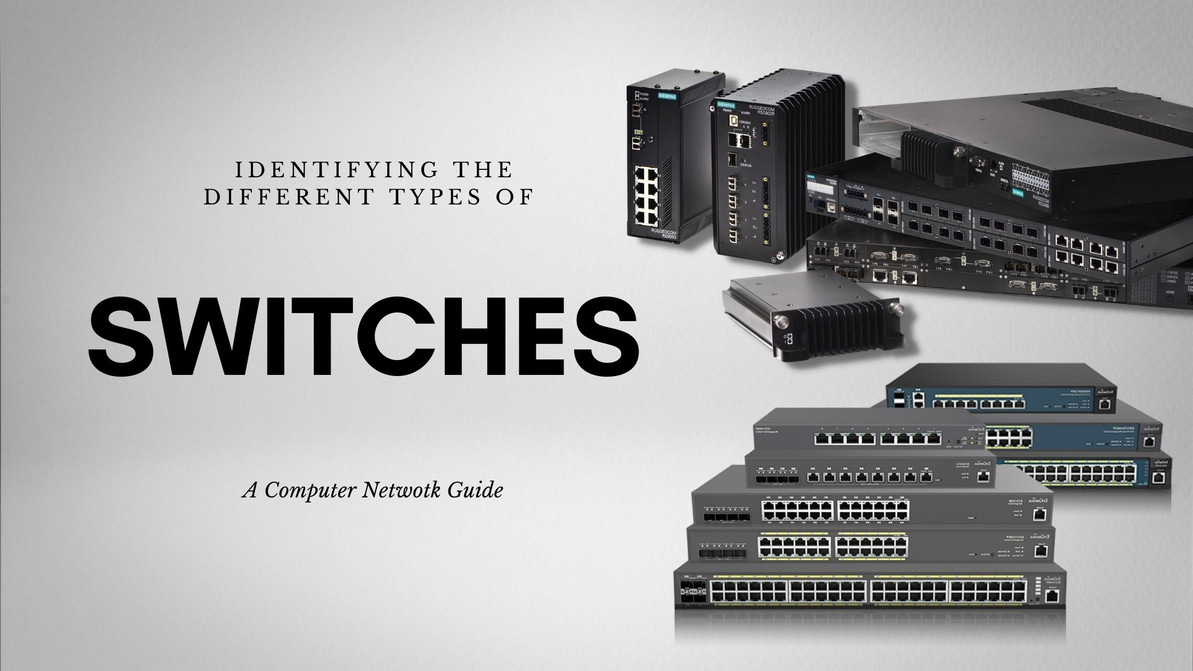
Identifying The Different Types of Switches: A Computer Network Guide
Ethernets are gaining popularity in industrial computer-controlled systems, because they allow for a single network protocol at both the higher and lower levels of an industrial communication infrastructure. It is a traditional technology for connecting devices within a wired local area network (LAN) or wide area network (WAN). Devices may communicate with each other utilizing a protocol, which is a set of regulations or agreed language used by all nodes on the network.
Switches are the network's connection points. These tiny gadgets can receive data from numerous input ports and send it to the right output port, which sends data to a destination in the network. In a network, there are several types of switches. The following are some of them:
Unmanaged Switches
These are the most popular switches for small businesses and home networks because they simply plug in and start functioning, and they do not need to be watched or configured. These may be connected using only little cable connections. It allows devices on a network to communicate with each other, such as a computer communicating with a computer or a computer communicating with a printer over a distance. They are the cheapest of all switches in terms of cost.
Managed Switches
A master/slave network operation is achieved by utilizing these sorts of switches, which have a number of characteristics, such as the highest levels of security, precision control, and whole network management. These are utilized in businesses with a large network that may be customized to improve the functionality of specific networks. They're the most expensive option around, but because of their scalability, they're an excellent choice for a growing network. They are made possible using a basic networking management method (SNMP).
They are of two types of managed switches:
Smart switches - In comparison to the other managed switches, these ones have fewer management capabilities, but they do include some security settings. They have a simpler management interface than the other managed switches because of this. As a result, they are commonly known as half-managed switches. These are mostly used in gigabit and continuous LANs that allow for data transfer at speeds of 10 Gb/s or greater. It's possible to configure VLANs on it (Virtual LAN).
Enterprise managed switches - The ability to repair, duplicate, transform, and display a number of network configurations is just one example. A web-based SNMP agent and command line interface are also included. These are also known as fully managed switches because they offer additional features that may be enhanced. These are used by businesses with a large number of ports, switches, and nodes.
LAN switches
These are also known as Ethernet switches or data switches and are used to separate a bundle of information into several parts. These are utilized to connect points on a LAN network.
PoE switches
In a bid to make the job easier, Power over Ethernet switches are used in PoE. This technology combines data and power on the same cable, allowing power devices to receive data in parallel to electricity. As a result of this, these switches provide greater freedom by reducing the amount of time spent on cabling.
Recent Posts
-
HPE R0Q55A 1.2TB SAS Enterprise Drive: Turbocharging HPE MSA 1060 & 2060 Storage with 10K Performance
HPE R0Q55A 1.2TB 10K RPM SAS 12Gbps 2.5-Inch Enterprise Hard Drive: The Complete Guide for MSA 1060/ …Jun 8th 2026 -
The Quiet Workhorse: How the HPE J9F48A Keeps Mission-Critical Systems Alive
HPE J9F48A 1.2TB 10000RPM 2.5-inch SFF Dual Port SAS-12Gbps Enterprise Hard Drive — A Complete Guide …Jun 7th 2026 -
The Last Line of Defense You'll Never Notice — HPE P9M81A Self-Encrypting Drive
Locked Down, Wide Open: The HPE P9M81A Self-Encrypting Drive That Protects Everything Without Slowin …Jun 6th 2026