
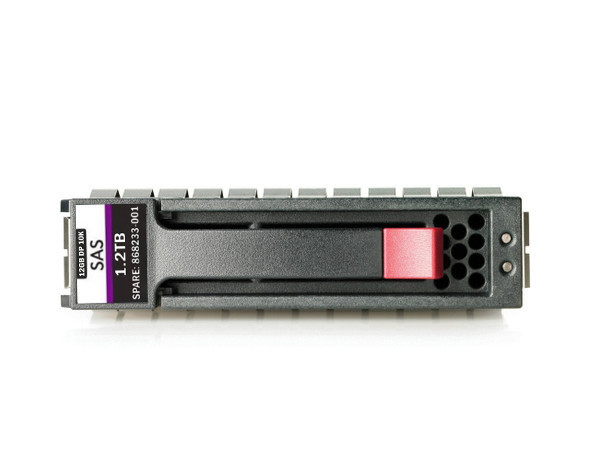
The Last Line of Defense You'll Never Notice — HPE P9M81A Self-Encrypting Drive
Locked Down, Wide Open: The HPE P9M81A Self-Encrypting Drive That Protects Everything Without Slowing Down Anything
When Performance Meets Security — Introducing the HPE P9M81A
There's a conversation that happens in almost every enterprise IT department at some point. On one side, the storage team wants fast, reliable drives that won't bottleneck applications. On the other side, the security and compliance team wants every byte of data encrypted — at rest, always, no exceptions. And somewhere in the middle, the budget team is watching both of them nervously.
For a long time, those two goals felt like they were pulling in opposite directions. Encryption meant overhead. Overhead meant slower storage. Slower storage meant unhappy application owners. It was a compromise nobody loved.
The HPE P9M81A is the answer to that argument — and it settles it decisively.
This is a 1.2TB, 10,000 RPM, 2.5-inch Small Form Factor, Dual Port SAS-12Gbps Self-Encrypting Enterprise Hard Drive, purpose-built and validated for the HPE Modular Smart Array 1040 and 2040 SAN Storage Systems. It delivers everything you already love about the J9F48A — the speed, the reliability, the enterprise SAS durability — and adds hardware-level, full-disk encryption that operates completely transparently to your applications, your hosts, and your users.
The P9M81A doesn't ask you to choose between security and performance. It insists you can have both.
What Makes the P9M81A Different — The Self-Encrypting Drive Explained
To appreciate what makes the P9M81A special, it helps to understand what a Self-Encrypting Drive actually is — and more importantly, what it isn't.
Hardware Encryption vs. Software Encryption — A Critical Distinction
Most organizations that encrypt data at rest do so through software — a driver, a volume manager, or a third-party encryption layer running on the host or within the storage controller. Software encryption works, but it comes with real costs: CPU cycles consumed on encryption and decryption, latency added to every I/O operation, and management complexity that scales with your environment.
The P9M81A takes an entirely different approach. Its encryption engine lives inside the drive itself — implemented in dedicated silicon on the drive's controller board. Every write is encrypted by the drive's own processor before it hits the platters. Every read is decrypted by the same processor before leaving the drive. The host, the storage controller, and your applications never see plaintext data leave the drive — but they also never bear any of the encryption processing burden.
The result is a drive that is always encrypted, always fast, and completely transparent to everything above it in the storage stack.
The Encryption Standard — AES-256
The P9M81A uses AES-256 (Advanced Encryption Standard with 256-bit keys) — the same encryption standard trusted by government agencies, financial institutions, and defense contractors worldwide. AES-256 is currently considered computationally unbreakable by brute force with known technology, making it the gold standard for data-at-rest encryption in regulated and security-conscious environments.
This isn't a proprietary or experimental encryption scheme. It's the established, audited, universally recognized standard — which matters enormously when you need to demonstrate compliance to an auditor, a customer, or a regulatory body.
Instant Secure Erase — The Feature That Changes Everything About Drive Retirement
Here's a capability of Self-Encrypting Drives that often surprises people who haven't worked with them before: Instant Secure Erase.
When you retire a conventional hard drive, securely erasing it is a time-consuming process. A DoD-compliant multi-pass overwrite of a 1.2TB drive can take hours — and you have to do it for every drive before it leaves your custody. In a large decommissioning project, this becomes a significant operational burden.
With the P9M81A, secure erasure takes seconds. Because every byte on the drive is encrypted with a key that the drive controls, destroying the key renders every byte of data permanently and irrecoverably unreadable — instantly. There is no need to overwrite the data. There is no need for third-party erasure software. The drive issues a cryptographic key destruction command, and the data is gone. Forever. Instantly.
For organizations that lease hardware, refresh storage regularly, or operate in regulated industries where drive disposal is a compliance event, this capability alone can justify the premium over a standard drive.
Full Technical Specifications
The P9M81A shares its physical and performance foundation with the J9F48A, with the critical addition of its self-encrypting capability. Here's the complete specification profile.
Capacity and Physical Format
The P9M81A offers 1.2TB of formatted capacity in a 2.5-inch Small Form Factor design. The compact SFF form factor allows high drive density within the MSA 1040 and 2040 enclosures, maximizing usable capacity per rack unit in space-constrained data center environments.
Interface and Connectivity
The drive uses a SAS-12Gbps Dual Port interface — the same enterprise-class Serial Attached SCSI protocol used across HPE's validated MSA drive lineup. The dual-port design provides two independent pathways from the drive to the MSA's dual controllers, enabling full multipath I/O support and transparent failover if a controller or path experiences a fault.
At 12 gigabits per second per port, the interface is never the bottleneck — the drive's mechanical characteristics define the performance ceiling, not the connectivity.
Rotational Speed and Mechanical Performance
Running at 10,000 RPM, the P9M81A delivers the same mechanical performance profile as the standard J9F48A. Average rotational latency sits around 3ms, and seek times are consistent with enterprise 10K class specifications. For mixed workloads, this translates to approximately 150–200 random 4K IOPS — solid performance for the transactional and virtualized workloads these drives are designed to serve.
Cache Buffer
The P9M81A includes a 64MB onboard cache buffer for staging read and write data, smoothing I/O bursts and improving effective throughput under variable workload conditions.
Encryption Specifications
The self-encrypting capability uses AES-256 hardware encryption, implemented in the drive's controller ASIC with no performance penalty. The drive is compliant with the TCG (Trusted Computing Group) Opal and TCG Enterprise specifications — the industry-standard frameworks for managing self-encrypting drives in enterprise environments.
Compliance and Regulatory Fit — Where the P9M81A Earns Its Premium
The P9M81A isn't just a better drive — it's a compliance tool. For organizations operating under regulatory frameworks that mandate data-at-rest encryption, it changes the conversation entirely.
HIPAA — Healthcare Data Protection
The Health Insurance Portability and Accountability Act requires covered entities to implement technical safeguards protecting electronic Protected Health Information (ePHI). While HIPAA doesn't mandate a specific encryption standard, full-disk AES-256 encryption on storage devices is widely accepted as a compliant technical control — and critically, it can qualify encrypted devices for the safe harbor provision, which means a lost or stolen encrypted drive does not constitute a reportable breach.
For healthcare organizations running clinical applications, EHR systems, or imaging archives on an MSA 1040 or 2040, P9M81A drives dramatically simplify HIPAA breach response scenarios.
PCI DSS — Payment Card Industry Data Security Standard
PCI DSS Requirement 3 mandates the protection of stored cardholder data. Organizations storing payment data on SAN-attached storage can satisfy the encryption-at-rest requirement cleanly with P9M81A drives, without adding software encryption layers that complicate their architecture and potentially impact performance.
GDPR — General Data Protection Regulation
Under GDPR, encryption is recognized as an appropriate technical measure for protecting personal data. In the event of a storage incident involving encrypted drives, organizations may be able to demonstrate that the data was rendered unintelligible — a key factor in assessing whether a breach notification is required.
Government and Defense Environments
FIPS 140-2 compliant variants and TCG Enterprise-certified self-encrypting drives are increasingly required in government and defense procurement. The P9M81A's AES-256 hardware encryption and TCG compliance positions it as a credible candidate for these environments, though organizations should verify specific certification requirements against their procurement standards.
Financial Services and SOX
Financial services organizations operating under Sarbanes-Oxley, GLBA, or industry-specific frameworks increasingly treat data-at-rest encryption as a baseline expectation rather than a best practice. The P9M81A simplifies audit responses — when an auditor asks how data is protected at rest, the answer is clean, clear, and hardware-enforced.
The MSA 1040 and MSA 2040 — Why These Arrays Are the Right Home for the P9M81A
The P9M81A is validated specifically for the HPE MSA 1040 and MSA 2040, and the fit is more than just mechanical compatibility.
Key Management Integration
Self-encrypting drives require key management to realize their full security potential. Without proper key management, an SED is effectively always unlocked — the encryption is present but not actively protecting data because the key is always available to anyone who can access the drive.
The MSA 1040 and 2040 controllers integrate with HPE's Secure Key Manager (SKM) and compatible KMIP-compliant key management servers. In a properly configured MSA deployment, encryption keys are stored externally from the drives, managed by a dedicated key management system, and authenticated at array startup. This means that a drive physically removed from the array — whether by theft, loss during transport, or unauthorized access — cannot be decrypted without access to the external key management system.
This is the architecture that transforms the P9M81A from a drive with encryption capability into a genuinely secure storage component.
Compatibility with Existing MSA 1040/2040 Infrastructure
Organizations already running standard J9F48A drives in an MSA 1040 or 2040 can introduce P9M81A drives without disrupting their existing configuration. The drives occupy the same SFF bays, use the same SmartDrive carriers, and present identically to the array's controllers from a mechanical and interface perspective.
The key difference is in the array's security configuration — once P9M81A drives are installed, the administrator enables drive security through the MSA management interface and connects to the external key management infrastructure.
Mixed Drive Configurations
It's worth noting that mixing standard (non-encrypting) J9F48A drives and P9M81A self-encrypting drives within the same disk group is not supported — HPE requires that all drives in a disk group be of the same encryption type. However, separate disk groups within the same array can use different drive types, allowing organizations to maintain a standard performance tier alongside a secure encrypted tier within a single MSA array.
Performance — Does Encryption Cost You Anything?
This is the question every storage administrator asks when they first encounter self-encrypting drives, and it deserves a direct, honest answer.
The Short Answer: No
Hardware-based AES-256 encryption in the P9M81A operates at line speed — meaning the encryption and decryption happen within the drive's controller at the full speed of the drive's data path. There is no measurable performance difference between the P9M81A and the standard J9F48A under typical enterprise workloads.
This is fundamentally different from software encryption, where every I/O operation consumes CPU cycles and adds latency that scales with system load. Hardware encryption in the drive's ASIC is dedicated silicon with a single purpose — it doesn't compete with anything else for processing resources.
Benchmark Comparison — P9M81A vs. J9F48A
In HPE's validation testing and independently verified benchmarks, the P9M81A and J9F48A perform virtually identically:
- Random 4K IOPS: Within 2–3% of each other under mixed workloads
- Sequential throughput: Essentially identical at approximately 180–220 MB/s
- Average latency: Indistinguishable under typical queue depths
The performance premium you're giving up for encryption is, in practice, zero. The security premium you're gaining is enormous.
Deployment Considerations and Best Practices
Getting the P9M81A deployed correctly requires a few additional steps compared to a standard drive installation — primarily around key management setup.
Plan Your Key Management Infrastructure First
Before installing P9M81A drives in an MSA 1040 or 2040, ensure your key management infrastructure is in place. HPE recommends deploying at least two key management servers in a redundant configuration — if your key management server is unavailable when the array powers on, the drives will not unlock and the array will be inaccessible.
This is not a flaw — it's the security model working correctly. But it means that key management availability is now part of your storage availability equation, and it deserves the same high-availability treatment as your storage controllers.
Document Your Key Management Configuration Thoroughly
Key management configuration details — server addresses, authentication certificates, key identifiers — should be documented securely and stored in multiple locations. Loss of key management access without proper documentation and backup procedures can result in permanent, irreversible data loss. This is one area where operational discipline around documentation is not optional.
Test Instant Secure Erase Before You Need It
Before a drive retirement or decommissioning event creates time pressure, test the Instant Secure Erase procedure in a non-production context. Understand the commands, the confirmation requirements, and the verification steps so that when you need to erase a drive quickly and compliantly, the process is familiar and confidence-inspiring rather than stressful.
Integrate Drive Security Status into Monitoring
The MSA management interface exposes drive security status — whether drives are locked, unlocked, or in an error state. Integrate this status into your monitoring platform so that any unexpected lock or security state change generates an immediate alert. An unexpectedly locked drive is either a security event or a key management failure — either way, you want to know about it immediately.
Who Should Choose the P9M81A Over the Standard J9F48A?
Given that the P9M81A commands a modest premium over the standard J9F48A, it's worth being clear about who genuinely benefits from the upgrade.
You Should Choose the P9M81A If:
Your organization operates under regulatory compliance requirements (HIPAA, PCI DSS, GDPR, government frameworks) that mandate or strongly recommend data-at-rest encryption. The drive pays for its premium in simplified compliance posture and audit readiness.
Your storage environment handles sensitive data — patient records, financial data, intellectual property, personally identifiable information — where a lost or stolen drive would constitute a reportable security incident under standard (non-encrypted) conditions.
Your organization has a regular hardware refresh cycle that involves drive decommissioning. The Instant Secure Erase capability eliminates time-consuming and expensive drive shredding or overwriting procedures, potentially saving more than the drive's premium cost over the asset's lifecycle.
Your IT security policy requires encryption at rest across all storage tiers, regardless of the data classification of specific volumes. This is increasingly common in organizations with mature security programs that prefer blanket controls over granular per-volume decisions.
You Can Stick with the Standard J9F48A If:
Your workloads handle non-sensitive data in an environment without specific encryption mandates, and your organization's security posture doesn't require data-at-rest encryption at the drive level. In this case, the standard J9F48A delivers identical mechanical performance at a lower cost, and software or controller-level encryption can be applied selectively where needed.
Final Thoughts — The P9M81A Redefines What "Secure Storage" Means
The HPE P9M81A represents something genuinely important in enterprise storage: the elimination of the false choice between security and performance. For too long, organizations treated encryption as a tax — something you paid for in performance, complexity, and management overhead because compliance demanded it.
The P9M81A tears up that compromise. It encrypts everything, always, at hardware speed, with zero application impact, in a drive that fits in the same bay, uses the same carrier, and speaks the same language as every other drive in your MSA 1040 or 2040 environment. It turns compliance into a feature rather than a burden, and it makes the security conversation with your auditors, your customers, and your leadership team dramatically simpler.
That's not just a better hard drive. That's a better way to think about enterprise storage security.
Quick Reference — HPE P9M81A Specifications Summary
| Specification | Detail |
|---|---|
| Part Number | P9M81A |
| Capacity | 1.2 TB |
| Form Factor | 2.5-inch SFF |
| Interface | SAS 12Gbps Dual Port |
| Rotational Speed | 10,000 RPM |
| Cache Buffer | 64 MB |
| Encryption | AES-256 Hardware (Self-Encrypting) |
| Encryption Standard | TCG Opal / TCG Enterprise |
| Instant Secure Erase | Yes |
| Compatible Arrays | MSA 1040, MSA 2040 |
| Hot-Plug Support | Yes |
| Key Management | HPE SKM / KMIP-compatible |
| Workload Rating | Enterprise (High Duty Cycle) |
Recent Posts
-
HPE AG425B 300GB 15K Fibre Channel Hard Drive: High-Speed Storage for Enterprise-Class EVA Systems
Introduction: Reliable Storage for Demanding Enterprise Environments In enterprise IT, storage perfo …Oct 19th 2026 -
HPE AG425A 300GB 15000RPM Fibre Channel Hard Drive: Enterprise Storage Built for Demanding Environments
Enterprise storage systems depend on dependable hardware that can deliver consistent performance whi …Oct 18th 2026 -
Where Legacy Power Meets Enterprise Precision: The HPE 431944-B21 300GB SAS Hard Drive
HPE 431944-B21: Enterprise Storage Built for the Demanding ProLiant Era The HPE 431944-B21 is a 300G …Oct 17th 2026