
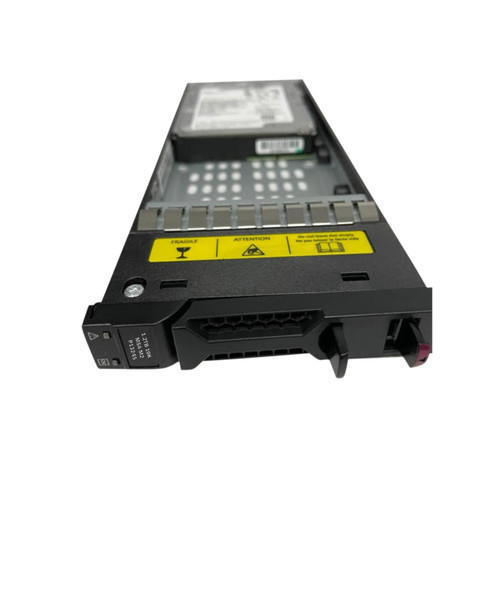
HPE R0Q55A 1.2TB SAS Enterprise Drive: Turbocharging HPE MSA 1060 & 2060 Storage with 10K Performance
HPE R0Q55A 1.2TB 10K RPM SAS 12Gbps 2.5-Inch Enterprise Hard Drive: The Complete Guide for MSA 1060/2060 SAN Storage
If you're managing enterprise storage infrastructure and looking for a drive that punches hard on performance without breaking your SAN architecture, the HPE R0Q55A deserves a serious look. This isn't just another hard drive — it's a purpose-engineered storage component designed from the ground up for the demanding, always-on world of enterprise SAN environments. Whether you're an IT administrator planning a storage expansion, a procurement specialist comparing options, or simply someone who wants to understand what makes this drive tick, this guide covers everything you need to know.
What Is the HPE R0Q55A and Why Does It Matter
Before diving into specs and performance characteristics, it's worth understanding the context in which this drive exists. Enterprise storage isn't the same game as consumer or even prosumer storage. The stakes are different. Downtime costs real money. Data integrity isn't a nice-to-have — it's a business-critical requirement. And the drives powering these environments need to reflect that reality.
The HPE R0Q55A is a 1.2TB Small Form Factor (SFF) 2.5-inch hard drive spinning at 10,000 RPM, leveraging the SAS-12Gbps interface and engineered specifically for HPE's Modular Smart Array (MSA) 1060 and 2060 SAN Storage platforms. It carries HPE's enterprise-grade designation, which means it goes through validation testing that goes far beyond what a standard drive would face. When HPE slaps the "Enterprise" label on a product, they're signaling something specific: this drive is built to live in a storage array, run 24 hours a day, 7 days a week, and keep your data safe while doing it.
The Role of Enterprise Hard Drives in Modern Data Centers
It might feel like SSDs have taken over the storage world entirely — and in many ways, they've transformed the landscape. But enterprise HDDs like the R0Q55A continue to hold a vital position in tiered storage architectures. They offer a compelling combination of high capacity per cost, proven reliability in high-IOPS environments, and compatibility with existing SAN infrastructure investments. For workloads that require fast random access but don't need the extreme low latency of flash, a 10K RPM SAS drive remains one of the most practical and cost-effective choices available.
HPE R0Q55A Technical Specifications at a Glance
Understanding the technical profile of the R0Q55A helps explain why it performs the way it does in production environments. These aren't arbitrary numbers — each specification reflects a deliberate engineering decision.
Capacity and Form Factor
The R0Q55A offers 1.2TB of formatted capacity in a 2.5-inch Small Form Factor (SFF) housing. This compact footprint makes it ideal for high-density storage deployments where rack space is a premium. In a world where data centers pay for every square foot of floor space and every rack unit of vertical height, the ability to pack meaningful capacity into a 2.5-inch drive profile is genuinely valuable. The SFF design also typically runs cooler and draws less power than its larger 3.5-inch counterparts, which contributes to lower operational costs over the drive's lifetime.
Rotational Speed: The 10,000 RPM Advantage
At 10,000 RPM, the R0Q55A sits in a sweet spot that enterprise storage engineers have long appreciated. The faster a drive spins, the shorter the rotational latency — meaning the drive spends less time waiting for the right sector to spin under the read/write head. At 10K RPM, average rotational latency drops to around 3 milliseconds, which translates directly into faster response times for random I/O workloads. This makes the drive particularly well-suited for databases, transactional applications, virtual machine storage, and other workloads where random access patterns dominate.
SAS-12Gbps Interface: Speed and Reliability Combined
The Serial Attached SCSI (SAS) interface has been the backbone of enterprise storage for good reason. The 12Gbps generation, sometimes called SAS-3, delivers a theoretical interface throughput of 12 gigabits per second per lane — double the bandwidth of the previous SAS-6Gbps generation. But raw bandwidth is only part of the story. SAS brings several enterprise-grade features that make it particularly valuable in shared storage environments.
SAS supports dual-port connectivity, meaning a single drive can be accessed through two independent paths simultaneously. This dual-porting capability is fundamental to building fault-tolerant storage systems. If one path fails — whether due to a faulty cable, a failed HBA, or a controller issue — the drive remains accessible through the second path without interruption. For a SAN serving hundreds of users or dozens of virtual machines, this kind of resilience isn't optional. It's the difference between a managed failover and an unplanned outage.
SAS also implements end-to-end error correction and detection mechanisms that are more sophisticated than what SATA drives offer. The protocol was designed from the ground up for multi-initiator environments where multiple hosts access shared storage simultaneously, and it handles these scenarios with the kind of robustness that enterprise administrators expect.
M.2 Form Factor Variant and Its Implications
The R0Q55A is described as an Enterprise M.2 Hard Drive variant, which is worth examining carefully. HPE has made specific engineering decisions around how this drive integrates within the MSA platform's backplane and carrier architecture. The M.2 designation in this context relates to the internal connector and physical integration design rather than the typical consumer M.2 SSD format most IT professionals are familiar with. This proprietary integration approach is part of what ensures the drive is validated and optimized for the specific MSA platform, rather than being a generic component dropped into a carrier.
This matters because the MSA's management firmware communicates directly with the drive using vendor-specific commands that report health data, temperature readings, wear indicators, and predictive failure metrics. A drive that hasn't been through HPE's validation process may technically spin up in the array, but it won't surface the rich telemetry data that HPE's management tools depend on for proactive health monitoring and predictive maintenance.
Compatibility: HPE Modular Smart Array 1060 and 2060 SAN Storage
The R0Q55A is explicitly validated for use in HPE's Modular Smart Array 1060 (MSA 1060) and MSA 2060 platforms. Understanding these arrays helps contextualize what the drive brings to each environment.
HPE Modular Smart Array MSA 1060 Overview
The MSA 1060 is HPE's entry-level SAN and NAS storage solution, designed to provide enterprise-grade storage capabilities without enterprise-grade complexity or price tags. It's a popular choice for small to midsize businesses, remote offices, and departmental deployments that need shared storage but don't have a dedicated storage team or a budget for Tier-1 systems. The MSA 1060 supports both SAS and SSD drives, offering flexible tiering options, and it's managed through HPE's intuitive GUI-based management tools that make day-to-day administration accessible even for generalist IT staff.
Deploying the R0Q55A in an MSA 1060 environment gives organizations access to high-performance 10K SAS storage in a system that's straightforward to configure and manage. For a growing business that needs to consolidate storage from multiple servers into a shared SAN, the combination of the MSA 1060 and drives like the R0Q55A represents a practical, cost-effective path forward.
HPE Modular Smart Array MSA 2060 Overview
The MSA 2060 steps up the performance and scalability ladder significantly. It supports more drive bays, higher maximum capacity, and more advanced features including automated tiering, remote replication, and enhanced QoS controls. The MSA 2060 is designed for organizations that have outgrown entry-level storage but aren't yet ready to invest in the full complexity of enterprise-class storage systems like HPE Primera or Nimble.
In the MSA 2060 context, the R0Q55A plays a role in building high-performance tiers within a tiered storage strategy. Organizations running mixed workloads can place their most active, latency-sensitive data on SAS drives while moving less frequently accessed data to higher-capacity SATA drives, letting the MSA's tiering engine manage the movement automatically. This kind of intelligent tiering is what allows the MSA 2060 to serve diverse workloads efficiently without requiring manual data management.
Why Validated Compatibility Is Non-Negotiable
It's tempting to assume that any SAS 12Gbps 2.5-inch drive would work in these arrays. In practice, this assumption creates real risks. HPE's MSA arrays use firmware-level communication with attached drives to perform Smart Array diagnostics, verify drive health, manage spare capacity, and report actionable alerts through HPE iLO and InfoSight. Drives that haven't been through HPE's qualification process may lack the firmware hooks that enable this integration, resulting in degraded management visibility and potentially missed failure warnings.
Beyond telemetry, HPE tests validated drives for specific behaviors under the array's workload patterns — sustained sequential writes, random mixed I/O, rebuild scenarios, and power cycling. A drive that passes generic enterprise certifications may still behave unexpectedly under the specific conditions an MSA controller generates. The validation process is HPE's way of guaranteeing that when you install an R0Q55A in an MSA 1060 or 2060, it will perform and behave exactly as designed.
Performance Characteristics in Enterprise Workloads
Numbers on a spec sheet tell part of the story. But the real question is: how does the R0Q55A perform in the workloads enterprises actually run?
Database and Transactional Workloads
Relational databases — whether SQL Server, Oracle, PostgreSQL, or MySQL — generate I/O patterns dominated by small random reads and writes. Transaction logs, index lookups, and row updates all generate the kind of scattered, non-sequential I/O that exposes the latency characteristics of storage. The R0Q55A's 10K RPM spindle speed and SAS-12Gbps interface help minimize the bottleneck this creates, delivering the kind of consistent low-latency random I/O that keeps database response times predictable even under concurrent load.
This is especially important for databases supporting business-critical applications where users expect sub-second response times. Inconsistent storage latency creates inconsistent application performance — and in production environments, that inconsistency is often the first sign of a storage subsystem under stress.
Virtualization Environments
VMware vSphere, Microsoft Hyper-V, and other hypervisor platforms place demanding and varied I/O requirements on shared storage. Multiple virtual machines run simultaneously, each with its own storage workload, and those workloads often don't follow polite, orderly patterns. A VM running a database competes for I/O with a VM doing a backup, which competes with another VM handling user file access.
In this kind of multi-tenant environment, drive latency and throughput need to remain stable even when multiple workloads are competing simultaneously. The SAS interface's quality of service mechanisms, combined with the MSA's I/O scheduling capabilities, help ensure that no single workload completely starves others of storage bandwidth. The R0Q55A's 12Gbps interface headroom means the drive's interface is rarely the limiting factor, which keeps the focus of performance optimization on workload distribution rather than raw hardware bottlenecks.
File Services and Collaboration
For organizations using their MSA as shared file storage — supporting Windows file shares, NFS exports, or enterprise content management platforms — the R0Q55A provides reliable throughput for the mix of sequential and random I/O that file services generate. Large file transfers benefit from the sustained sequential read/write performance, while metadata operations and small file access benefit from the low rotational latency. The result is a drive that handles the real-world messiness of file service workloads without forcing administrators to optimize for any single access pattern.
Reliability and Data Integrity Features
In enterprise storage, reliability isn't just about whether a drive works on day one. It's about whether it keeps working on day 1,000, and whether it alerts you before it doesn't.
Enterprise-Grade MTBF and Workload Ratings
Enterprise hard drives like the R0Q55A are rated for workloads and duty cycles far beyond what consumer or NAS-grade drives handle. While consumer drives are typically rated for 55TB per year of workload and MTBF values around 1 million hours, enterprise SAS drives routinely carry MTBF ratings of 1.4 to 2 million hours and workload ratings measured in hundreds of terabytes per year. This reflects not just better components, but a different fundamental design philosophy — these drives are engineered to run continuously under heavy load.
Error Recovery and Data Protection
SAS drives implement T10 Protection Information (T10 PI), a standard that adds an 8-byte checksum to every 512-byte data block. These checksums are maintained end-to-end from the host application through the HBA, across the SAS cable, and all the way to the drive platters. Any corruption that occurs anywhere in that chain — whether from a cosmic ray flipping a bit, a failing cache chip, or a marginal connection — is detected and flagged before corrupted data can be written to or read from storage. For enterprise data that needs to survive long-term, this kind of end-to-end integrity protection is genuinely important.
RAID Rebuild and Array Health
One often-overlooked aspect of enterprise drive selection is how a drive behaves during RAID rebuilds. When a drive in an array fails, the surviving drives need to read every sector they hold while the RAID controller reconstructs the failed drive's data onto a spare. This is an intensive, extended operation that can take hours on a large array. During this window, the array is at elevated risk — if a second drive fails before the rebuild completes, data can be lost entirely.
Enterprise drives like the R0Q55A are designed to minimize the risk of surface errors during rebuilds. They implement Error Recovery Control (ERC), which sets a time limit on how long the drive will spend attempting to recover from a read error before reporting it to the RAID controller. This might sound counterintuitive — why would you want faster error reporting instead of more aggressive recovery? The answer is that RAID controllers can handle reported errors by reconstructing data from parity, but a drive that spends 30 seconds silently retrying a bad sector causes the RAID controller to time out and potentially mark the drive as failed, triggering another rebuild and compounding the risk. ERC keeps drives communicating reliably with the controller even when they encounter surface issues.
Installation and Deployment Considerations
Getting the most out of the R0Q55A requires paying attention to a few deployment details that make a meaningful difference in long-term performance and reliability.
Physical Installation in MSA Drive Bays
The 2.5-inch SFF form factor fits into the MSA 1060 and 2060 drive bays using HPE's standard SFF drive carriers. These carriers ensure proper alignment, secure the drive against vibration, and provide the mechanical connection to the backplane. HPE's drive carriers are designed to enable hot-swap installation — you can add or replace drives while the array is running without taking down the entire storage system. This is critical for environments with high availability requirements where even a brief maintenance window causes problems.
When installing drives, it's good practice to allow a brief settling period before initializing the drive in the array. While modern SAS arrays handle hot-add gracefully, allowing the drive to spin up fully and pass initial controller diagnostics before beginning initialization ensures a clean starting state.
Cabling and Backplane Considerations
The SAS-12Gbps interface requires SAS-12Gbps-rated cabling and backplane connections to achieve full performance. In the MSA 1060 and 2060, the backplane is designed to support 12Gbps throughput, so the native configuration is well-suited to the R0Q55A. However, if you're connecting expansion enclosures or using external SAS connections, verifying that all cabling is rated for 12Gbps prevents the interface from negotiating down to lower speeds and unnecessarily bottlenecking drive performance.
RAID Configuration Recommendations
For most enterprise workloads, the R0Q55A is deployed in RAID 5, RAID 6, or RAID 10 configurations depending on the balance between capacity efficiency and performance requirements. RAID 10 provides the best random write performance and fastest rebuild times, making it the preferred choice for write-intensive databases. RAID 5 offers better capacity efficiency and works well for read-heavy workloads with moderate write activity. RAID 6 adds an extra layer of fault tolerance — tolerating two simultaneous drive failures — making it appropriate for large drive groups where the statistical probability of a second failure during rebuild is non-trivial.
The MSA's Smart Array controller handles RAID management transparently, and HPE's management tools provide guidance on optimal configuration based on the workloads you describe. Taking advantage of these recommendations rather than manually configuring RAID parameters helps ensure you get the right balance of performance, capacity, and resilience for your specific use case.
HPE Smart Array Technology Integration
One of the most compelling arguments for staying within the HPE ecosystem is the depth of integration between HPE drives and HPE's Smart Array controller technology.
Predictive Drive Failure and HPE InfoSight
The R0Q55A surfaces detailed health telemetry that feeds into HPE InfoSight, HPE's cloud-based predictive analytics platform. InfoSight analyzes this telemetry not just in isolation but in the context of patterns observed across thousands of HPE storage deployments globally. When a drive begins showing early signs of failure — elevated reallocated sector counts, increasing error rates, temperature anomalies — InfoSight can flag the issue before the drive actually fails, giving administrators time to proactively replace the drive and rebuild the array during a planned maintenance window rather than scrambling during an emergency.
This predictive capability fundamentally changes the risk profile of managing enterprise storage. Instead of hoping a drive doesn't fail at the worst possible moment, administrators can act on data-driven predictions and keep their arrays in healthy states continuously.
HPE Secure Encryption
Enterprise data often carries compliance requirements around encryption at rest. The R0Q55A supports HPE Secure Encryption, which implements AES-256 hardware encryption at the drive level. Because encryption is handled by dedicated encryption hardware on the drive itself, there's no CPU overhead on the host system and no performance degradation compared to unencrypted operation. The encryption keys are managed through HPE's Secure Key Manager, providing centralized key management that meets the requirements of compliance frameworks like PCI DSS, HIPAA, and GDPR.
When drives reach end of life or need to be replaced, Secure Encryption enables cryptographic erasure — the encryption key is discarded, rendering all data on the drive permanently unreadable without any need for physical destruction. This simplifies secure drive retirement significantly, especially for organizations that lease equipment or operate in regulated industries where drive disposition documentation is required.
Comparing the R0Q55A to Alternative Storage Options
Every storage decision involves tradeoffs, and understanding where the R0Q55A fits relative to alternatives helps make better purchasing and planning decisions.
HPE R0Q55A vs. SSD Drives for MSA Platforms
Solid-state drives offer dramatically lower latency and higher IOPS than any spinning disk technology. For workloads where storage latency is the primary bottleneck — high-frequency trading systems, in-memory databases with persistent logging requirements, or applications requiring sub-millisecond response times — SSD is the right answer. However, SSDs cost significantly more per gigabyte than enterprise HDDs, and the gap remains meaningful for large capacity deployments. For workloads that are I/O intensive but not latency-critical, the R0Q55A delivers excellent performance at a substantially lower cost per terabyte than comparable SSD options.
Many organizations use a tiered approach within their MSA deployments, combining SSD drives for the hottest tier with R0Q55A drives for the performance tier and higher-capacity SATA drives for the capacity tier. The MSA's automated tiering engine migrates data between tiers based on access frequency, ensuring that the most active data lives on the fastest media while the overall cost per gigabyte remains manageable.
HPE R0Q55A vs. 7.2K RPM SATA Drives
On the other end of the spectrum, 7,200 RPM SATA drives offer higher capacity per unit cost but significantly lower random I/O performance and higher latency. The spindle speed difference alone — 10,000 RPM versus 7,200 RPM — results in roughly 28% higher average rotational speed, which translates directly to lower average rotational latency. Combined with the performance and reliability advantages of the SAS interface over SATA, the R0Q55A delivers meaningfully better performance for latency-sensitive workloads while the SATA drives remain appropriate for bulk storage, backups, and archival tiers.
For organizations building tiered MSA environments, pairing R0Q55A drives for the performance tier with high-capacity SATA drives for the capacity tier is a common and effective strategy that balances cost and performance across the full workload spectrum.
Purchasing, Part Numbers, and Support
Navigating HPE's part number ecosystem can be confusing, particularly when the same product appears under multiple identifiers across different procurement channels.
Understanding HPE Part Numbers for the R0Q55A
The R0Q55A is HPE's factory-sealed option kit part number for this drive. In HPE's product lineup, drives often carry multiple identifiers — the base part number, an option kit number, a spare part number, and sometimes different numbers for different regional markets. The R0Q55A designation indicates this is the customer-installable option kit version, packaged with the drive carrier and any required documentation for self-installation in an MSA array.
When purchasing through authorized HPE resellers or the HPE PointNext service channel, verify that the part number matches your specific MSA configuration. The MSA 1060 and MSA 2060 use the same drive bays and are compatible with the same drive family, but it's worth confirming with your HPE account team or authorized reseller that you have the right option kit for your specific array model and firmware revision.
HPE Support and Warranty Considerations
HPE enterprise drives come with support options that consumer and near-line drives simply don't offer. HPE's standard warranty for enterprise drives is typically three years, with options to extend coverage through HPE PointNext support contracts. More importantly, HPE's support infrastructure means that if you experience a drive failure, replacement drives are available through HPE's next-business-day and four-hour response support programs.
For organizations running business-critical applications on their MSA arrays, pairing the R0Q55A with an HPE PointNext Proactive Care or Foundation Care support contract provides peace of mind that goes beyond just hardware replacement. These contracts include proactive health monitoring, direct access to HPE storage specialists, and the kind of expert guidance that helps prevent problems before they impact operations.
Real-World Use Cases Where the R0Q55A Excels
Theory and specifications are useful, but it helps to connect this drive to the real environments where it makes a meaningful difference.
Healthcare Organizations Running EHR Systems
Electronic Health Record systems like Epic and Cerner are among the most demanding storage workloads in any vertical. These systems combine large databases, intensive concurrent access, strict uptime requirements, and regulatory requirements around data integrity and encryption. The R0Q55A's combination of 10K RPM performance, SAS reliability, end-to-end data integrity protection, and HPE Secure Encryption support makes it well-suited for the storage tier backing these critical systems. Healthcare organizations running MSA-based storage for their EHR environments can deploy the R0Q55A knowing it meets the technical requirements of healthcare-grade storage while remaining within the support and compliance frameworks that healthcare IT demands.
Financial Services and Banking Applications
Core banking systems, trading platforms, and financial reporting applications share a common requirement for storage that is simultaneously fast, reliable, and provably secure. The audit trail and compliance requirements in financial services make the combination of HPE Secure Encryption and predictive health monitoring particularly valuable — organizations can demonstrate that their storage infrastructure meets security standards and that they're managing drive health proactively rather than reactively.
Manufacturing and Industrial Environments
Manufacturing environments running MES (Manufacturing Execution Systems) or SCADA (Supervisory Control and Data Acquisition) systems often have unique requirements around continuous operation and data retention. Production lines can't pause for storage maintenance windows, and the data these systems generate is often legally required to be retained for years. The R0Q55A's high reliability and enterprise support options make it a good fit for these environments, particularly when deployed in MSA arrays configured for high availability with redundant controllers and properly designed RAID protection.
Education and Research Institutions
Universities and research organizations running HPC (High Performance Computing) workloads, research databases, or large-scale data analysis pipelines benefit from the R0Q55A's combination of high capacity and strong sequential throughput. Research data often needs to be both generated quickly — during experiments or data collection phases — and retained reliably for long periods afterward. The MSA 2060 paired with R0Q55A drives provides a practical platform for these workloads at a price point that fits academic budgets while meeting the reliability requirements of research data management.
Maintenance Best Practices for Long-Term Health
Even the best enterprise drives require thoughtful management to deliver their rated reliability over time.
Temperature Management
Hard drives are sensitive to temperature. Operating above rated temperature accelerates wear on mechanical components and increases the probability of surface errors. The MSA's enclosure is designed to maintain proper airflow around installed drives, but administrators should monitor ambient data center temperatures and verify that airflow paths within the rack aren't obstructed by cable management issues or adjacent equipment. HPE's management tools surface per-drive temperature readings continuously, making it easy to identify drives that are running hotter than expected and investigate the cause.
Monitoring Drive Health Metrics
The R0Q55A reports a comprehensive set of SMART (Self-Monitoring, Analysis, and Reporting Technology) attributes through the MSA controller to HPE management tools. Administrators should establish baseline health readings shortly after deploying new drives and monitor for meaningful changes over time. Attributes like reallocated sector count, uncorrectable error count, and seek error rate tend to trend upward as drives age, and understanding what "normal" looks like for your specific environment makes anomalies easier to identify.
Planning Drive Replacements Proactively
No drive lasts forever, and the best time to replace a drive is before it fails — not after. Using HPE InfoSight's predictive analytics, administrators can identify drives that are approaching end of life and schedule replacements during planned maintenance windows. This proactive approach eliminates the emergency response scenario that drive failures in production environments otherwise create, and it ensures that arrays are always operating with healthy drives that have full fault tolerance intact.
Final Thoughts: Is the HPE R0Q55A the Right Drive for Your Environment
Making the right storage decision requires honestly assessing your workload requirements, your budget constraints, and your operational capabilities. The HPE R0Q55A earns its place in enterprise deployments by offering a well-rounded combination of performance, reliability, ecosystem integration, and supported compatibility that's difficult to match with alternatives.
If you're running an HPE MSA 1060 or MSA 2060 SAN and you need drives for a performance tier that will handle database workloads, virtualization storage, or latency-sensitive applications, the R0Q55A is a logical choice. Its 10K RPM spindle speed, SAS-12Gbps interface, enterprise-grade reliability features, and deep integration with HPE's management and support ecosystem make it a purpose-built solution for exactly this use case.
The value proposition isn't purely about raw performance numbers on a benchmark. It's about the complete package — a drive that performs well, integrates fully with HPE's management tools, comes with enterprise support options, meets compliance requirements through Secure Encryption, and has been validated to work reliably in the specific arrays you're deploying it into. For IT organizations that have invested in the MSA platform and need to build reliable, high-performance storage without taking on unnecessary risk, the R0Q55A represents exactly the kind of validated, integrated solution that enterprise storage decisions should be based on.
The conversation around storage is always evolving, and no single drive is the right answer for every situation. But for the specific combination of HPE MSA infrastructure, performance-tier storage requirements, and enterprise operational expectations, the HPE R0Q55A 1.2TB 10K SAS 12Gbps SFF drive makes a compelling and well-supported case for itself.
Recent Posts
-

HPE AG425B 300GB 15K Fibre Channel Hard Drive: High-Speed Storage for Enterprise-Class EVA Systems
Introduction: Reliable Storage for Demanding Enterprise Environments In enterprise IT, storage perfo …Oct 19th 2026 -
HPE AG425A 300GB 15000RPM Fibre Channel Hard Drive: Enterprise Storage Built for Demanding Environments
Enterprise storage systems depend on dependable hardware that can deliver consistent performance whi …Oct 18th 2026 -
Where Legacy Power Meets Enterprise Precision: The HPE 431944-B21 300GB SAS Hard Drive
HPE 431944-B21: Enterprise Storage Built for the Demanding ProLiant Era The HPE 431944-B21 is a 300G …Oct 17th 2026