
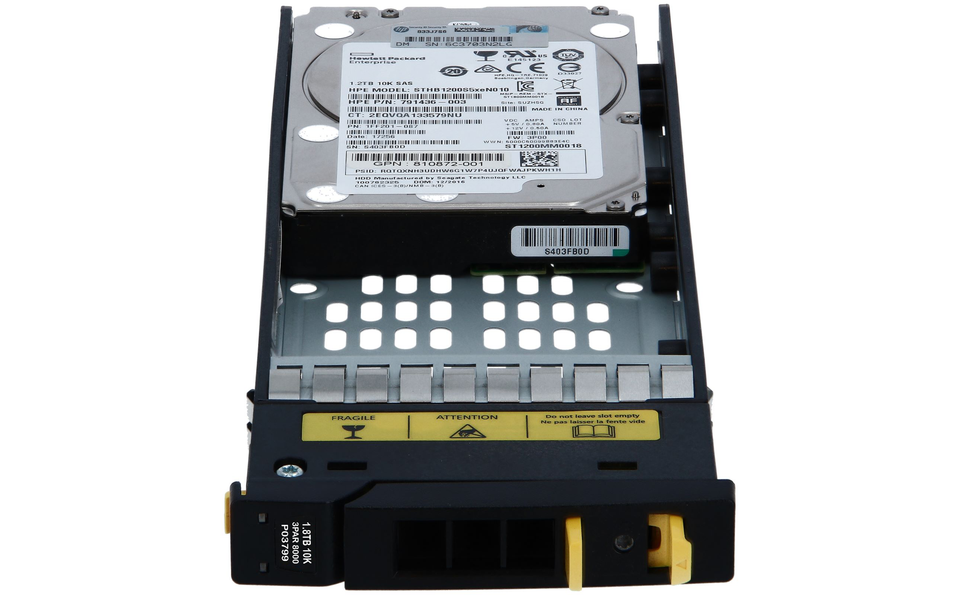
10,000 Reasons to Trust It: The Complete Story of the HPE K2P94B SAS-12Gbps Enterprise Hard Drive
HPE K2P94B 1.8TB 10000RPM 2.5-Inch SAS 12Gbps Hot-Swap Hard Drive for StoreServ 8000 Series — Complete Guide
Introduction to the HPE K2P94B Hard Drive
In enterprise storage environments where uptime, performance, and data integrity are non-negotiable, choosing the right hard drive is one of the most critical infrastructure decisions an IT professional can make. The HPE K2P94B 1.8TB 10000RPM 2.5-inch Small Form Factor Dual Port SAS-12Gbps Hot-Swap 3PAR Hard Drive is purpose-built for exactly these high-demand scenarios. Designed specifically for use in HPE StoreServ 8000 Series Enclosures, this drive delivers a compelling combination of high capacity, blazing SAS-12Gbps connectivity, and enterprise-class reliability in a compact 2.5-inch form factor.
Whether you're expanding an existing 3PAR storage array or building out a new all-flash or hybrid storage infrastructure, the HPE K2P94B is a component worth understanding in depth. This comprehensive guide covers every aspect of this drive — from its core technical specifications to real-world use cases, compatibility details, installation best practices, and purchasing considerations.
What Is the HPE K2P94B? An Overview
The HPE K2P94B is a Small Form Factor (SFF) 2.5-inch enterprise SAS hard disk drive manufactured and validated by Hewlett Packard Enterprise (HPE) for use within its 3PAR StoreServ platform — specifically the StoreServ 8000 Series storage enclosures. It belongs to HPE's lineup of mission-critical spinning media drives that bridge the gap between the raw performance of solid-state drives and the cost-per-gigabyte advantages of traditional hard disks.
This drive is a factory-tested, HPE-branded unit that ships with the firmware and configuration required to integrate seamlessly into 3PAR storage arrays. Unlike generic off-the-shelf drives, the K2P94B is qualified by HPE engineering teams to meet the stringent demands of 24/7 enterprise workloads, making it a trusted choice for data centers worldwide.
Key Highlights at a Glance
- Part Number: K2P94B
- Capacity: 1.8TB (1,800GB)
- Rotational Speed: 10,000 RPM
- Form Factor: 2.5-inch Small Form Factor (SFF)
- Interface: SAS 12Gbps (Dual Port)
- Hot-Swap: Yes
- Compatible Platform: HPE 3PAR StoreServ 8000 Series Enclosures
- Drive Type: Enterprise Hard Disk Drive (HDD)
- Cache: 128MB
Technical Specifications of the HPE K2P94B
Understanding the technical specifications of the HPE K2P94B is essential for storage architects, procurement specialists, and IT administrators making informed purchasing and deployment decisions.
Storage Capacity and Density
The HPE K2P94B offers 1.8 terabytes of formatted storage capacity, positioning it in the sweet spot for enterprise workloads that demand higher per-spindle density without moving entirely to flash. When deployed across a full 3PAR StoreServ 8000 enclosure, multiple K2P94B drives combine to provide substantial raw storage pools that can be tiered, deduplicated, and compressed using 3PAR's native software intelligence.
At 1.8TB per drive, organizations can achieve significant storage density per rack unit compared to older 600GB or 900GB 10K SAS drives, reducing the number of spindles required while maintaining comparable performance profiles.
Rotational Speed: 10,000 RPM
The drive operates at 10,000 revolutions per minute (RPM), a rotational speed historically associated with enterprise-grade HDDs that require a balance of performance and power efficiency. The 10K RPM spindle speed provides:
- Lower average rotational latency compared to 7,200 RPM drives
- Faster sequential and random read/write performance
- Suitability for mixed workload environments including OLTP databases, virtual machine datastores, and file serving
While 15K RPM drives offer higher rotational speed, the 10K RPM category at 1.8TB capacity represents a significant advancement in areal density that allows more data per platter without sacrificing too much on access times.
Interface: SAS 12Gbps Dual Port
One of the most important attributes of the K2P94B is its Serial Attached SCSI (SAS) 12Gbps Dual Port interface. SAS remains the gold standard for enterprise storage connectivity, and the 12Gbps generation (sometimes called SAS-3) doubles the bandwidth of the previous SAS-6Gbps generation.
Dual Port SAS means the drive physically has two SAS ports, enabling:
- Multipath I/O (MPIO): Redundant data paths between the host and the drive, eliminating single points of failure at the interface level
- Higher aggregate bandwidth: Both ports can be active simultaneously, increasing throughput for demanding workloads
- Improved fault tolerance: If one SAS expander path fails, the drive continues operating through the second port without data loss or downtime
This dual-port architecture is a critical feature in the context of 3PAR StoreServ arrays, which are designed around high-availability principles and require drives that support persistent, redundant connectivity.
Form Factor: 2.5-Inch Small Form Factor (SFF)
The 2.5-inch SFF form factor of the K2P94B provides significant advantages in enterprise enclosure design:
- Higher drive density per enclosure: More 2.5-inch drive bays fit within a given rack unit compared to 3.5-inch Large Form Factor (LFF) designs
- Lower power consumption per drive: Smaller platters require less motor power
- Reduced heat output: Beneficial for high-density enclosure deployments with tight thermal budgets
- Compatibility with the StoreServ 8000 SFF enclosure bays, which are engineered specifically for 2.5-inch SAS drives
Hot-Swap Capability
The K2P94B supports hot-swap functionality, which is an essential feature in any enterprise storage environment. Hot-swap allows administrators to:
- Remove a failed drive from the array without powering down the enclosure or disrupting ongoing I/O operations
- Insert a replacement drive while the system remains fully operational
- Trigger automatic RAID or 3PAR RAID-MP rebuild processes immediately upon drive insertion
This capability is fundamental to maintaining the five-nines (99.999%) availability that many enterprise SLAs demand. Combined with 3PAR's always-on data protection features, hot-swap significantly reduces or eliminates planned and unplanned downtime associated with drive replacement events.
Cache Buffer
The K2P94B features a 128MB cache buffer, which serves as high-speed volatile memory between the drive's read/write heads and the SAS interface. A larger cache improves:
- Sequential read performance through read-ahead caching
- Write performance by temporarily buffering write commands before committing them to platters
- Overall I/O throughput during burst workloads
HPE 3PAR StoreServ 8000 Series: The Platform Context
To fully appreciate the value of the HPE K2P94B, it's important to understand the platform it's designed for — the HPE 3PAR StoreServ 8000 Series.
What Is the StoreServ 8000 Series?
The HPE 3PAR StoreServ 8000 Series is a family of midrange to enterprise-class storage arrays built on HPE's proven 3PAR OS and hardware architecture. These systems are characterized by:
- Gen 5 ASIC technology for hardware-accelerated RAID, deduplication, and compression
- Always-On software stack including thin provisioning, deduplication, compression, and replication natively
- Scale-up and scale-out architecture, allowing organizations to grow storage capacity and performance non-disruptively
- All-flash and hybrid configurations, supporting a mix of SSD and HDD tiers within the same system
The StoreServ 8000 Series targets workloads including virtual machine infrastructure (VMware, Microsoft Hyper-V), Oracle and Microsoft SQL Server databases, VDI deployments, and cloud service provider environments.
How the K2P94B Fits Into the StoreServ 8000
Within the StoreServ 8000 ecosystem, the K2P94B serves as a Tier 2 or nearline performance drive, occupying the middle tier in a multi-tier storage architecture:
- Tier 1 (All-Flash): NVMe or SAS SSDs handling the hottest, most latency-sensitive data
- Tier 2 (10K SAS HDD — K2P94B): Active, frequently accessed data requiring good performance at lower cost per GB than flash
- Tier 3 (7.2K SAS/NL-SAS HDD): Cold or archival data with infrequent access requirements
3PAR's Adaptive Optimization (AO) software automatically migrates data between tiers based on access patterns, ensuring that the K2P94B drives are consistently utilized for the workloads best suited to their performance profile.
StoreServ 8000 Enclosure Compatibility
The K2P94B is validated for use in the following StoreServ 8000 Series enclosure configurations:
- HPE 3PAR StoreServ 8200 Storage
- HPE 3PAR StoreServ 8400 Storage
- HPE 3PAR StoreServ 8440 Storage
- HPE 3PAR StoreServ 8450 Storage
All of these systems support 2.5-inch SFF drive bays and SAS-12Gbps backplane connectivity, making them natively compatible with the K2P94B's interface and form factor specifications.
Performance Characteristics and Workload Suitability
Random I/O Performance
At 10,000 RPM, the K2P94B delivers competitive random I/O performance for a spinning disk drive. Typical enterprise 10K SAS drives at this generation support:
- Random Read IOPS: Up to approximately 200–230 IOPS at 4K block sizes under realistic mixed workloads
- Random Write IOPS: Comparable figures, benefiting from the 128MB write cache for burst workloads
- Average Rotational Latency: Approximately 3ms (half a revolution at 10,000 RPM)
- Average Seek Time: Typically under 5ms for enterprise 10K drives
These figures make the K2P94B well-suited for workloads that are read-intensive or have mixed read/write patterns with moderate IOPS demands.
Sequential Throughput
For sequential workloads such as backup, streaming, and large file transfers, the K2P94B's SAS-12Gbps interface ensures the drive interface is never the bottleneck. Sequential transfer rates at the physical media level typically reach:
- Sustained Sequential Read: Up to approximately 200MB/s
- Sustained Sequential Write: Comparable figures depending on workload pattern
When aggregated across multiple drives in a 3PAR RAID-MP configuration, sequential throughput scales linearly with the number of drives in a RAID set, enabling very high bandwidth for demanding applications.
Ideal Workloads for the HPE K2P94B
The K2P94B is best suited for the following enterprise workloads:
- OLTP Databases: Oracle, Microsoft SQL Server, PostgreSQL environments with mixed read/write patterns
- Virtual Machine Datastores: VMware vSphere or Microsoft Hyper-V environments with moderate I/O density per host
- Email and Collaboration Platforms: Microsoft Exchange, SharePoint, and similar workloads
- Enterprise Resource Planning (ERP): SAP, Oracle EBS, and Microsoft Dynamics applications
- File and Print Services: High-capacity file shares with active user access patterns
- Development and Test Environments: Where consistent performance and data integrity are required without all-flash costs
Reliability, Availability, and Serviceability (RAS) Features
Enterprise-Grade Reliability Design
The K2P94B is built to enterprise durability standards. Key reliability attributes include:
- Mean Time Between Failures (MTBF): Typically rated at 1.4–2.0 million hours for enterprise 10K SAS drives of this generation, reflecting 24/7 operational design
- Annualized Failure Rate (AFR): Less than 0.7%, consistent with enterprise HDD industry standards for this tier
- Non-Recoverable Read Errors: Rated at 1 sector per 10^16 bits read, significantly better than desktop or nearline drives (which typically rate at 1 per 10^14 or 10^15)
- Workload Rating: Designed for full 24×7 duty cycles with no workload restrictions common to consumer or nearline drives
HPE Smart Drive Technology
As an HPE-branded and validated drive, the K2P94B benefits from HPE Smart Drive integration within the 3PAR StoreServ platform:
- Automatic identification and configuration upon insertion into a recognized enclosure bay
- Embedded drive metadata that allows the array OS to inventory, configure, and monitor the drive without manual administrator intervention
- Seamless firmware update support through HPE's Storage Management Utility and 3PAR OS update processes
- Proactive failure prediction through integration with HPE InfoSight predictive analytics, which can identify drives at elevated risk of failure before data loss occurs
HPE InfoSight Integration
The K2P94B, as part of the StoreServ 8000 platform, benefits from HPE InfoSight, HPE's AI-driven infrastructure analytics platform. InfoSight continuously collects telemetry from the drive and array, enabling:
- Predictive failure detection days or weeks before a drive actually fails
- Automated support case creation when anomalies are detected
- Cross-customer analytics that improve failure prediction accuracy across the entire HPE installed base
This integration transforms drive management from a reactive to a predictive discipline, substantially reducing the operational burden on storage administrators.
Installation and Deployment Best Practices
Pre-Installation Checklist
Before installing HPE K2P94B drives in a StoreServ 8000 enclosure, administrators should verify:
- The target enclosure is a supported StoreServ 8000 Series model
- The running 3PAR OS version is compatible with the K2P94B drive firmware
- Sufficient free bays exist in the target enclosure for the planned drive count
- Proper ESD (electrostatic discharge) precautions are in place
- HPE's spare drive documentation or configuration guide for the target array has been consulted
Physical Installation Procedure
Step 1: Identify the Target Drive Bay
Using the 3PAR Management Console (SSMC) or CLI, identify an empty drive bay in the target enclosure. Note the cage and magazine position for accurate physical location.
Step 2: Observe ESD Safety Precautions
Always wear an anti-static wrist strap grounded to the enclosure chassis before handling any drive. The K2P94B's PCB and components are sensitive to electrostatic discharge.
Step 3: Insert the Drive
Slide the K2P94B into the identified drive bay until you feel the drive connector engage with the backplane. Secure the drive latch or retaining mechanism as per the enclosure's physical design.
Step 4: Confirm Drive Recognition
Within 60–90 seconds of insertion, the 3PAR OS should automatically discover the new drive. Verify recognition using:
showphysinv -slot <cage>.<magazine>.<drive>or through the SSMC graphical interface under the Physical Infrastructure view.
Step 5: Add the Drive to a CPG or Spare Pool
Depending on your capacity planning intent, use createpd or the SSMC to admit the new physical disk into the array's active disk pool. The system will then make the capacity available for allocation to Common Provisioning Groups (CPGs).
Firmware Management
HPE periodically releases firmware updates for drives like the K2P94B to address performance improvements, reliability fixes, and compatibility enhancements. Always:
- Review HPE's Service Pack for ProLiant (SPP) or 3PAR firmware matrix for validated drive firmware versions
- Apply firmware updates during scheduled maintenance windows using HPE's online firmware update tools
- Never interrupt a firmware update in progress, as this can render the drive inoperable
HPE K2P94B vs. Alternative Drive Options
K2P94B vs. HPE 900GB 10K SAS (Predecessor Models)
Compared to HPE's previous-generation 900GB 10K SAS drives, the K2P94B offers:
- 2× the storage capacity per spindle (1.8TB vs. 900GB)
- Identical interface performance (SAS 12Gbps)
- Lower cost per terabyte due to increased areal density
- Same hot-swap and dual-port reliability features
For environments looking to refresh aging 900GB drive populations, the K2P94B provides a straightforward capacity upgrade path with no changes to enclosure infrastructure.
K2P94B vs. SAS SSD Options
Compared to SAS SSD alternatives for the StoreServ 8000:
| Attribute | K2P94B (10K HDD) | SAS SSD |
|---|---|---|
| Capacity | 1.8TB | Up to 3.84TB+ |
| Random IOPS | ~200 | 100,000+ |
| Latency | ~3–5ms | <1ms |
| Cost Per GB | Lower | Higher |
| Endurance | Very high (no write limit) | TBW-limited |
| Best Use | Active working data, Tier 2 | Tier 1 hot data |
The K2P94B is not a replacement for flash — it is a complement to it in a properly tiered storage architecture. Organizations leveraging 3PAR's Adaptive Optimization can maximize the value of both drive types by ensuring data resides on the appropriate tier based on access patterns.
K2P94B vs. NL-SAS 7.2K Drives
Compared to 7,200 RPM nearline SAS (NL-SAS) drives:
- K2P94B delivers 30–40% better random I/O performance due to higher spindle speed
- NL-SAS drives offer higher per-spindle capacity (up to 8TB+) at lower cost
- K2P94B is better suited for active workloads while NL-SAS targets archival and backup tiers
For a balanced storage architecture, using K2P94B drives for Tier 2 active data alongside NL-SAS drives for cold data provides optimal cost/performance efficiency.
Environmental and Power Specifications
Power Consumption
Enterprise 2.5-inch 10K SAS drives of this generation typically consume:
- Active (Read/Write): Approximately 8–10 watts
- Idle: Approximately 4–6 watts
- Standby/Sleep: Under 1 watt (if supported)
In high-density enclosures with dozens of K2P94B drives, total power draw should be factored into rack PDU planning and cooling requirements.
Operating Temperature Range
The K2P94B is rated for standard enterprise data center conditions:
- Operating Temperature: 5°C to 60°C (41°F to 140°F)
- Non-Operating Temperature: -40°C to 70°C (-40°F to 158°F)
- Relative Humidity (Operating): 5% to 95% non-condensing
These specifications align with ASHRAE Class A1 and A2 data center environmental standards, making the drive suitable for most enterprise facilities.
Vibration Tolerance
As a 10K RPM spinning drive in a dense enclosure environment, the K2P94B is designed with rotational vibration (RV) compensation technology. This allows the drive to maintain reliable performance in enclosures where multiple drives operate simultaneously — a common source of vibration that can degrade performance in drives lacking RV sensors.
Frequently Asked Questions (FAQ)
Is the HPE K2P94B compatible with non-HPE SAS controllers?
The K2P94B is specifically firmware-configured and validated for HPE 3PAR StoreServ 8000 Series enclosures. While the physical SAS-12Gbps interface is industry-standard, the drive's embedded firmware and HPE-specific configuration are optimized for the 3PAR platform. HPE does not warrant compatibility with third-party storage controllers, and the drive may not be recognized or function as expected in non-HPE systems.
Can the K2P94B be used in HPE ProLiant servers?
The K2P94B is a 3PAR-specific drive, not a ProLiant server drive. HPE's ProLiant server platforms use differently configured SAS drives sold under separate part numbers. Using storage array drives in server platforms (or vice versa) is not supported and can result in recognition failures, firmware incompatibilities, or data integrity risks.
What happens if a K2P94B drive fails?
Within a 3PAR StoreServ 8000 array, a drive failure triggers an immediate RAID-MP rebuild process using spare capacity distributed across the array (known as distributed sparing). Data remains continuously available throughout the rebuild. Simultaneously, HPE InfoSight can automatically generate a support ticket and dispatch a replacement drive through HPE's support organization, minimizing administrator intervention required.
How many K2P94B drives can I install in a StoreServ 8000 enclosure?
The maximum drive count per StoreServ 8000 enclosure depends on the specific enclosure model and its SFF bay count. HPE StoreServ 8000 drive enclosures are available in configurations supporting 24 or more 2.5-inch SFF drives per enclosure. Consult the specific enclosure's QuickSpecs document for precise bay counts and expansion options.
Does the K2P94B support SED (Self-Encrypting Drive) functionality?
The K2P94B in its standard configuration is a non-SED drive. HPE offers separate SED variants of its enterprise drive portfolio for environments requiring FIPS-validated at-rest encryption. If data-at-rest encryption is a requirement, consult your HPE representative for the appropriate SED-enabled drive part number for the StoreServ 8000 platform.
Conclusion: Is the HPE K2P94B the Right Drive for Your Storage Environment?
The HPE K2P94B 1.8TB 10000RPM 2.5-inch SFF Dual Port SAS-12Gbps Hot-Swap 3PAR Hard Drive represents a mature, enterprise-grade storage component that delivers exactly what midrange and enterprise storage environments demand: high capacity, reliable performance, comprehensive redundancy, and deep integration with the HPE 3PAR software ecosystem.
For organizations running HPE StoreServ 8000 Series arrays, the K2P94B is an ideal choice for:
- Expanding existing capacity in production 3PAR environments
- Replacing failed or aging drives with an identical or larger-capacity successor
- Building Tier 2 storage tiers in conjunction with SAS SSDs for Tier 1 hot data
- Supporting mixed workload environments where all-flash costs cannot be justified for the entire dataset
Its hot-swap support eliminates downtime during replacement events, its dual-port SAS design ensures continuous multipath availability, and its HPE validation guarantees seamless integration with StoreServ 8000 firmware and management software.
When combined with HPE's InfoSight predictive analytics, 3PAR Adaptive Optimization, and the broader HPE Pointnext support ecosystem, the K2P94B becomes far more than just a hard drive — it becomes an actively managed, intelligently monitored component in a high-availability storage architecture designed to keep enterprise workloads running without interruption.
For procurement teams, storage architects, and IT administrators evaluating enterprise SAS drive options for the StoreServ 8000 platform, the HPE K2P94B warrants serious consideration as a proven, high-value addition to any 3PAR storage environment.
Recent Posts
-
HPE AG425B 300GB 15K Fibre Channel Hard Drive: High-Speed Storage for Enterprise-Class EVA Systems
Introduction: Reliable Storage for Demanding Enterprise Environments In enterprise IT, storage perfo …Oct 19th 2026 -

HPE AG425A 300GB 15000RPM Fibre Channel Hard Drive: Enterprise Storage Built for Demanding Environments
Enterprise storage systems depend on dependable hardware that can deliver consistent performance whi …Oct 18th 2026 -
Where Legacy Power Meets Enterprise Precision: The HPE 431944-B21 300GB SAS Hard Drive
HPE 431944-B21: Enterprise Storage Built for the Demanding ProLiant Era The HPE 431944-B21 is a 300G …Oct 17th 2026