
HPE E2D56A 450GB 10K SAS Powerhouse: High-Speed Enterprise Storage Engineered for MSA 1040 & 2040 SANs
HPE E2D56A 450GB 10K SAS Hard Drive: Reliable Enterprise Storage for MSA 1040 and MSA 2040
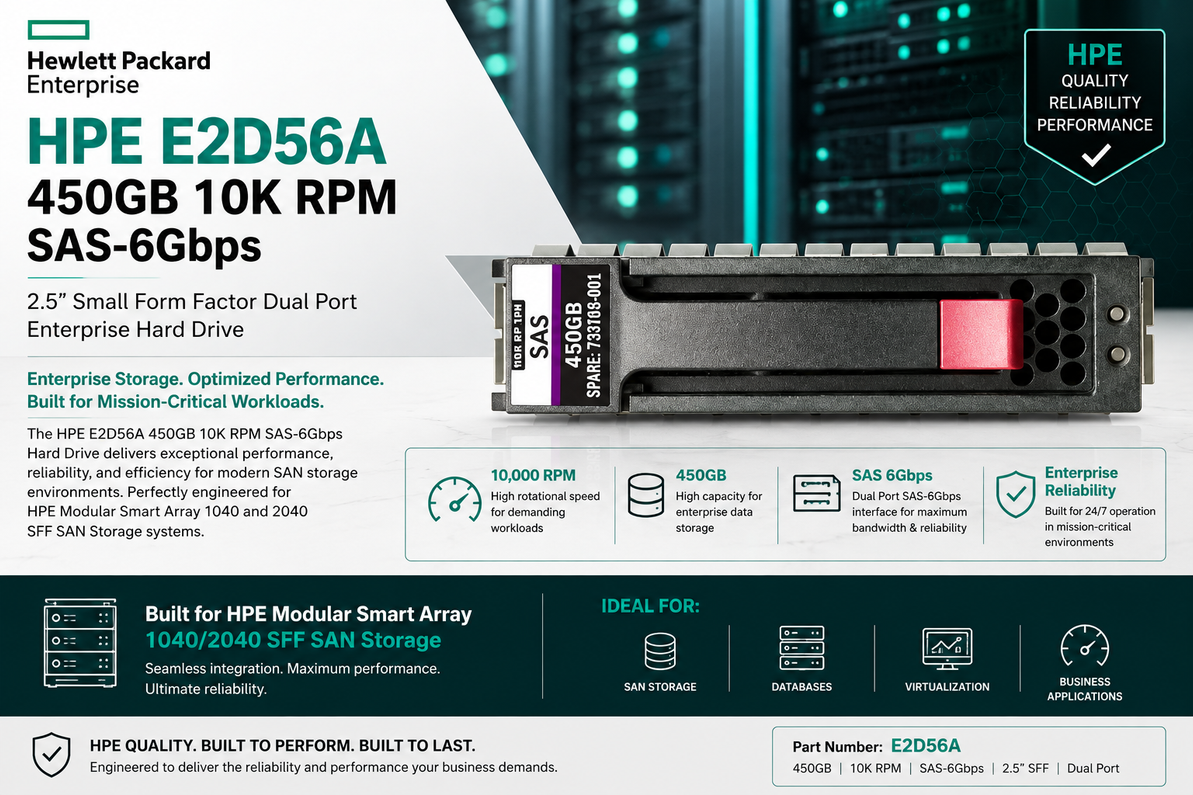
The HPE E2D56A 450GB 10000RPM 2.5-inch Small Form Factor Dual Port SAS-6Gbps Enterprise Hard Drive is an enterprise-grade storage drive designed for compatible HPE Modular Smart Array 1040 and MSA 2040 SFF storage systems. Built around a 10,000 RPM mechanical platform and a dual-port 6Gbps SAS interface, this drive is intended for organizations that need dependable shared storage, predictable performance, and enterprise-class connectivity.
With a 450GB capacity, compact 2.5-inch Small Form Factor design, and SAS architecture, the HPE E2D56A can be an effective choice for expanding or maintaining compatible MSA storage environments. It is particularly suited to workloads where reliability, storage availability, and compatibility with an existing SAN infrastructure are more important than adopting the newest flash-based technology.
The E2D56A belongs to HPE's portfolio of drives developed for MSA storage platforms, making platform compatibility especially important when selecting, replacing, or expanding drives in an existing array.
Understanding the HPE E2D56A
What Is the HPE E2D56A?
The HPE E2D56A is a 450GB enterprise SAS hard drive featuring a 10,000 RPM spindle speed, 6Gbps SAS interface, dual-port connectivity, and 2.5-inch SFF form factor.
Unlike a conventional desktop hard disk, this type of enterprise drive is intended to operate within a compatible storage architecture. The drive works together with the MSA controller, drive enclosure, firmware, storage management software, and RAID configuration to deliver shared enterprise storage.
This makes the E2D56A particularly relevant for organizations already using an HPE MSA 1040 or MSA 2040 SFF environment and looking for compatible storage expansion or replacement hardware.
Designed for Shared Storage
The HPE Modular Smart Array family is designed around shared storage requirements. Instead of simply attaching a hard drive directly to an individual server, an MSA system provides centralized storage that can be presented to multiple connected hosts.
The E2D56A therefore becomes part of a larger storage ecosystem. Its performance and reliability should be considered alongside the MSA controller architecture, RAID level, host connectivity, cache configuration, and workload.
Key Specifications of HPE E2D56A
450GB Storage Capacity
The drive provides 450GB of raw storage capacity, making it suitable for organizations that need moderate-capacity enterprise storage while maintaining a relatively high spindle speed.
A 450GB drive can be used for application data, virtual machine storage, databases, file services, and other business workloads when deployed in an appropriately configured MSA array.
Actual usable capacity will depend on the RAID configuration and storage architecture. For example, RAID 1, RAID 5, RAID 6, RAID 10, or other supported configurations will provide different amounts of usable capacity and different levels of redundancy.
10,000 RPM Performance
The 10,000 RPM rotational speed is one of the defining characteristics of the E2D56A.
Compared with slower 7,200 RPM enterprise HDDs, 10K RPM drives generally offer lower rotational latency and faster access to frequently requested data. This can make them useful for workloads involving frequent random reads and writes.
The drive is still a mechanical HDD, however, so it cannot deliver the extremely low latency or high IOPS associated with modern enterprise SSDs.
6Gbps SAS Interface
The E2D56A uses a 6Gbps Serial Attached SCSI interface. SAS is an enterprise storage interface designed for server and storage environments.
The 6Gbps specification describes the maximum interface signaling rate. It does not mean that the mechanical hard disk can continuously transfer data at 6Gbps. Real-world performance depends on the disk's mechanical characteristics, workload, controller, RAID configuration, cache, and storage system.
Dual-Port SAS Connectivity
The dual-port SAS architecture is especially important in enterprise storage environments.
Dual-port SAS can provide two independent paths to a drive when supported by the storage enclosure and controller architecture. This can contribute to improved storage availability and path redundancy.
In an MSA environment, redundant connectivity can help reduce the impact of an individual path or component failure. The exact behavior depends on the MSA configuration and supported controller architecture.
2.5-Inch Small Form Factor
The E2D56A uses a 2.5-inch Small Form Factor (SFF) design.
SFF drives allow compatible MSA enclosures to achieve a high level of storage density within a relatively compact chassis. This is especially useful in data centers where rack space, drive density, and efficient infrastructure utilization are important.
HPE MSA 1040 and MSA 2040 Compatibility
Designed for HPE MSA Storage
The HPE E2D56A is specifically associated with HPE Modular Smart Array 1040 and MSA 2040 SFF storage systems.
This distinction is important because enterprise SAS drives should not be selected solely according to capacity and interface. Storage arrays often have specific compatibility requirements covering drive type, firmware, capacity, form factor, and supported configurations.
Using the correct HPE drive option helps administrators maintain a storage configuration designed for the target MSA platform.
MSA 1040 Storage Environments
The MSA 1040 was developed as a shared storage platform for small and medium-sized business environments and other applications requiring centralized storage.
An appropriately configured E2D56A drive can provide additional capacity or serve as a replacement within a compatible MSA 1040 SFF configuration.
MSA 2040 Storage Environments
The MSA 2040 provides a higher-performance storage platform aimed at organizations requiring shared storage for virtualization, databases, business applications, and other workloads.
When deployed in a compatible MSA 2040 SFF environment, 10K SAS HDDs such as the E2D56A can provide a balance between storage capacity and mechanical performance.
Enterprise Features That Matter
Reliability for Business Storage
Enterprise storage drives are designed for environments where drives may operate continuously and handle sustained workloads.
The E2D56A is therefore better suited to data center and SAN environments than a standard consumer desktop HDD. Its SAS interface and dual-port architecture are particularly aligned with enterprise storage requirements.
Integration With Storage Controllers
A drive in an MSA array does not operate independently. The storage controller manages the drives, RAID configuration, logical volumes, host presentation, and other storage functions.
This controller-based architecture allows organizations to build storage pools that can provide redundancy and centralized management.
Hot-Plug Storage Environments
When used with an appropriately configured MSA enclosure and carrier, compatible enterprise drives can be replaced without shutting down the entire storage system.
Hot-plug capability is particularly valuable in production environments because storage administrators can replace failed drives while keeping critical services online, subject to the system's redundancy and maintenance procedures.
HPE E2D56A Technical Specifications
Specification Overview
| Specification | HPE E2D56A |
|---|---|
| Part Number | E2D56A |
| Storage Capacity | 450GB |
| Drive Type | Enterprise Hard Drive |
| Interface | SAS |
| Interface Speed | 6Gbps |
| Rotational Speed | 10,000 RPM |
| Form Factor | 2.5-inch Small Form Factor |
| Port Configuration | Dual Port |
| Drive Class | Enterprise |
| Target Storage Platforms | HPE MSA 1040 / MSA 2040 SFF |
| Application | SAN / Shared Storage |
| Drive Technology | Mechanical HDD |
Specifications can vary depending on the exact HPE assembly or configuration, so buyers should verify the drive label, firmware, carrier, and supported MSA configuration before installation.
Why 10K RPM SAS Drives Remain Useful
A Balance Between Cost and Performance
Although enterprise SSDs dominate modern high-performance storage, 10K RPM SAS HDDs can still make sense for legacy or cost-conscious storage deployments.
The E2D56A offers a combination of relatively fast mechanical access, enterprise SAS connectivity, and moderate storage capacity. For an organization already operating an MSA system based on HDDs, adding compatible 10K SAS drives can be more practical than immediately replacing the entire storage infrastructure.
Suitable for Mixed Storage Strategies
Some organizations use different storage tiers according to application requirements.
Frequently accessed or latency-sensitive workloads may be placed on SSD storage, while less demanding applications and general-purpose data can reside on HDD-based storage.
A 10K SAS drive can occupy a middle position in such an environment, offering better mechanical performance than slower HDDs while costing less than high-end flash storage.
Applications for HPE E2D56A
Virtualization
Virtualization platforms can generate significant random storage activity because multiple virtual machines may access the same storage system simultaneously.
The 10K RPM speed of the E2D56A can make it useful for moderate virtualization workloads when deployed in an appropriately configured MSA array.
For very high virtual-machine density, however, SSD-based storage will generally provide considerably better latency and IOPS.
Database Storage
Databases often generate a combination of sequential and random I/O. A properly designed RAID configuration using 10K SAS drives can support many business database workloads.
Database administrators should consider transaction volume, working-set size, caching, RAID configuration, and application requirements before determining whether HDD or SSD storage is appropriate.
File and Application Storage
The E2D56A can also be suitable for shared file storage and general business applications.
Organizations can use an MSA array to centralize data storage and provide shared access to connected servers, making the storage system easier to manage than multiple independent server disks.
Backup and Secondary Storage
A 450GB enterprise SAS drive can also be useful for certain backup, staging, and secondary storage roles.
However, organizations should evaluate the total amount of backup data before selecting 450GB drives, particularly because modern backup datasets can grow rapidly.
RAID and the HPE E2D56A
RAID 1
RAID 1 mirrors data across two drives. It provides redundancy but sacrifices half of the raw capacity for mirroring.
This configuration can be appropriate for workloads where simple redundancy and read performance are important.
RAID 5
RAID 5 uses distributed parity to provide redundancy while retaining more usable capacity than RAID 1.
However, parity-based arrays can experience additional write overhead and longer rebuild periods, particularly with mechanical HDDs.
RAID 6
RAID 6 provides protection against two simultaneous drive failures and can be useful for larger arrays where additional fault tolerance is required.
RAID 10
RAID 10 combines mirroring and striping. It can provide strong random I/O performance and redundancy, although usable capacity is reduced compared with some parity-based RAID levels.
The best RAID configuration ultimately depends on the MSA model, workload, number of drives, capacity requirements, performance targets, and fault-tolerance requirements.
HPE E2D56A for SAN Storage
Centralized Enterprise Storage
SAN environments allow servers to access centralized storage resources over dedicated storage networking infrastructure.
An MSA system containing compatible E2D56A drives can provide centralized storage capacity to connected hosts. This approach can simplify storage administration and allow organizations to allocate storage according to application requirements.
Storage Availability
Enterprise SANs are commonly designed with redundancy at multiple levels. Dual-port SAS drives can participate in redundant storage paths, while MSA controllers, power supplies, network connections, and RAID configurations can be designed to reduce individual points of failure.
The E2D56A should therefore be viewed as one component within a broader highly available storage architecture.
Installation Considerations
Verify MSA Compatibility
Before purchasing the E2D56A, verify that the exact MSA enclosure and firmware configuration support the drive.
Do not assume that every 2.5-inch SAS drive will work simply because it has the same physical dimensions and interface.
Match Drive Types Within an Array
Storage arrays can have restrictions concerning drive type, capacity, performance class, and configuration.
When expanding an existing array, administrators should verify the recommended drive configuration rather than mixing incompatible drive types without checking the platform documentation.
Check the Carrier
The physical drive carrier is also important. MSA SFF systems use specific drive carriers designed to fit the enclosure correctly.
A bare drive and a complete HPE drive assembly are not necessarily equivalent from an installation perspective, so buyers should confirm exactly what is included with the product.
HPE E2D56A vs Enterprise SSD
Where the E2D56A Has an Advantage
The main advantage of the E2D56A is its suitability for maintaining compatible legacy MSA HDD storage at a potentially lower acquisition cost than replacing the infrastructure with an all-flash platform.
Its 10K RPM spindle speed also gives it better mechanical responsiveness than slower HDDs.
Where SSDs Win
Enterprise SSDs are dramatically faster in terms of latency and random I/O performance. They also have no moving mechanical components.
For demanding virtualization, analytics, high-transaction databases, and latency-sensitive applications, SSDs are generally the better technology.
However, if the goal is to maintain an existing HPE MSA 1040 or MSA 2040 SFF SAN, compatibility and infrastructure continuity can make the E2D56A a practical choice.
Maintenance and Data Protection
Monitor Storage Health
Administrators should regularly monitor the MSA management interface, controller alerts, drive health information, and RAID status.
Early detection of drive problems can give administrators time to replace a failing disk before a more serious storage failure occurs.
Keep Independent Backups
RAID redundancy does not replace backups.
Even if an MSA array contains multiple E2D56A drives and can tolerate a drive failure, accidental deletion, malware, application corruption, controller problems, and other incidents can still affect data.
Critical information should therefore be protected with a separate backup strategy.
Plan for Drive Replacement
Enterprise HDDs are mechanical devices and eventually wear out. Maintaining spare compatible drives can reduce downtime when a drive fails.
For older MSA systems, keeping compatible replacement hardware available can be particularly valuable because sourcing legacy enterprise drives may become more difficult over time.
Why Choose HPE E2D56A?
A Strong Choice for Legacy MSA Infrastructure
The HPE E2D56A makes the most sense for organizations that already operate compatible MSA storage and need additional or replacement HDD capacity.
Its 450GB capacity, 10K RPM speed, dual-port SAS architecture, 6Gbps interface, and SFF form factor provide a balanced solution for traditional enterprise storage requirements.
Enterprise-Oriented Design
Unlike consumer storage, the E2D56A is intended for use as part of an enterprise storage system. Its SAS architecture and dual-port connectivity make it particularly appropriate for compatible SAN environments.
Practical Storage Expansion
When a compatible MSA enclosure needs additional storage, using a supported HPE drive can simplify deployment and help maintain consistency across the storage array.
Final Verdict
The HPE E2D56A 450GB 10000RPM 2.5-inch SFF Dual Port SAS-6Gbps Enterprise Hard Drive is a practical storage solution for compatible HPE MSA 1040 and MSA 2040 SFF SAN environments. Its 10K RPM spindle speed provides responsive mechanical storage performance, while the 6Gbps dual-port SAS interface is designed for enterprise storage architectures.
For organizations maintaining existing MSA infrastructure, the E2D56A can provide a straightforward way to replace aging drives or expand storage without immediately migrating to a completely new platform. Its compact SFF design is also well suited to dense storage environments.
While modern enterprise SSDs offer substantially higher performance, the HPE E2D56A remains relevant where compatibility, traditional SAS storage, predictable mechanical performance, and cost-effective maintenance of existing MSA infrastructure are the primary priorities.
Recent Posts
-

HPE P04693-B21: Ignite Your Enterprise with 300GB of 15K RPM Storage Performance
In today's data-driven business environment, server storage plays a crucial role in keeping applicat …Oct 11th 2026 -
HPE 870755-B21: Unleash Enterprise Storage Power with 300GB of High-Speed 15K RPM Performance
In enterprise IT, storage performance can make a significant difference in how efficiently servers h …Oct 10th 2026 -
HPE 737261-B21: Unleashing 15K Enterprise Performance with 300GB SAS Storage Power
Introduction: High-Speed Storage for Demanding Enterprise Environments In enterprise IT environments …Oct 9th 2026