
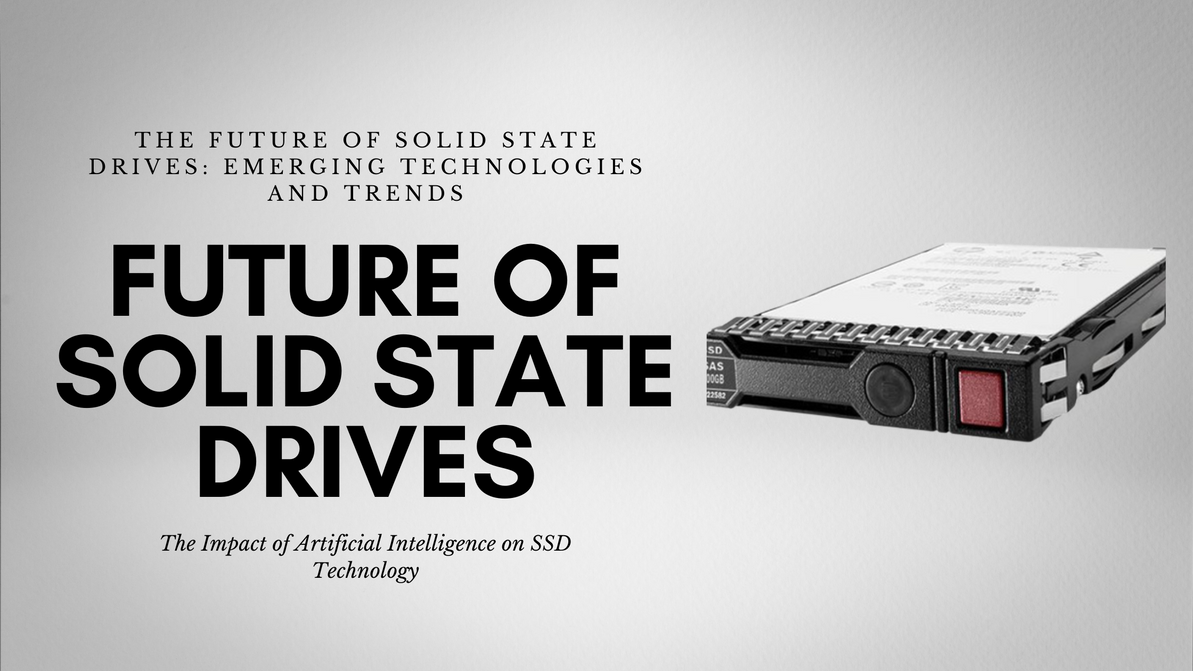
The Future Of Solid State Drives: Emerging Technologies And Trends
Solid state drives, commonly known as SSDs, have rapidly gained prominence due to their exceptional performance compared to traditional hard disk drives (HDD). As the demand for storage solutions continues to grow, it is essential to explore the future of SSD technology. This article delves into emerging technologies and trends shaping the future of solid-state drives.
Advancements in SSD Capacities:
The progression in SSD capacities has been remarkable, revolutionizing data storage possibilities. Technological breakthroughs such as 3D NAND have facilitated increased memory densities while improving reliability and endurance. Multi-level cell (MLC) and triple-level cell (TLC) technologies have played a crucial role in achieving these higher-capacity SSDs by allowing more data to be stored within memory cells.
Performance Enhancements in SSDs:
The integration of Non-Volatile Memory Express (NVMe), an efficient protocol explicitly designed for flash-based storage devices, has significantly mitigated performance limitations earlier associated with older interfaces. Furthermore, the utilization of PCIe Gen4 interface offers faster data transfer speeds whilst providing robust reliability – making enterprise workloads more responsive than ever before.
The Impact of Artificial Intelligence on SSD Technology:
Artificial intelligence (AI) plays a key role even when it comes to boosting the prowess of solid-state drive products. AI-powered storage solutions leverage machine learning algorithms that analyze workload patterns and optimize performance accordingly in real-time. Predictive analytics offer reduced latency issues by accurately predicting application requirements ahead of time– thus enhancing overall efficiency.
Emergence and Progression of QLC Technology:
Another exciting development within the realm of solid-state drives lies with Quad-Level Cell (QLC) technology – assisting increased capacity at economical prices. By storing four bits per memory cell instead of three, QLC-based SSDs can maintain competitive pricing while offering larger capacities demanded by modern applications without compromising on performance or endurance characteristics.
Reliable Enterprise-Grade Storage Solutions with TLC:
Triple-Level Cell (TLC) technology provides impressive gains relating primarily to cost-efficiency compared to MLC counterparts - enabling organizations to enjoy enterprise-grade SSD benefits with lower costs. TLC-based SSDs cater more towards server-centric applications, delivering on the requirements of data-driven enterprises at a fraction of the cost associated with other solutions.
SSD Backup Solutions: Protecting Data Integrity:
Data integrity is a top priority for businesses and individuals alike. In contrast to traditional HDD backup systems, utilizing solid-state drive technology significantly improves reliability and reduces failure rates due to their lack of mechanical parts. As a result, implementing robust data redundancy methods safeguards critical information and minimizes the risk of loss or corruption.
Future Innovations: More Than Fast Loading Times:
While fast loading times remain one aspect where SSDs excel over HDD alternatives, future innovations go beyond mere speed improvements. Quantum computing presents exciting possibilities for significant advancements in storage capacities and data processing speeds – revolutionizing how we approach contemporary challenges. Additionally, developments such as NRAM (Non-Volatile Random-Access Memory) continue to push technological boundaries as manufacturers strive to deliver higher-performing storage solutions while maintaining energy efficiency.
Conclusion
As emerging technologies propel solid-state drives forward, it becomes increasingly evident that they will continue shaping our digital landscape for years to come. The ongoing advancements in capacities, performance enhancements through protocols like NVMe, AI-powered optimizations, and QLC technology deployments alongside reliable TLC options have established SSDs as dominant storage platforms across various applications.
Recent Posts
-
Don't Retire That Server Yet — The HPE 693648-B21 1.2TB 10K SAS Drive Changes the Math
HPE 693648-B21 1.2TB 10K RPM SAS 6Gbps 2.5-Inch Hard Drive: The Complete Guide for ProLiant Server U …Jun 16th 2026 -
Built to Disappear: The HPE 718160-B21 and the Highest Compliment in Enterprise Storage
HPE 718160-B21 1.2TB 10K RPM SAS Hard Drive: Everything You Need to Know Before You Buy If you're ru …Jun 15th 2026 -
The Drive That Doesn't Flinch: Inside the HPE 718162-B21 and What Makes It a Data Center Workhorse
HPE 718162-B21 1.2TB 10K SAS Hard Drive: The Complete Guide for ProLiant Server Users If you manage …Jun 14th 2026