
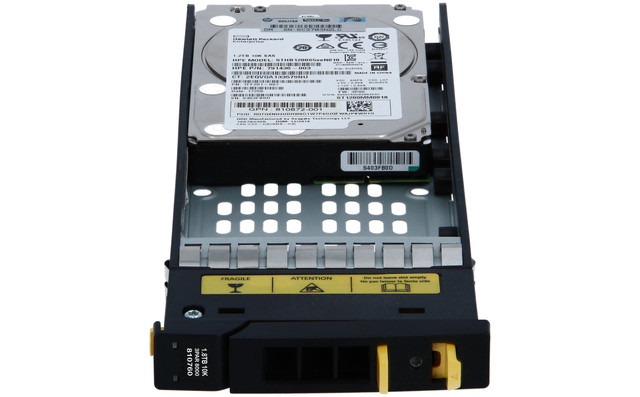
The Drive That Keeps the Lights On: Everything You Never Knew You Needed to Know About the HPE K2P94A
HPE K2P94A 1.8TB 10K RPM SAS 12Gbps Hard Drive: The Complete Guide for StoreServ 8000 Series
If you've ever stared at a storage configuration page and thought, "There has to be a better way to pack this much performance into something so small," — meet the HPE K2P94A. This little powerhouse of a drive is the kind of hardware that makes storage engineers genuinely excited at work (yes, that's a thing). Let's break it all down in plain English, with enough technical depth to satisfy the pros and enough clarity to make sense to everyone else.
What Exactly Is the HPE K2P94A?
The Quick Pitch
The HPE K2P94A is a 1.8TB, 10,000 RPM, 2.5-inch Small Form Factor (SFF) hard drive designed specifically for HPE 3PAR StoreServ 8000 Series Enclosures. It uses a Dual Port SAS-12Gbps interface and supports hot-swap functionality, meaning you can pull it out and replace it while the system is still running — no scheduled downtime, no drama, no cold sweats.
Think of it as the dependable, high-speed workhorse of enterprise storage. It doesn't get flashy press conferences, but it keeps the lights on for businesses around the world.
Breaking Down the Part Number
HPE part numbers can feel like alphabet soup, so here's the decode:
- K2P94A — HPE's unique SKU for this specific drive configuration
- 1.8TB — usable formatted capacity
- 10K RPM — rotational speed (10,000 revolutions per minute)
- 2.5-inch SFF — compact form factor
- Dual Port SAS-12Gbps — the interface type and speed
- Hot-Swap — field-replaceable without powering down
- 3PAR StoreServ 8000 — the target platform
Key Technical Specifications
Raw Performance Numbers That Matter
Let's get nerdy for a moment — in a fun way, we promise.
| Specification | Detail |
|---|---|
| Capacity | 1.8TB |
| Form Factor | 2.5-inch Small Form Factor (SFF) |
| Interface | Dual Port SAS 12Gbps |
| Rotational Speed | 10,000 RPM |
| Hot-Swap Support | Yes |
| Drive Type | Enterprise HDD |
| Compatible Platform | HPE 3PAR StoreServ 8000 Series |
| Ports | Dual Port (redundant path support) |
Why 10,000 RPM Still Matters in a Flash-Heavy World
You might be thinking: "Isn't everything SSD these days?" Fair question. But here's the deal — for workloads where you need high capacity at a lower cost per gigabyte, while still demanding respectable IOPS and latency, a 10K RPM SAS drive hits a sweet spot that all-flash can't always justify economically.
The K2P94A at 10,000 RPM delivers strong sequential throughput and consistent random read/write performance, making it ideal for:
- Structured data storage (databases, ERP systems)
- Mixed workload environments
- Tiered storage configurations where not every block needs flash speed
- Secondary storage tiers in hybrid arrays
It's not trying to beat NVMe at its own game. It's playing a different one — and winning it.
The Interface: Why Dual Port SAS-12Gbps Is a Big Deal
SAS 12Gbps — Speed You Can Actually Feel
SAS (Serial Attached SCSI) at 12Gbps represents the current gold standard for enterprise spinning drives. Compared to older 6Gbps SAS or even SATA interfaces, SAS-12Gbps offers:
- Twice the throughput of SAS-6Gbps
- Better error recovery mechanisms designed for enterprise uptime
- Full duplex communication — it can send and receive data simultaneously
- Protocol-level reliability features that SATA simply doesn't have
In plain terms: data moves faster, more reliably, and with far better error handling. When you're running a hospital records system or a financial trading platform, those aren't nice-to-haves — they're non-negotiables.
The "Dual Port" Advantage: Because Single Points of Failure Are So Last Decade
Here's where the K2P94A really earns its enterprise badge. Dual port SAS means the drive has two independent data paths to the host system. If one path fails — a cable breaks, a HBA port dies, a controller hiccups — the other path keeps data flowing without interruption.
This is called multipath I/O (MPIO), and it's fundamental to building highly available storage systems. For IT teams managing 24/7 operations, dual port support isn't a feature — it's a lifeline.
Hot-Swap Capability: The Unsung Hero of Enterprise Storage
What Hot-Swap Actually Means (and Why You Should Care)
Let's say a drive fails at 2 AM on a Tuesday. With hot-swap capability, your on-call engineer can walk in, slide out the failed drive, slide in a replacement, and walk back out — all while the system keeps running and users keep working. No maintenance window. No panic email to the CEO. No explaining to clients why the website was down.
The HPE K2P94A supports full hot-swap operation, which means:
- Zero downtime for drive replacement
- Immediate RAID rebuild can begin on the new drive
- Reduced mean time to recovery (MTTR) for storage failures
- Simplified maintenance procedures for storage administrators
It's the storage equivalent of replacing a tire on a moving car — except, you know, much safer and legally permissible.
How Hot-Swap Works in the StoreServ 8000 Ecosystem
Within the HPE 3PAR StoreServ 8000 architecture, hot-swap drives integrate seamlessly with the system's Persistent Cache and Always-On QoS features. When a drive is swapped, the array's intelligence automatically begins the rebuild process, redistributing data across the remaining drives in the enclosure while maintaining performance for active workloads.
This isn't magic — it's years of engineering refinement in HPE's 3PAR OS — but it might as well be magic from where the end user is sitting.
HPE 3PAR StoreServ 8000 Series: The Home Base
A Quick Primer on the Platform
The HPE 3PAR StoreServ 8000 Series is an all-inclusive enterprise storage array platform designed for mixed and virtualized workloads. It's used by mid-size to large enterprises that need:
- High availability (typically 99.9999% uptime targets)
- Multi-tenancy for virtualized environments
- Autonomous storage tiering (data automatically moves to the right tier)
- Federated storage across multiple arrays
- NVMe-ready architecture for future scalability
The 8000 Series supports a range of drive types — SSD, SAS, and NL-SAS — allowing organizations to build tiered storage pools that balance performance and cost intelligently. The K2P94A slots into the performance SAS tier, giving the system a reliable mid-tier option between costly all-flash and higher-latency nearline drives.
Enclosure Compatibility: No Surprises at Rack Time
The K2P94A is specifically validated for use in StoreServ 8000 Series Enclosures, which means HPE has tested and certified this drive for:
- Firmware compatibility with 3PAR OS versions
- Thermal performance within enclosure airflow specifications
- Mechanical fit within 2.5-inch SFF drive bays
- Full feature support including predictive failure analysis (SMART)
- Compliance with HPE's SmartBuy and support contracts
This matters more than it might seem. Uncertified drives in enterprise arrays can void support agreements and introduce firmware incompatibilities that create subtle, hard-to-diagnose issues. Sticking with HPE-certified hardware like the K2P94A keeps your support status clean and your sleep quality high.
Performance Use Cases: Where the K2P94A Shines
Tier 2 Storage in Automated Storage Tiering
One of the most powerful features of 3PAR StoreServ is Adaptive Optimization (AO) — HPE's automated storage tiering technology. It monitors data access patterns and moves frequently accessed data to faster storage (SSD), while less-accessed data migrates down to SAS or NL-SAS tiers.
The K2P94A lives comfortably at Tier 2 in this model, acting as the performance mid-tier that handles:
- Warm data that's accessed regularly but not constantly
- Database tables with moderate query frequency
- Virtual machine workloads with mixed I/O profiles
- Application logs and transactional records
Mixed Workload Environments
Enterprise environments rarely run one thing. You've got databases, file shares, backup targets, and VMs all competing for storage resources simultaneously. The K2P94A's combination of high rotational speed, wide dual-port bandwidth, and large capacity makes it an excellent general-purpose drive for these complex, multi-tenant environments.
Backup and Recovery Target Storage
While you wouldn't typically run primary backup software on a 10K SAS drive, the K2P94A works well as a fast backup target — especially for restore operations where speed matters. Recovering 1.8TB of data from a 10K RPM SAS drive over a 12Gbps interface is significantly faster than pulling from nearline SAS or tape. When something goes wrong and your team is in recovery mode, those minutes and hours matter enormously.
Capacity and Density Considerations
1.8TB in a 2.5-Inch Package
Squeezing 1.8TB into a 2.5-inch SFF form factor is genuinely impressive from an engineering standpoint. Traditional thinking put high-capacity drives in 3.5-inch large form factor (LFF) bays, but advances in perpendicular magnetic recording (PMR) and areal density have pushed 2.5-inch drives to capacities once reserved for their bigger siblings.
The benefits of SFF in a dense enclosure context include:
- More drives per rack unit — higher density configurations
- Lower power consumption per drive (generally)
- Better thermal management in high-density enclosures
- Lighter physical weight per unit of storage
For a data center trying to maximize capacity per square meter of floor space, these are meaningful advantages.
Calculating Usable Capacity in 3PAR Configurations
It's worth noting that raw capacity and usable capacity diverge depending on your RAID or RAID-like protection scheme. HPE 3PAR uses its own RAID-MP (Multi-Parity RAID) and Autonomic Grouping technology to protect data. In a typical configuration:
- RAID 5 (1 parity drive): approximately 80% usable capacity
- RAID 6 (2 parity drives): approximately 67-75% usable capacity
- RAID-MP: varies by configuration, but optimized for performance and protection
Plan your storage pools accordingly, and always consult HPE's Sizer tool or a certified HPE storage architect for accurate usable capacity calculations.
Reliability and Enterprise-Grade Durability
Mean Time Between Failures (MTBF) and AFR
Enterprise SAS drives like the K2P94A are built to a different standard than consumer or desktop drives. Key reliability metrics typically include:
- MTBF (Mean Time Between Failures): commonly rated at 1.4–2 million hours for enterprise 10K SAS drives
- AFR (Annualized Failure Rate): typically under 0.5% for enterprise-grade SAS drives
- Rated workload: up to 550TB transferred per year — far beyond what a desktop drive could handle
These aren't just marketing numbers. Enterprise drives undergo more rigorous vibration testing, temperature cycling, and burn-in validation before they ship. They're built to live in a loud, vibrating, always-on data center rack for years without complaint.
Predictive Failure Analysis (SMART Integration)
The K2P94A supports SMART (Self-Monitoring, Analysis, and Reporting Technology), which the HPE 3PAR OS actively polls to detect early warning signs of drive degradation before a failure occurs. When a drive starts showing concerning SMART attributes — increased reallocated sectors, elevated temperature, growing error rates — the system can alert administrators and begin proactive data migration before the drive actually fails.
This predictive approach is a key part of why enterprise storage systems achieve five and six nines of availability. They don't just react to failures; they see them coming.
Installation and Deployment Notes
Physical Installation: Simpler Than You'd Think
Installing the K2P94A in a StoreServ 8000 Series Enclosure is refreshingly straightforward:
- Identify an available SFF drive bay in the enclosure
- Ensure the drive carrier/tray is compatible (HPE drives ship in carriers configured for the target platform)
- With the system running, slide the drive into the bay until it clicks into place
- The 3PAR OS will detect the new drive automatically within seconds
- Add the drive to a storage pool via the SSMC (StoreServ Management Console) or CLI
No special tools required for the physical installation. The hot-plug mechanism handles electrical connection on insertion.
Firmware Considerations
Always verify that the drive firmware version is compatible with your current 3PAR OS version before deployment. HPE regularly releases firmware updates for drives and controllers that improve performance, fix bugs, and patch security vulnerabilities. The HPE Service Pack for ProLiant (SPP) and the HPE 3PAR OS Media Kit are your go-to resources for keeping drive firmware current.
Pro tip: Set up HPE InfoSight if you haven't already. This AI-driven platform analyzes telemetry from your 3PAR arrays and often identifies drive issues — and even firmware recommendations — before they become your problem.
HPE Support and CarePack Extensions
The K2P94A is fully supported under HPE's 3PAR StoreServ support agreements. If your array is under an active HPE support contract, failed drives are typically covered for next-business-day or even 4-hour replacement depending on your SLA tier. For large deployments, this support coverage is often more valuable than the drive itself — because it's not just the hardware you're buying, it's the peace of mind.
SEO-Relevant Comparisons: How the K2P94A Stacks Up
K2P94A vs. SSD Options in the StoreServ 8000
| Feature | HPE K2P94A (SAS HDD) | SSD Alternative |
|---|---|---|
| Cost per GB | Lower | Higher |
| Random IOPS | ~200–400 IOPS | 50,000–400,000 IOPS |
| Sequential Throughput | ~200 MB/s | 500 MB/s–3+ GB/s |
| Capacity Sweet Spot | Warm/Cold data | Hot data |
| Longevity | High (for spinning HDD) | High (enterprise SSD) |
| Best For | Tier 2/Tier 3 | Tier 1 / latency-sensitive |
The K2P94A is not meant to replace SSDs — it's meant to complement them. In a well-architected 3PAR storage pool, you want SSD for your hottest data and 10K SAS for the warm tier below it. That balance is where TCO (Total Cost of Ownership) gets optimized.
K2P94A vs. Nearline SAS (NL-SAS) Drives
NL-SAS drives (like 7,200 RPM options) offer even higher capacities at lower cost, but with slower performance. The K2P94A is the better choice when:
- Your workload requires more than 200 concurrent IOPS per drive
- Latency below 10ms is important for application response time
- You need faster rebuild times after a drive failure (important for large arrays)
- The data access pattern is more random than sequential
Final Thoughts: Should You Choose the HPE K2P94A?
The Bottom Line
If you're running an HPE 3PAR StoreServ 8000 Series environment and you need reliable, high-performance Tier 2 storage that won't break the budget the way all-flash would, the K2P94A is a natural fit. It delivers:
- Proven enterprise reliability with dual-port redundancy
- Solid mid-tier performance at 10K RPM and SAS-12Gbps speeds
- Operational simplicity with hot-swap support
- Seamless 3PAR OS integration for automated tiering and monitoring
- A mature, well-supported platform backed by HPE's global support network
It's not glamorous. It doesn't have a sleek marketing campaign or a catchy name. But in enterprise storage, the best compliment you can give a drive is this: it just works, day after day, without anyone having to think about it. That's exactly what the HPE K2P94A does.
And honestly? For the folks responsible for keeping enterprise infrastructure humming, that's everything.
Recent Posts
-
Where Smart Storage Meets 10K Speed: Unlocking the Power of HPE 728712-B21 Enterprise SAS
HPE 728712-B21 300GB 10K SAS Hard Drive: Smart Storage Performance for ProLiant Gen8 and Gen9 Server …Oct 5th 2026 -
Where Legacy Meets Performance: Unleashing the HPE 574879-B21 300GB 10K SAS Enterprise Drive
HPE 574879-B21 300GB 10K SAS Hard Drive: Dependable Enterprise Storage for Legacy ProLiant Servers E …Oct 4th 2026 -
HPE 696736-B21: The 10K SAS Storage Engine Built for ProLiant Performance
HPE 696736-B21 300GB 10000RPM SAS-6Gbps Smart Carrier Enterprise Hard Drive for ProLiant Servers The …Oct 3rd 2026