
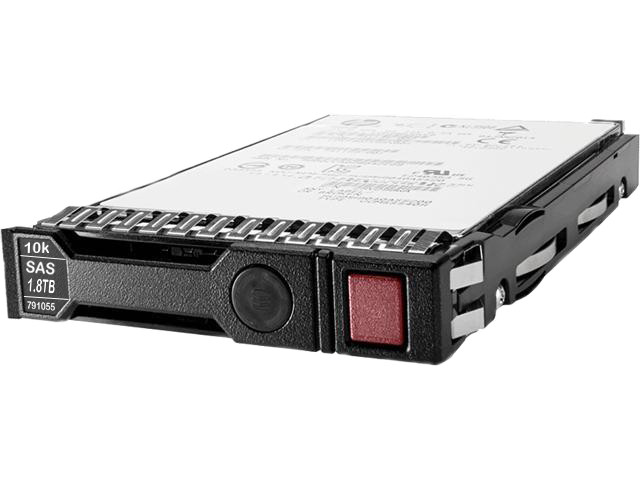
The Drive That Doesn't Call in Sick: A Complete Guide to the HPE 791034-B21 1.8TB SAS Hard Drive
HPE 791034-B21 1.8TB SAS Drive: Everything You Need to Know Before You Buy
If you manage HPE ProLiant servers and you're hunting for a reliable, high-capacity enterprise drive that won't let you down at 3am — this one deserves a serious look. Here's the full breakdown: specs, real-world performance, compatibility, installation, and whether it's actually the right fit for your setup.
What is the HPE 791034-B21?
The HPE 791034-B21 is a 1.8TB enterprise-class hard drive built specifically for HPE ProLiant Gen8, Gen9, and Gen10 servers. It spins at 10,000 RPM, connects via SAS 12Gbps, and is rated for 24/7 continuous operation in demanding environments.
Unlike consumer or standard business-grade drives, this one is engineered to stay reliable under pressure — month after month, year after year. Databases, virtualisation platforms, file servers serving hundreds of users simultaneously — the 791034-B21 handles all of it without complaint.
The "Smart Carrier" designation is more than a label. It means the drive tray actively communicates health data back to the server management system, giving your team early warning before a quiet failure turns into a very loud outage.
Full technical specifications
Here's everything on the spec sheet, laid out clearly:
| Part number | HPE 791034-B21 |
| Capacity | 1.8TB (1,800GB) |
| Spindle speed | 10,000 RPM |
| Interface | SAS 12Gbps |
| Form factor | 2.5-inch Small Form Factor (SFF) |
| Sector format | 512e (512-byte emulation) |
| Port config | Dual port |
| Hot-swap | Yes |
| Carrier type | Smart Carrier (SC) |
| Compatible servers | ProLiant Gen8, Gen9, Gen10 |
| Cache | 128MB |
| MTBF | 1,400,000 hours |
| Warranty | 1-year HPE limited warranty |
Key features — what they actually mean
10,000 RPM: fast enough for the real world
Ten thousand RPM translates directly into lower seek times and faster sustained throughput. When dozens of processes are competing for disk access simultaneously — as they are in any busy database or VM host — that difference is tangible. Compared to a 7,200 RPM drive, you'll feel it in query response times, VM boot speeds, and overall server snappiness.
SAS 12Gbps: built for enterprise I/O
SAS is the interface of choice in enterprise environments for good reason. It supports dual-port connectivity, offers more robust error recovery than SATA, and is designed for the kind of continuous, intensive I/O that enterprise applications generate. The 12Gbps version offers twice the theoretical bandwidth of SAS 6Gbps — and with a capable RAID controller, you'll see that in reduced queue depths and more responsive storage under load.
Dual port: redundancy you can't afford to skip
This one tends to get overlooked until the moment it saves you. With two independent data paths to the drive, if one fails — cable fault, HBA issue, controller problem — the drive stays accessible through the second. In mission-critical environments, that path redundancy is the difference between a brief alert and an unplanned outage.
512e: modern internals, legacy compatibility
512e (512-byte emulation) gives you the reliability benefits of modern 4K physical sector architecture while maintaining full compatibility with older operating systems, file systems, and applications expecting traditional 512-byte sectors. In most ProLiant environments running Windows Server, VMware, or Linux, 512e just works — no extra configuration needed.
Hot-swap: replace drives without downtime
You can physically remove and replace this drive while the server stays powered on and running. Combined with a RAID configuration, this means failed drives can be swapped out during business hours — no maintenance window, no 2am call. The Smart Carrier goes further by surfacing drive status through iLO, so you know exactly which bay needs attention before you touch the rack.
Server compatibility
The 791034-B21 is certified for HPE ProLiant Gen8, Gen9, and Gen10. Here's a quick breakdown by generation:
Gen8 — fully supported
- DL360p, DL380p, DL560, DL580 Gen8
- ML350p Gen8
- BL460c Gen8 (blade)
Gen8 servers will run the drive at 6Gbps on older backplanes. Updated backplanes deliver the full 12Gbps throughput.
Gen9 — the sweet spot
- DL360, DL380, DL560, DL580 Gen9
- ML110, ML350 Gen9
- BL460c Gen9
Gen9 was built with SAS 12Gbps as the standard. This is where the 791034-B21 performs at its best. Smart Array P440, P440ar, P840, and P840ar controllers are fully optimised for this drive.
Gen10 — supported for SAS workloads
- DL360, DL380, DL580 Gen10
- ML350 Gen10
On Gen10, the drive integrates with iLO 5 and HPE Smart Array controllers. Note: always verify Gen10 Plus models against HPE's SPOCK database — updated backplanes may affect compatibility.
Performance expectations
Sequential throughput
At 10K RPM with SAS 12Gbps, expect sequential read speeds of 185–210 MB/s, with writes closely following. For large file transfers, backup operations, and streaming data — solid and consistent.
Set expectations clearly: this is a mechanical drive, not an SSD. Sequential performance is strong for an HDD, but for workloads dominated by thousands of tiny random reads and writes, an SSD is a better fit. The 791034-B21 shines in mixed and sequential-heavy scenarios.
Random I/O
Rated at approximately 300 IOPS on random 4K reads and around 200 IOPS on random writes. More than adequate for:
- File and print servers
- Email platforms like Microsoft Exchange
- ERP and CRM databases with moderate transaction volumes
- Backup targets and nearline archive storage
- Virtual machine storage for non-latency-sensitive VMs
In RAID arrays
The dual-port SAS design supports multi-path I/O, letting the RAID controller distribute load across both drive ports and maintain access if one path encounters issues. HPE Smart Array controllers support RAID 0, 1, 5, 6, 10, 50, and 60. RAID 5 or 6 for capacity and redundancy, RAID 10 for best random write performance.
How it compares to alternatives
vs. Seagate Exos 10E2400 1.8TB
Both drives offer similar sequential throughput and IOPS. The differentiator is ecosystem integration: the HPE 791034-B21 is firmware-matched, tested, and validated for ProLiant, which means Smart Array optimisations, iLO health monitoring, and guaranteed compatibility. A Seagate OEM drive may work, but it won't give you the same management visibility.
vs. HPE 872481-B21 (1.2TB 10K SAS)
Both drives perform similarly for I/O. Choose the 791034-B21 when you need more raw capacity per bay — fewer drives to reach your target storage, which directly reduces hardware cost and power consumption per terabyte.
vs. SSD alternatives
SSDs win on random IOPS and latency. The 791034-B21 wins on cost per terabyte. Many well-designed ProLiant deployments combine SSD caching (via Smart Array controllers) with SAS HDD storage — hot data on SSD, bulk data on spinning drives. It's often the most cost-effective architecture for mixed workloads.
Best use cases
Enterprise file and backup storage
Excellent price-to-capacity-to-reliability ratio. 1.8TB per bay means fewer drives to manage, 10K RPM means restores are fast, and hot-swap means storage can be expanded or replaced without taking the server offline.
Virtualisation and private cloud
Works well as part of a high-density RAID array in VMware, Hyper-V, or KVM environments. Pair multiple drives in RAID 10 or RAID 5 with Smart Array controllers for good aggregate IOPS. Supplement with SSD caching for latency-sensitive VMs.
Database and application servers
Mid-sized SQL Server, Oracle, or PostgreSQL workloads are a classic deployment for this drive. At 10K RPM with dual-port SAS redundancy, the 791034-B21 handles sustained transactional read/write demand comfortably — especially in a RAID 10 array.
High-availability clusters
Dual-port SAS provides the path redundancy that cluster configurations depend on. Combined with a SAS expander or dual-domain array, these drives support the multi-path I/O architectures that keep clustered workloads running through hardware failures.
The HPE 791034-B21 is one of those drives you deploy with confidence and largely forget about — which, in IT infrastructure, is exactly the kind of compliment that counts. Smart Carrier integration, dual-port redundancy, 10K performance, and genuine ProLiant compatibility make it a dependable choice for Gen8, Gen9, and Gen10 environments running databases, file services, virtualisation, or any mixed enterprise workload where reliability and manageability matter as much as raw speed.
Recent Posts
-
Reviving Legacy Server Performance: HPE 785071-B21 300GB 10K SAS Storage for ProLiant Servers
HPE 785071-B21 300GB 10K SAS Hard Drive: Enterprise Storage for ProLiant Gen1 Through Gen7 Servers T …Sep 29th 2026 -
Where Enterprise Speed Meets Dependability: HPE P40430-B21 300GB 10K SAS Storage for ProLiant Gen10 Plus Servers
HPE P40430-B21 300GB 10K SAS Hard Drive: Reliable Mission Critical Storage for ProLiant Gen10 Plus S …Sep 24th 2026 -
Built for the Critical Workload: HPE P28028-B21 300GB 15K SAS Drive for High-Performance ProLiant Servers
HPE P28028-B21 300GB 15K SAS Hard Drive: High-Speed Enterprise Storage for ProLiant Gen9 and Gen10 P …Sep 23rd 2026