
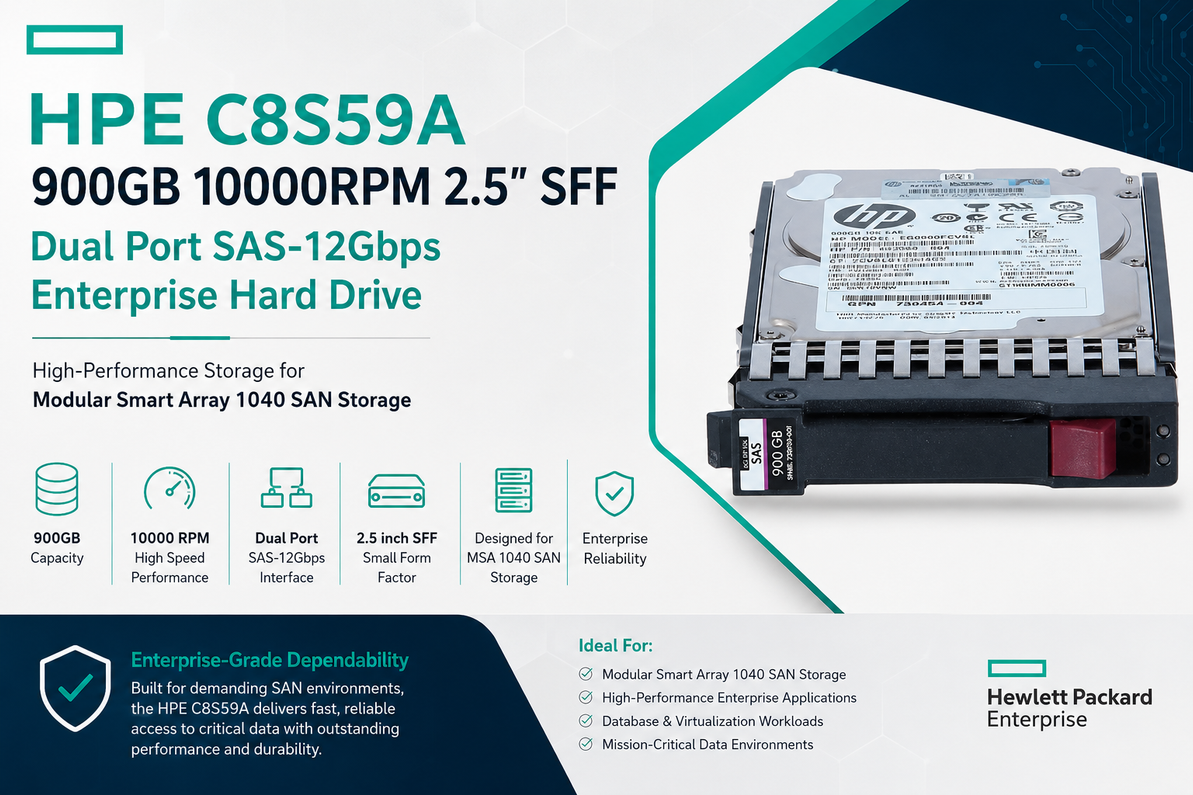
Power Your SAN with Confidence: HPE C8S59A 900GB 10K RPM SAS Enterprise Storage Built for MSA 1040
HPE C8S59A 900GB 10K RPM SAS Hard Drive: Reliable Enterprise Storage for HPE Modular Smart Array 1040 SAN
Introduction
Storage is at the heart of every reliable enterprise environment. Applications can be fast, processors can be powerful, and networks can offer impressive bandwidth, but when data storage becomes a bottleneck, the entire infrastructure can feel slower. This is especially true in businesses that depend on shared storage, databases, virtualization, file services, and other applications that need consistent access to data.
The HPE C8S59A 900GB 10000RPM 2.5-inch Small Form Factor Dual Port SAS-12Gbps Enterprise Hard Drive is designed for enterprise storage environments where dependable performance, connectivity, and compatibility matter. Built for use with the HPE Modular Smart Array 1040 SAN Storage, this 10K RPM SAS hard drive provides a practical combination of capacity and performance for organizations maintaining compatible HPE storage infrastructure.
With a 900GB capacity, 10,000RPM rotational speed, 2.5-inch Small Form Factor design, and dual-port SAS-12Gbps interface, the HPE C8S59A is aimed at storage environments that need more than basic desktop-class storage. It is an enterprise-oriented drive intended to work as part of a larger storage architecture.
For businesses that already have an HPE Modular Smart Array environment in place, selecting the right drive is particularly important. Storage devices need to match the array's supported interface, form factor, firmware expectations, and configuration requirements. The HPE C8S59A is therefore best understood not simply as a 900GB hard drive, but as a component designed to fit into a specific enterprise storage ecosystem.
Understanding the HPE C8S59A
What is the HPE C8S59A?
The HPE C8S59A is a 900GB 10,000RPM SAS enterprise hard drive designed for compatible HPE storage systems. It uses a compact 2.5-inch Small Form Factor and a dual-port SAS-12Gbps interface.
Unlike a typical consumer hard drive, this type of storage device is designed around enterprise storage architectures. It can be installed in compatible storage arrays where multiple drives work together under the control of storage management and RAID technologies.
The drive's intended association with the HPE Modular Smart Array 1040 SAN Storage makes it particularly relevant to organizations operating shared storage infrastructure.
900GB Capacity for Enterprise Storage
A practical capacity for SAN environments
A 900GB drive provides a useful amount of storage for many enterprise workloads. While modern systems can use drives with several terabytes of capacity, 900GB can still be highly practical when working with existing SAN configurations and workloads that prioritize performance and reliability over maximum capacity.
In a storage array, individual drive capacity is only part of the overall equation. Multiple drives can be combined into RAID groups or other storage configurations, allowing organizations to create larger logical storage pools while also implementing redundancy and performance strategies.
For example, several 900GB drives can contribute to a storage pool used for application servers, databases, virtual machines, or shared business data. The usable capacity will depend on the number of drives and the RAID configuration selected.
10,000RPM Performance
Why 10K RPM still matters
The HPE C8S59A operates at 10,000RPM, which places it in the performance-oriented segment of mechanical enterprise hard drives.
A traditional HDD stores information on rotating magnetic platters. The faster those platters rotate, the more quickly the drive can position the required data beneath its read/write heads. As a result, 10K RPM drives generally offer quicker mechanical response than slower 7,200RPM drives.
This characteristic can be useful in enterprise workloads involving frequent storage requests. Database applications, virtualization platforms, transactional systems, and business applications can generate substantial input/output activity throughout the day.
While SSDs and NVMe drives have largely taken the lead in high-performance storage, 10K RPM SAS drives can remain useful where organizations want a balance between performance, capacity, compatibility, and cost within an existing enterprise storage platform.
Dual-Port SAS-12Gbps Interface
Built for enterprise connectivity
One of the defining features of the HPE C8S59A is its dual-port SAS-12Gbps interface.
SAS, or Serial Attached SCSI, is an enterprise storage interface designed for servers and storage arrays. Compared with conventional desktop-oriented storage interfaces, SAS provides features that are particularly valuable in professional storage environments.
The dual-port design can support redundant connectivity when the surrounding storage architecture supports it. In a properly configured environment, multiple paths between the storage device and storage controllers can improve availability and help reduce the impact of a failed communication path.
The 12Gbps SAS interface also provides substantial interface bandwidth for supported storage architectures. However, the actual performance experienced by applications depends on many factors, including the drive's mechanical characteristics, RAID configuration, controller, storage workload, and overall SAN design.
Designed for HPE Modular Smart Array 1040 SAN Storage
A drive for shared enterprise storage
The HPE Modular Smart Array 1040 is designed around shared storage requirements, making drive compatibility especially important.
In a SAN environment, storage is not simply connected to one desktop or workstation. Instead, storage resources can be made available to multiple servers and applications through the storage infrastructure.
The HPE C8S59A fits into this type of environment by providing enterprise HDD storage for compatible configurations. Its 10K RPM speed can make it appropriate for workloads where consistent mechanical storage performance is more important than simply maximizing capacity.
For organizations already using compatible MSA infrastructure, selecting a supported enterprise drive can be a practical way to expand or maintain existing storage resources.
2.5-Inch Small Form Factor Design
Compact storage for dense configurations
The 2.5-inch Small Form Factor is an important advantage in enterprise storage environments.
Compared with larger 3.5-inch drives, SFF drives take up less physical space. This allows compatible storage systems to accommodate multiple drives within a relatively compact chassis.
In data centers, physical space, power consumption, cooling, and storage density all matter. A compact drive design can therefore contribute to a more efficient overall storage architecture.
The HPE C8S59A is designed around this enterprise SFF approach, making it suitable for compatible storage systems that use 2.5-inch drive configurations.
Enterprise Hard Drive Reliability
Designed for demanding environments
Enterprise storage is expected to remain available for long periods while handling workloads that may generate continuous input/output activity.
The HPE C8S59A is designed as an enterprise hard drive rather than a consumer desktop drive. This makes it appropriate for storage environments where predictable operation and compatibility with enterprise storage systems are important considerations.
A dependable storage environment also depends on more than the individual drive. Controllers, RAID groups, cooling, power protection, firmware, monitoring, and maintenance procedures all contribute to storage reliability.
That is why a good enterprise storage strategy treats the hard drive as one component of a larger system rather than relying on the drive alone to provide data protection.
RAID and Data Protection
Why RAID matters in SAN storage
Enterprise storage arrays commonly use RAID or other redundancy technologies to protect data and maintain availability.
RAID allows multiple physical drives to operate together as a logical storage configuration. Depending on the RAID level, an array can provide increased performance, redundancy, or a combination of both.
For example, a redundant RAID configuration may allow an array to continue operating when an individual drive fails. The failed drive can then be replaced and the array rebuilt.
The HPE C8S59A can be part of such a configuration when used with compatible HPE storage hardware and supported RAID technology.
However, RAID should never be treated as a complete backup strategy. RAID can help protect against certain hardware failures, but it does not protect against accidental deletion, malware, corruption, or every other form of data loss. Important enterprise data should still be backed up separately.
Applications for the HPE C8S59A
Database workloads
Databases frequently perform numerous read and write operations, making storage performance an important consideration.
A 10K RPM SAS drive can provide a useful performance level for database workloads that are appropriate for mechanical storage. When several drives are combined into a suitable RAID configuration, the storage subsystem can provide additional performance and redundancy.
The actual results will depend on the database software, workload pattern, RAID level, controller, caching, and number of drives involved.
Virtualization
Virtualization environments can generate unpredictable and highly concurrent storage activity because multiple virtual machines may share the same physical storage.
The HPE C8S59A can be useful for compatible virtualization storage where a 10K RPM SAS tier is appropriate. It may also work well as part of a tiered storage strategy in which different workloads are placed on different types of storage according to their performance requirements.
File and application storage
Businesses also use SAN storage for shared files and enterprise applications.
A properly configured MSA storage environment can provide centralized storage resources for multiple servers. The HPE C8S59A can contribute to that storage pool while providing the performance characteristics associated with 10K RPM enterprise HDDs.
Business-critical workloads
Many organizations continue to operate applications that do not require flash storage but still need dependable enterprise infrastructure.
For these environments, a 10K RPM SAS drive can provide a reasonable balance between storage capacity, mechanical performance, enterprise connectivity, and compatibility.
SAS-12Gbps and Real-World Performance
Interface speed is not the same as drive speed
It is important to understand what the 12Gbps SAS specification actually means.
The 12Gbps figure describes the theoretical signaling rate of the SAS interface. It does not mean that a mechanical hard drive will continuously transfer data at 12Gbps.
The physical limitations of spinning disks mean that actual drive performance is considerably lower than the interface's maximum signaling rate. The faster interface is still valuable because it belongs to a modern enterprise storage architecture and can provide sufficient bandwidth for the storage device and surrounding infrastructure.
In other words, SAS-12Gbps provides the connectivity framework, while the 10K RPM mechanical design determines much of the drive's real-world storage performance.
Hot-Swap and Enterprise Maintenance
Simplifying drive replacement
Enterprise storage systems are designed with maintenance in mind. In compatible configurations, hot-swappable drives can be removed and replaced without shutting down the entire storage environment.
This can significantly reduce maintenance windows and help administrators respond more quickly to drive failures.
When a drive fails inside a redundant RAID configuration, administrators can replace the failed unit with a compatible replacement. The storage system can then rebuild the affected array according to its configuration.
Hot-swapping should always be performed using the procedures recommended for the specific HPE storage system. Compatibility and array status should be checked before removing any drive.
Choosing the Right Drive for an MSA Environment
Compatibility comes first
When purchasing an enterprise hard drive for an HPE Modular Smart Array environment, capacity and RPM are not the only specifications to consider.
The exact MSA model, drive interface, form factor, supported firmware, drive carrier, RAID configuration, and storage controller should all be checked before installation.
The HPE C8S59A is specifically associated with Modular Smart Array 1040 SAN Storage, so organizations should confirm their exact storage hardware before purchasing.
A drive can physically fit into a bay and still be unsuitable for the system. Enterprise storage compatibility is determined by the complete hardware and firmware ecosystem.
Maintaining the HPE C8S59A
Monitor storage health
Once installed, the drive should be monitored through the storage system's management tools.
Administrators should pay attention to drive health indicators, errors, temperatures, failed drives, and RAID status. Early detection of storage problems can provide valuable time to replace a drive before a second problem puts the array at greater risk.
Regular monitoring is especially important in older storage environments because aging drives can become more likely to experience mechanical or media-related problems.
Keep replacement drives available
For mission-critical storage, keeping compatible replacement drives available can reduce downtime.
If a drive fails, having the correct replacement immediately available allows administrators to begin the recovery process without waiting for procurement or shipping.
This is particularly valuable for organizations operating older MSA hardware where finding compatible replacement components may become more difficult over time.
HPE C8S59A vs Modern SSD Storage
Why businesses may still choose enterprise HDDs
Modern SSDs provide dramatically faster access times and are often the preferred choice for high-performance workloads. However, that does not mean every enterprise storage environment needs to migrate completely to flash storage.
HDDs can still provide attractive capacity-to-cost characteristics, especially when large amounts of data need to be stored and ultra-low latency is not required.
For organizations that already have compatible MSA 1040 infrastructure, using an appropriate enterprise SAS HDD can also be more practical than redesigning the entire storage environment.
The right storage technology ultimately depends on workload requirements, budget, compatibility, performance expectations, and the expected lifespan of the infrastructure.
Benefits of the HPE C8S59A
A balanced enterprise storage solution
The HPE C8S59A brings together several characteristics that make it useful for compatible enterprise storage environments.
Its 900GB capacity provides substantial storage space, while the 10,000RPM rotational speed gives it a performance advantage over slower mechanical drives. The dual-port SAS-12Gbps interface supports enterprise-oriented connectivity, and the 2.5-inch SFF design helps support compact, high-density storage configurations.
Most importantly, its intended use with the HPE Modular Smart Array 1040 makes it relevant to organizations maintaining established HPE SAN infrastructure.
Final Thoughts
The HPE C8S59A 900GB 10000RPM 2.5-inch Small Form Factor Dual Port SAS-12Gbps Enterprise Hard Drive is a practical storage component for compatible HPE Modular Smart Array 1040 SAN environments.
It combines a useful 900GB capacity with 10K RPM mechanical performance and enterprise-grade SAS connectivity. Its dual-port design, compact SFF form factor, and compatibility with an established HPE storage ecosystem make it a strong option for businesses maintaining compatible enterprise infrastructure.
While modern SSDs and NVMe drives dominate the highest-performance storage market, enterprise HDDs continue to have a place in environments where capacity, reliability, compatibility, and cost all need to be balanced.
For organizations operating compatible HPE MSA storage, the HPE C8S59A can provide a straightforward way to maintain or expand their existing storage environment without immediately replacing the entire platform.
As with any enterprise storage component, compatibility should always be confirmed before purchase. Verify the exact MSA model, storage configuration, controller, firmware, drive carrier, and RAID requirements to ensure the drive is appropriate for the intended environment.
When correctly matched with supported hardware, the HPE C8S59A offers a dependable combination of 900GB capacity, 10,000RPM performance, dual-port SAS-12Gbps connectivity, and compact 2.5-inch enterprise storage design.
Recent Posts
-
Reviving Legacy Server Performance: HPE 785071-B21 300GB 10K SAS Storage for ProLiant Servers
HPE 785071-B21 300GB 10K SAS Hard Drive: Enterprise Storage for ProLiant Gen1 Through Gen7 Servers T …Sep 29th 2026 -
Where Enterprise Speed Meets Dependability: HPE P40430-B21 300GB 10K SAS Storage for ProLiant Gen10 Plus Servers
HPE P40430-B21 300GB 10K SAS Hard Drive: Reliable Mission Critical Storage for ProLiant Gen10 Plus S …Sep 24th 2026 -
Built for the Critical Workload: HPE P28028-B21 300GB 15K SAS Drive for High-Performance ProLiant Servers
HPE P28028-B21 300GB 15K SAS Hard Drive: High-Speed Enterprise Storage for ProLiant Gen9 and Gen10 P …Sep 23rd 2026