
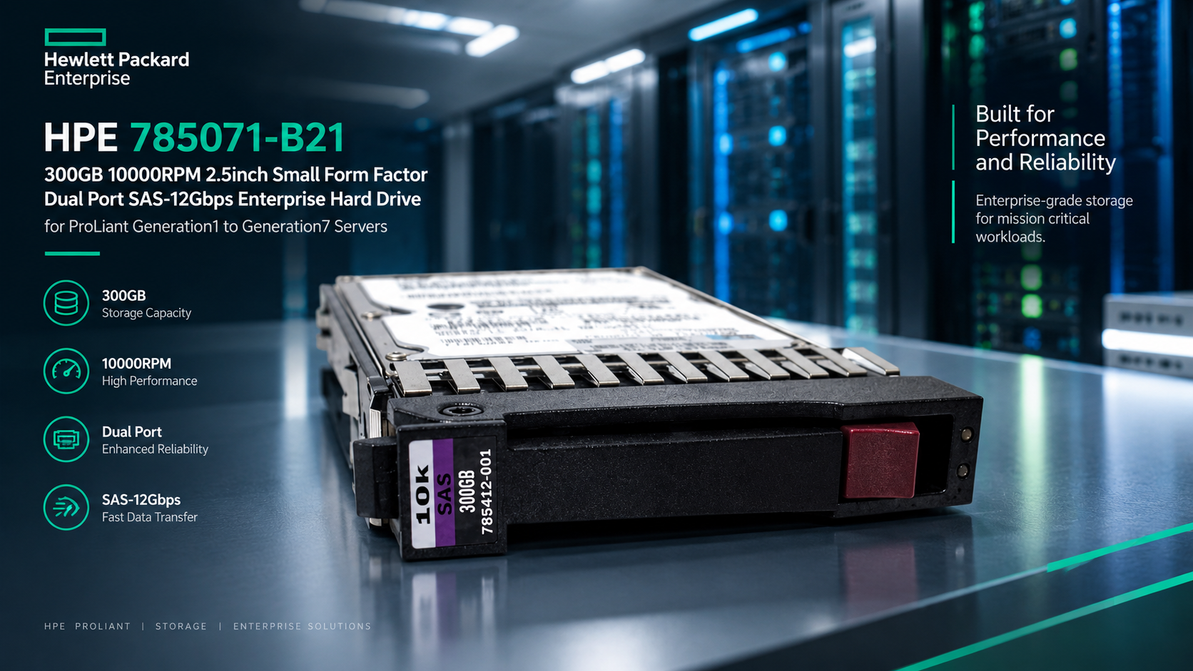
Reviving Legacy Server Performance: HPE 785071-B21 300GB 10K SAS Storage for ProLiant Servers
HPE 785071-B21 300GB 10K SAS Hard Drive: Enterprise Storage for ProLiant Gen1 Through Gen7 Servers
The HPE 785071-B21 300GB 10000RPM 2.5-inch Small Form Factor Dual Port SAS-12Gbps Enterprise Hard Drive is an enterprise-class mechanical storage solution designed for compatible HPE ProLiant server environments. With a 300GB capacity, 10,000RPM rotational speed, 2.5-inch Small Form Factor design, dual-port SAS connectivity, and a 12Gbps interface, this drive is intended for server workloads that require dependable storage and responsive mechanical disk performance.
For organizations maintaining older or established ProLiant infrastructure, selecting the correct enterprise drive is important. Storage compatibility depends on more than physical dimensions. Interface generation, controller support, firmware, drive carrier, sector format, and server generation can all affect whether a particular drive is appropriate.
The HPE 785071-B21 is positioned as a dual-port enterprise SAS drive for compatible ProLiant systems spanning Generation 1 through Generation 7, making it relevant to businesses and data centers that continue to operate legacy HPE server hardware.
Understanding the HPE 785071-B21
300GB Enterprise Storage Capacity
The HPE 785071-B21 provides 300GB of storage capacity, offering a practical amount of enterprise disk space for operating systems, applications, databases, business data, and other server workloads.
While modern storage environments frequently use multi-terabyte drives and solid-state storage, 300GB enterprise hard drives remain useful when maintaining older server installations or replacing existing drives with matching capacity.
Using drives with similar capacity in an existing RAID configuration can also help maintain a consistent storage architecture.
10000RPM Rotational Speed
The drive operates at 10,000RPM, giving it a performance advantage over many conventional 7,200RPM mechanical hard drives.
Higher rotational speed reduces rotational latency, which can improve responsiveness when a server performs frequent random disk operations. This makes 10K SAS drives particularly relevant to workloads where mechanical storage remains in use but faster access is desirable.
Potential applications include:
- Database workloads
- Business applications
- Virtualization
- File and application servers
- Transaction-oriented workloads
- Frequently accessed enterprise data
- Operating-system volumes
Actual performance depends on the complete storage environment, including the RAID controller, cache, RAID level, workload pattern, queue depth, and server architecture.
12Gbps SAS Interface
Enterprise SAS Connectivity
The 785071-B21 uses a SAS-12Gbps interface, providing a high-speed storage connection for compatible enterprise server controllers.
SAS, or Serial Attached SCSI, is designed for professional storage environments and provides features that make it particularly suitable for servers and enterprise storage systems.
The 12Gbps specification represents the interface's signaling capability. It does not mean the mechanical hard disk will continuously deliver 12Gbps of real-world data throughput. Actual performance is constrained by the drive's mechanical characteristics and the surrounding storage infrastructure.
Why SAS Matters in Server Environments
Enterprise SAS drives are designed to work with professional storage controllers and server backplanes.
A compatible SAS controller can manage multiple drives, implement RAID configurations, monitor drive health, and provide storage-management functionality. This makes the 785071-B21 part of a larger enterprise storage architecture rather than simply a standalone hard disk.
Dual-Port SAS Architecture
Multiple Storage Paths
One of the notable features of the HPE 785071-B21 is its dual-port SAS design.
Dual-port SAS provides two independent SAS connections to the drive. In compatible server and storage architectures, multiple paths can be used for redundancy and availability.
This can be especially useful in enterprise environments where storage availability is important and administrators want to minimize the impact of a failed connection, controller path, or related component.
Supporting Enterprise Availability
Dual-port connectivity should not be confused with automatic data redundancy. The drive itself does not create a backup simply because it has two ports.
Instead, dual-port SAS provides connectivity flexibility within a supported architecture. Overall redundancy depends on the server's backplane, controller configuration, RAID design, cabling, firmware, and system architecture.
2.5-Inch Small Form Factor Design
Compact Storage for ProLiant Servers
The 2.5-inch Small Form Factor (SFF) design allows the 785071-B21 to fit compatible ProLiant server configurations designed for SFF storage.
SFF drives can provide high drive density inside a server chassis, allowing administrators to install multiple storage devices without requiring the physical space of larger 3.5-inch drives.
This design is particularly useful in rack-mounted enterprise servers where internal space and storage density are important considerations.
High-Density Server Storage
Multiple SFF drives can be combined into RAID arrays to provide increased capacity, performance, and redundancy.
For example, several 300GB 10K SAS drives can be organized into a suitable RAID configuration depending on the capabilities of the installed controller and the requirements of the workload.
ProLiant Generation 1 Through Generation 7 Compatibility
Supporting Established HPE Server Infrastructure
The HPE 785071-B21 is intended for compatible ProLiant Generation 1 through Generation 7 server environments.
These server generations represent an earlier era of HPE infrastructure, and many organizations continue to operate legacy ProLiant systems for specialized applications, internal services, development environments, or workloads that have not yet been migrated to newer platforms.
For these installations, finding compatible enterprise storage can be important when maintaining existing systems.
Compatibility Should Always Be Verified
Server-generation compatibility should be treated as a starting point rather than a guarantee for every model.
Before installing the 785071-B21, administrators should verify the exact:
- ProLiant server model
- Drive bay configuration
- SAS controller
- Backplane
- Drive carrier
- Firmware version
- RAID configuration
- Supported drive family
This is especially important with older ProLiant systems because storage technologies and controller generations changed significantly across product families.
Enterprise Storage Performance
10K SAS for Responsive Mechanical Storage
The 10,000RPM spindle speed makes the 785071-B21 a performance-oriented mechanical drive.
Compared with slower rotational hard drives, a 10K drive can reduce rotational latency and provide more responsive random-access behavior.
For legacy server environments, this can make the drive a useful choice for applications that require more responsiveness than basic archival or bulk-storage workloads.
Performance Depends on the Entire System
A hard drive's advertised interface speed is only one part of overall storage performance.
Actual results can be influenced by:
- RAID level
- SAS controller
- Controller cache
- Drive queue depth
- Server CPU and memory
- Application workload
- Filesystem
- Sequential versus random I/O
- Number of drives in the array
Adding multiple drives to a properly designed RAID configuration can also increase aggregate storage performance.
RAID Configurations
RAID 0
RAID 0 stripes data across multiple drives and can provide improved aggregate performance and full combined capacity.
However, RAID 0 offers no drive-failure protection. If one drive fails, the entire array can become unavailable.
For important enterprise data, RAID 0 should only be used when its specific characteristics are appropriate and other protection mechanisms exist.
RAID 1
RAID 1 mirrors data between two drives. It provides redundancy because each drive contains a copy of the data.
The trade-off is reduced usable capacity because only approximately half of the combined raw capacity is available for data.
RAID 5
RAID 5 distributes data and parity across multiple drives. It can provide a balance between usable capacity and redundancy while allowing the array to tolerate a single drive failure.
Its suitability depends on workload, array size, controller capabilities, and rebuild requirements.
RAID 10
RAID 10 combines mirroring and striping. It can provide strong performance and redundancy, making it suitable for workloads with significant random I/O requirements.
The drawback is that it requires additional drives and sacrifices storage capacity for mirroring.
Enterprise Applications for the 785071-B21
Database Servers
Databases can produce substantial random I/O, particularly when applications frequently read and modify records.
A 10K SAS drive can provide responsive mechanical storage for suitable database workloads, especially when multiple drives are combined into an optimized RAID configuration.
Database performance also depends heavily on system memory, CPU resources, database architecture, indexing, controller cache, and application design.
Virtualization
Virtualization servers can generate multiple simultaneous I/O requests because several virtual machines share the same physical storage.
A collection of 10K SAS drives can provide a useful storage layer for certain virtualization deployments on compatible legacy ProLiant systems.
Modern virtualization environments may benefit from SSD storage, but 10K SAS drives can remain useful where organizations need to maintain existing mechanical storage infrastructure.
File and Application Servers
The drive can also be used for compatible file servers and application servers where moderate capacity and responsive storage are required.
Multiple 785071-B21 drives can be combined into RAID arrays to create a larger and more resilient storage pool.
Benefits of the HPE 785071-B21
300GB Enterprise Capacity
The 300GB capacity makes the drive useful for replacing similarly sized drives in established ProLiant storage configurations.
10,000RPM Performance
The 10K RPM spindle speed provides lower rotational latency than many slower enterprise hard drives.
12Gbps SAS Interface
The SAS-12Gbps interface provides a high-speed enterprise storage connection for compatible controllers and infrastructure.
Dual-Port Connectivity
Dual-port SAS can support redundant storage paths in compatible architectures.
2.5-Inch SFF Design
The compact SFF form factor supports high-density storage configurations in compatible ProLiant servers.
Enterprise-Class Architecture
The drive is designed for server environments rather than conventional desktop or consumer systems.
Technical Specifications
| Specification | Details |
|---|---|
| HPE Part Number | 785071-B21 |
| Capacity | 300GB |
| Rotational Speed | 10,000RPM |
| Form Factor | 2.5-inch Small Form Factor |
| Interface | SAS |
| Interface Speed | 12Gbps |
| Port Configuration | Dual Port |
| Drive Type | Enterprise Hard Disk Drive |
| Intended Platform | Compatible HPE ProLiant servers |
| Server Generations | Generation 1 through Generation 7 |
| Typical Applications | Databases, virtualization, applications, file servers |
| Storage Architecture | Enterprise SAS |
Installation Considerations
Check the Exact ProLiant Model
Before ordering the 785071-B21, verify the precise ProLiant server model.
Different ProLiant generations and models can use different drive carriers, backplanes, controllers, and firmware requirements.
A drive that physically fits into a bay may still not be supported by the server's storage controller.
Verify the SAS Controller
The installed SAS controller must support the drive and its interface characteristics.
Older ProLiant servers may use SAS controllers with different generations and capabilities, so checking the controller model is an important part of compatibility verification.
Check the Existing RAID Array
If the drive is being used as a replacement, compare it with the existing drives in the array.
Pay particular attention to capacity, interface, sector format, rotational speed, firmware, and HPE qualification.
Using a replacement drive with inappropriate specifications can create compatibility or array-management issues.
Back Up Critical Data
RAID can protect against certain hardware failures, but it is not a substitute for backup.
Important business data should be protected with an independent backup strategy that addresses accidental deletion, corruption, malware, hardware failure, and other potential causes of data loss.
Why 10K SAS Drives Still Matter
Although solid-state storage has transformed enterprise storage performance, mechanical SAS drives continue to have a place in legacy infrastructure.
Many businesses operate server hardware that remains perfectly adequate for its original application. Replacing a failed storage drive can therefore be more practical than replacing an entire server.
The 785071-B21 can be relevant in these circumstances because it combines a compact SFF design, 10K RPM performance, dual-port SAS connectivity, and enterprise-oriented construction.
For organizations maintaining older ProLiant systems, matching the existing storage architecture can also simplify maintenance and reduce unnecessary configuration changes.
HPE 785071-B21 for Legacy Server Maintenance
Legacy server maintenance often requires careful hardware selection.
An administrator replacing a failed drive should consider not only the capacity but also the server's storage architecture. The correct replacement needs to fit the drive bay, communicate with the controller, work with the backplane, and integrate with the existing RAID configuration.
The 785071-B21 can be considered when maintaining compatible ProLiant Generation 1 through Generation 7 environments that require a 300GB 10K dual-port SAS drive.
Who Should Consider the HPE 785071-B21?
This enterprise hard drive can be relevant to organizations that:
- Maintain compatible HPE ProLiant Gen1 through Gen7 servers
- Need a 300GB SAS replacement drive
- Require 10,000RPM mechanical storage
- Use 2.5-inch SFF drive bays
- Need dual-port SAS connectivity
- Maintain legacy enterprise applications
- Operate RAID-based server storage
- Need to replace an aging or failed compatible drive
Final Thoughts
The HPE 785071-B21 300GB 10000RPM 2.5-inch Small Form Factor Dual Port SAS-12Gbps Enterprise Hard Drive is designed around the requirements of established enterprise server environments.
Its combination of 300GB capacity, 10K RPM rotational speed, 12Gbps SAS connectivity, dual-port architecture, and compact SFF form factor makes it a practical storage component for compatible HPE ProLiant systems.
For organizations maintaining ProLiant Generation 1 through Generation 7 servers, the drive can provide a suitable replacement or expansion option when the exact server, controller, backplane, firmware, and storage configuration support it.
As with any enterprise hard drive, compatibility should be verified before installation. When correctly matched to the server environment and combined with an appropriate RAID and backup strategy, the 785071-B21 can help extend the useful life of established HPE server infrastructure while maintaining a dependable SAS-based storage architecture.
Recent Posts
-
Reviving Legacy Server Performance: HPE 785071-B21 300GB 10K SAS Storage for ProLiant Servers
HPE 785071-B21 300GB 10K SAS Hard Drive: Enterprise Storage for ProLiant Gen1 Through Gen7 Servers T …Sep 29th 2026 -
Where Enterprise Speed Meets Dependability: HPE P40430-B21 300GB 10K SAS Storage for ProLiant Gen10 Plus Servers
HPE P40430-B21 300GB 10K SAS Hard Drive: Reliable Mission Critical Storage for ProLiant Gen10 Plus S …Sep 24th 2026 -
Built for the Critical Workload: HPE P28028-B21 300GB 15K SAS Drive for High-Performance ProLiant Servers
HPE P28028-B21 300GB 15K SAS Hard Drive: High-Speed Enterprise Storage for ProLiant Gen9 and Gen10 P …Sep 23rd 2026