
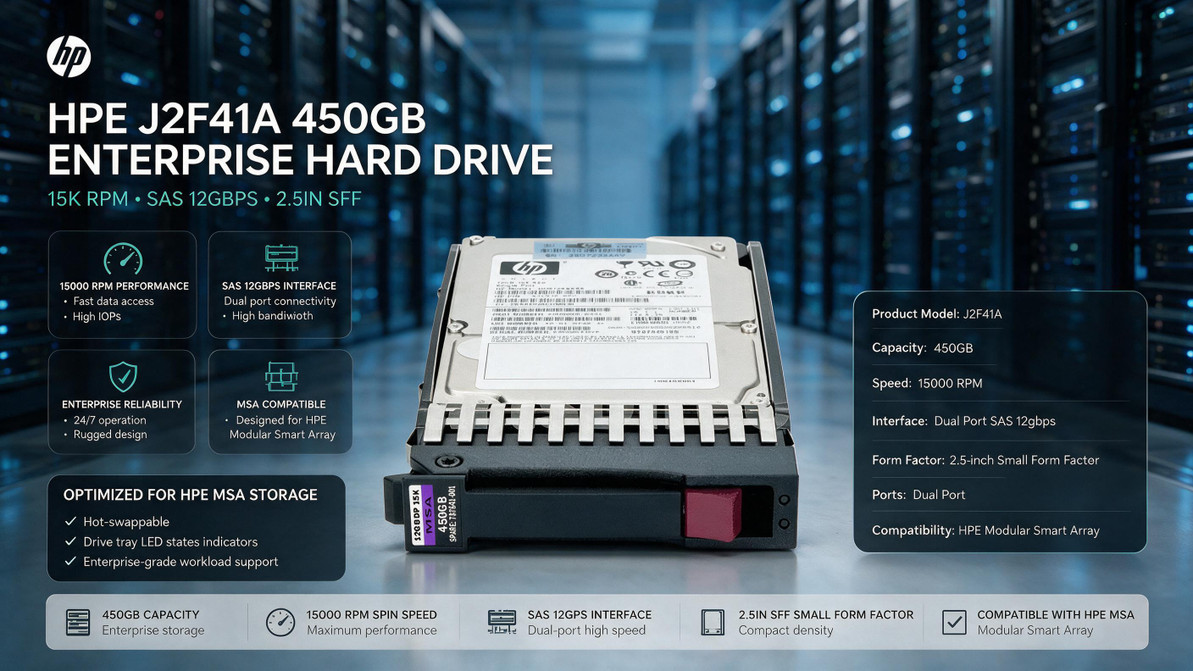
HPE J9F41A 450GB 15K SAS Powerhouse: High-Speed Enterprise Storage for HPE Modular Smart Array
HPE J9F41A 450GB 15000RPM SAS Hard Drive: High-Performance Enterprise Storage for Modular Smart Array
The HPE J9F41A 450GB 15000RPM 2.5-inch Small Form Factor Dual Port SAS-12Gbps Enterprise Hard Drive is designed for organizations that need dependable, high-performance mechanical storage for compatible HPE Modular Smart Array environments. Combining a 15,000 RPM rotational speed, dual-port 12Gbps SAS connectivity, enterprise-class construction, and a compact 2.5-inch Small Form Factor design, this drive is aimed at storage environments where performance, availability, and reliable operation are important.
With a 450GB capacity, the HPE J9F41A is not intended to compete with modern high-capacity HDDs or SSDs on raw storage space. Instead, its primary strength is delivering responsive mechanical storage for active enterprise workloads. The 15K RPM spindle speed helps reduce rotational latency, while the SAS architecture provides the connectivity and management features expected in professional storage infrastructure.
For businesses maintaining compatible HPE Modular Smart Array systems, the J9F41A can be an attractive option for replacing failed drives, expanding an existing storage pool, or maintaining a consistent drive configuration across an established storage environment.
Understanding the HPE J9F41A
A purpose-built enterprise SAS drive
The HPE J9F41A belongs to the enterprise storage category rather than the consumer desktop HDD market. It is designed around a 2.5-inch Small Form Factor, making it suitable for compatible HPE storage systems that use SFF drive bays.
Its 15,000 RPM spindle speed is one of its most important characteristics. While modern SSDs have largely replaced high-speed mechanical drives in many new deployments, 15K SAS HDDs remain useful in older or specialized enterprise infrastructures where the storage architecture is already based on SAS technology.
The drive's dual-port SAS interface is particularly important for storage arrays. Dual-port SAS allows the drive to maintain connectivity through two independent SAS paths when the surrounding storage infrastructure supports multipath operation. This can help improve availability by providing an alternative path if one connection or controller path becomes unavailable.
HPE J9F41A Key Specifications
Specification overview
The HPE J9F41A offers a combination of capacity, speed, interface technology, and form factor designed for enterprise storage applications.
| Specification | HPE J9F41A |
|---|---|
| Drive Type | Enterprise Hard Drive |
| Capacity | 450GB |
| Rotational Speed | 15,000 RPM |
| Form Factor | 2.5-inch Small Form Factor |
| Interface | SAS |
| SAS Speed | 12Gbps |
| Port Configuration | Dual Port |
| Intended Environment | HPE Modular Smart Array |
| Drive Class | Enterprise |
| Storage Technology | Mechanical HDD |
The combination of 450GB capacity and 15K RPM performance makes the J9F41A particularly interesting for workloads where fast mechanical access is more important than maximizing capacity per drive.
Why 15,000 RPM Matters
Faster mechanical response
Hard disk drives store information on spinning platters. When the system requests data, the drive must position its read/write heads and wait for the appropriate portion of the platter to rotate into position.
A 15,000 RPM drive spins significantly faster than conventional 7,200 RPM HDDs. This reduces rotational latency and can improve responsiveness when the workload involves frequent random reads and writes.
That difference can be valuable in enterprise environments where storage performance affects application response times.
The HPE J9F41A therefore makes particular sense for workloads that repeatedly access smaller blocks of information rather than simply transferring large sequential files.
Designed for active workloads
A 15K RPM SAS drive is traditionally associated with applications such as transactional databases, virtualization, application servers, and other workloads requiring relatively quick mechanical storage response.
It will not provide the extremely low latency of an enterprise SSD, but within the mechanical HDD category, 15K RPM remains a performance-oriented design.
Dual-Port SAS Connectivity
Built for storage availability
One of the defining characteristics of the HPE J9F41A is its dual-port SAS interface.
Unlike a basic single-path storage connection, dual-port SAS allows compatible storage architectures to establish two independent communication paths to the drive. This is especially useful in enterprise storage arrays where redundancy and continuous access are important.
If one communication path experiences a problem, a properly configured multipath storage environment can potentially continue accessing the drive through the alternative path.
This makes dual-port SAS particularly valuable in environments where storage availability is a major consideration.
SAS versus SATA
SAS is designed specifically for enterprise storage and offers capabilities that go beyond the basic interface found on many consumer SATA hard drives.
SAS supports features and architectures designed for servers and storage arrays, including dual-port connectivity, enterprise controllers, multipath configurations, and professional storage management.
For this reason, the J9F41A is not simply a faster version of a desktop hard drive. It is part of a storage ecosystem designed around enterprise infrastructure.
12Gbps SAS Interface Explained
High-speed storage connectivity
The HPE J9F41A uses a 12Gbps SAS interface, giving it access to a high-bandwidth connection between the drive and compatible storage controllers.
It is important to understand that 12Gbps is the interface's theoretical signaling rate. It does not mean the mechanical HDD will continuously transfer data at 12Gbps.
Actual performance depends on the physical characteristics of the drive, workload, controller, RAID configuration, queue depth, storage architecture, and other components.
Nevertheless, a 12Gbps SAS interface provides an appropriate high-speed connection for enterprise storage systems and avoids making the storage interface an unnecessary bottleneck when the drive is operating alongside modern SAS infrastructure.
2.5-Inch Small Form Factor Design
Compact storage for dense systems
The 2.5-inch Small Form Factor design allows the HPE J9F41A to fit into compatible compact enterprise storage systems.
SFF drives are particularly useful in rack-mounted infrastructure because they allow manufacturers to install multiple drives within a relatively small physical footprint.
For data centers, this can provide greater flexibility when building storage arrays while preserving valuable rack space.
The compact design also makes the J9F41A suitable for storage environments where multiple drives are installed together for RAID, redundancy, or performance.
HPE Modular Smart Array Compatibility
Designed for enterprise storage environments
The HPE J9F41A is intended for use with compatible HPE Modular Smart Array storage environments. Modular Smart Array systems are designed to provide shared and expandable storage capabilities for enterprise and business infrastructure.
In an MSA environment, storage drives are not simply installed as individual disks. They become components of a larger storage architecture involving controllers, disk groups, RAID levels, storage pools, volumes, and host connectivity.
This makes selecting the correct drive important. Compatibility should always be confirmed against the exact MSA model, controller generation, firmware, drive interface, form factor, and supported drive list before purchasing.
Performance Benefits of the HPE J9F41A
Responsive mechanical storage
The biggest performance advantage of the J9F41A comes from its 15,000 RPM spindle speed.
For workloads with random I/O activity, faster rotational speed can help reduce the amount of time the drive spends waiting for the desired data location to rotate underneath the heads.
This can improve overall storage responsiveness compared with slower mechanical drives.
However, performance should always be evaluated in the context of the complete storage array. A single drive's specifications do not determine the performance of an entire MSA system.
RAID can increase aggregate performance
Multiple J9F41A drives can be combined into an appropriate RAID configuration. Depending on the RAID level, workload, controller, and number of drives, striping can increase aggregate throughput by distributing I/O operations across multiple disks.
At the same time, RAID can provide varying degrees of protection against drive failures.
The correct RAID level should be selected according to the application's performance and availability requirements rather than simply choosing the configuration with the highest theoretical speed.
Enterprise Applications for HPE J9F41A
Database workloads
Databases frequently generate random read and write operations, making storage latency an important consideration.
A 15K RPM SAS drive can be useful in database environments where an organization is maintaining a traditional HDD-based storage array.
For extremely latency-sensitive modern databases, enterprise SSDs or NVMe storage may provide substantially better performance. However, the J9F41A remains a practical choice for compatible legacy SAS environments.
Virtualization
Virtualization platforms can generate mixed and unpredictable storage activity because multiple virtual machines may access shared storage simultaneously.
The J9F41A's 15K RPM speed and SAS connectivity can make it suitable for certain virtualization environments where mechanical enterprise storage remains in use.
Using multiple drives in an appropriately configured RAID or storage pool can also help distribute I/O workloads.
Application servers
Enterprise applications frequently require dependable access to operating system files, application data, logs, and databases.
The J9F41A can serve as an active storage component in compatible application server environments, particularly where the infrastructure is already based on SAS HDD technology.
Reliability in Enterprise Storage
Designed for continuous operation
Enterprise storage drives are built for environments where storage devices may operate continuously and experience sustained workloads.
The HPE J9F41A is intended for professional storage infrastructure rather than ordinary desktop systems. Its SAS interface, dual-port architecture, enterprise positioning, and compatibility with Modular Smart Array environments all reflect this intended use.
However, no hard drive is immune to failure. Even enterprise HDDs should be deployed with appropriate RAID protection, monitoring, backups, and a tested recovery strategy.
HPE J9F41A and RAID Protection
Building a resilient storage system
One of the primary reasons to use enterprise drives inside an MSA storage array is the ability to combine multiple drives into a redundant storage architecture.
RAID 1 mirrors data between drives, providing protection against a single drive failure in a mirrored pair. RAID 5 uses distributed parity and can tolerate a single drive failure, while RAID 6 provides protection against two simultaneous drive failures. RAID 10 combines mirroring and striping to deliver strong performance and redundancy.
The appropriate configuration depends on the MSA platform, number of drives, capacity requirements, workload, performance expectations, and acceptable recovery time.
RAID should always be complemented by independent backups because RAID protects availability, not against every type of data loss.
Installation Considerations
Verify the storage array first
Before installing an HPE J9F41A, administrators should verify that the exact Modular Smart Array model supports the drive.
The following components should be checked:
The MSA model and generation should be confirmed first. The drive bay should support the 2.5-inch SFF form factor. The storage system must also support SAS drives at the relevant interface generation.
Controller firmware and storage-system firmware should be reviewed as well. Firmware compatibility can be particularly important when introducing replacement or additional drives into an existing storage array.
The existing RAID or disk group should also be checked before adding a new drive. Mixing drives with substantially different capacities, sector formats, performance characteristics, or firmware behavior may affect how the storage system handles the new disk.
Why Drive Compatibility Matters
Avoiding expensive storage mistakes
Enterprise storage hardware is considerably less forgiving of compatibility assumptions than a typical desktop PC.
A drive may physically fit inside a storage enclosure while still being unsupported by the controller or storage management software.
For this reason, purchasing based solely on the physical appearance of the drive is not recommended. The exact HPE part number, storage array model, drive type, interface, capacity, firmware requirements, and carrier configuration should all be verified.
For the J9F41A, buyers should specifically confirm compatibility with their particular HPE Modular Smart Array system.
HPE J9F41A for Storage Expansion
Adding performance-oriented capacity
The 450GB capacity of the J9F41A can be useful when expanding an existing enterprise storage environment with additional performance-oriented HDDs.
Rather than focusing exclusively on maximum terabytes per drive, administrators can use smaller, faster disks when the workload benefits from greater I/O performance.
This approach can be useful for databases, active application data, virtualization workloads, and other environments where storage responsiveness matters.
HPE J9F41A Versus 10K RPM SAS HDDs
Choosing between capacity and speed
Enterprise SAS HDDs are commonly available in different rotational speeds, particularly 10K RPM and 15K RPM.
A 10K RPM drive generally provides a compromise between performance, capacity, power consumption, and cost. A 15K RPM drive such as the J9F41A places greater emphasis on mechanical responsiveness.
If an application generates frequent random I/O, a 15K RPM HDD can offer an advantage over a slower mechanical drive.
On the other hand, organizations prioritizing capacity may prefer larger 10K RPM or nearline SAS drives.
HPE J9F41A Versus SSDs
When a traditional HDD still makes sense
It would be easy to assume that an SSD is always the better choice, but enterprise storage decisions are rarely that simple.
SSDs provide much lower latency and can deliver substantially higher IOPS than mechanical HDDs. However, an existing MSA infrastructure may already be designed around SAS HDDs, and replacing the entire storage environment can be expensive.
For organizations maintaining older but still functional enterprise infrastructure, a compatible 15K SAS drive can provide an economical way to keep an existing storage platform operational.
The J9F41A is therefore best viewed as a high-performance enterprise HDD for compatible SAS environments rather than as a direct competitor to modern NVMe SSDs.
Maintenance and Monitoring
Keep enterprise storage healthy
Installing a reliable enterprise drive is only one part of maintaining a healthy storage environment.
Administrators should regularly monitor storage-system alerts, drive health information, RAID status, predictive failure notifications, temperature, and controller events.
If a drive reports signs of failure, it should be replaced according to the organization's maintenance procedure rather than waiting for complete failure.
A proactive monitoring strategy can reduce downtime and make drive replacement much more predictable.
Benefits of the HPE J9F41A
Why this drive remains useful
The HPE J9F41A offers several characteristics that make it attractive for compatible enterprise storage systems. Its 15,000 RPM spindle speed provides fast mechanical access, while its 12Gbps SAS interface provides high-speed enterprise connectivity.
Its dual-port SAS architecture supports redundant connectivity in compatible storage designs, while the 2.5-inch SFF format allows it to fit into dense storage configurations.
Its 450GB capacity can also make it suitable for replacing similarly sized drives within established storage arrays without immediately redesigning the entire storage infrastructure.
Who Should Choose the HPE J9F41A?
Ideal users and environments
The HPE J9F41A is primarily suited to businesses, data centers, IT administrators, and organizations operating compatible HPE Modular Smart Array storage systems.
It is particularly useful for organizations that need to replace failed enterprise drives while maintaining an existing array configuration.
It can also make sense when adding storage to a compatible MSA environment where 15K RPM SAS drives are already being used.
For brand-new deployments where maximum I/O performance, energy efficiency, and low latency are the highest priorities, enterprise SSDs should be considered. For established SAS infrastructure, however, the J9F41A can remain a practical and cost-conscious storage solution.
Final Thoughts
A high-speed enterprise HDD for HPE Modular Smart Array
The HPE J9F41A 450GB 15000RPM 2.5-inch Small Form Factor Dual Port SAS-12Gbps Enterprise Hard Drive is built around a straightforward goal: provide fast, dependable mechanical storage for compatible enterprise environments.
Its 15K RPM spindle speed gives it a performance advantage over slower HDDs, while the 12Gbps SAS interface provides modern enterprise connectivity. The dual-port design is particularly valuable in storage environments that require redundant communication paths, and the compact SFF form factor allows high-density storage configurations.
For organizations maintaining compatible HPE Modular Smart Array systems, the J9F41A can be a useful replacement or expansion drive for performance-focused SAS storage. It is especially relevant for database, virtualization, application, and transactional workloads where high-speed mechanical storage remains appropriate.
As with any enterprise storage component, compatibility should be verified before purchase. Check the exact MSA model, controller, firmware, backplane or enclosure configuration, supported drive list, and existing RAID or disk-group requirements.
When deployed in the right environment, the HPE J9F41A provides a practical combination of 15K RPM performance, 12Gbps SAS connectivity, dual-port architecture, enterprise reliability, and compact SFF design, making it a capable storage option for compatible HPE Modular Smart Array infrastructure.
Recent Posts
-

Where Smart Storage Meets 10K Speed: Unlocking the Power of HPE 728712-B21 Enterprise SAS
HPE 728712-B21 300GB 10K SAS Hard Drive: Smart Storage Performance for ProLiant Gen8 and Gen9 Server …Oct 5th 2026 -
Where Legacy Meets Performance: Unleashing the HPE 574879-B21 300GB 10K SAS Enterprise Drive
HPE 574879-B21 300GB 10K SAS Hard Drive: Dependable Enterprise Storage for Legacy ProLiant Servers E …Oct 4th 2026 -

HPE 696736-B21: The 10K SAS Storage Engine Built for ProLiant Performance
HPE 696736-B21 300GB 10000RPM SAS-6Gbps Smart Carrier Enterprise Hard Drive for ProLiant Servers The …Oct 3rd 2026