
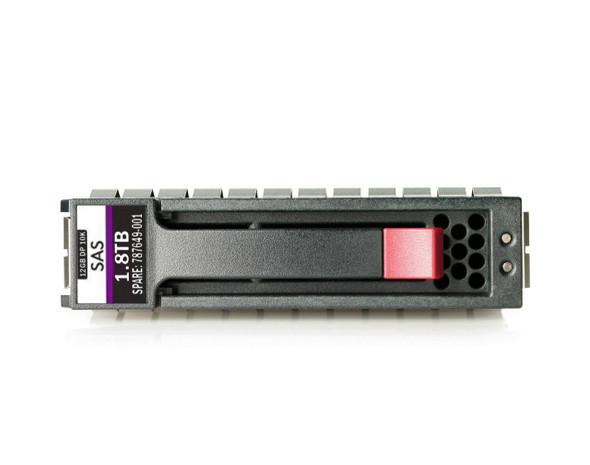
Shared Storage, Zero Compromises: The Complete Guide to the HPE J9F49A 1.8TB SAS Drive for MSA 1040 & 2040
HPE J9F49A 1.8TB 10K RPM SAS Hard Drive: The Definitive Guide for MSA 1040 & 2040 SAN Storage
When your SAN storage platform is the backbone of your business — hosting virtual machines, databases, file shares, or backup repositories — the hard drives inside it are not a detail. They are the foundation. The HPE J9F49A is a 1.8TB, 10,000 RPM SAS 12Gbps enterprise hard drive purpose-engineered for HPE's Modular Smart Array (MSA) 1040 and 2040 SAN storage platforms. In this guide, we cover everything from raw specifications and standout features to compatibility, installation, real-world performance, and how this drive fits into a well-designed storage strategy.
What Is the HPE J9F49A? Understanding the Drive and Its Purpose
The HPE J9F49A is an enterprise-grade 2.5-inch Small Form Factor (SFF) hard drive designed exclusively for deployment inside HPE Modular Smart Array storage systems. Unlike server-side direct-attach drives, this unit is built and certified for SAN (Storage Area Network) environments, where multiple hosts access shared storage pools simultaneously and drive reliability has direct consequences for business continuity.
At 1.8TB capacity with a 10,000 RPM spindle speed, the J9F49A occupies the sweet spot in enterprise HDD design: enough capacity to build cost-effective storage pools, and enough speed to handle mixed enterprise workloads without becoming a bottleneck. The dual-port SAS 12Gbps interface provides the redundant path connectivity that SAN environments demand, while the hot-swap design ensures that maintenance and replacements can occur without service interruption.
What makes the J9F49A distinct from ProLiant server drives — such as the HPE 791034-B21 — is that it is specifically validated, firmware-matched, and performance-tuned for the MSA 1040 and MSA 2040 storage controller ecosystem. Inserting a non-certified drive into an MSA system risks compatibility issues, missed firmware updates, and potential voiding of support contracts. The J9F49A eliminates those risks from the start.
Complete Technical Specifications of the HPE J9F49A
The table below provides a comprehensive reference for all technical parameters of the HPE J9F49A drive:
|
Part Number |
HPE J9F49A |
|
Drive Capacity |
1.8TB (1,800GB) |
|
Spindle Speed |
10,000 RPM |
|
Interface Type |
SAS 12Gbps (Serial Attached SCSI) |
|
Form Factor |
2.5-inch Small Form Factor (SFF) |
|
Sector Format |
512e (512-byte Emulation) |
|
Port Configuration |
Dual Port |
|
Hot-Swap Support |
Yes |
|
Compatible Storage |
HPE MSA 1040, HPE MSA 2040 |
|
Cache Buffer |
128MB |
|
Sustained Transfer Rate |
Up to 204 MB/s |
|
Average Seek Time |
< 4.2ms |
|
Rotational Latency |
3ms (average) |
|
Mean Time Between Failures |
1,400,000 hours |
|
Drive Type |
Enterprise HDD |
|
Warranty |
1-Year HPE Limited Warranty |
Key Features of the HPE J9F49A — A Detailed Breakdown
10,000 RPM Spindle Speed: Performance Built for Shared Storage
In a SAN environment, storage is not accessed by one server at a time — it is shared across multiple hosts simultaneously. This makes spindle speed far more consequential than in direct-attach scenarios. At 10,000 RPM, the J9F49A delivers an average rotational latency of 3ms and average seek times under 4.2ms, which translates to consistently responsive storage even when multiple hosts are generating concurrent I/O.
For workloads like virtual machine datastores, shared database volumes, or multi-host file services, this performance profile means fewer queue depth issues and more predictable response times — exactly what a SAN is expected to deliver.
SAS 12Gbps Interface: The Right Choice for Enterprise SAN
The SAS 12Gbps interface is the current-generation standard for enterprise HDD connectivity, and its advantages in a SAN context go beyond raw bandwidth numbers. SAS is designed for continuous, high-demand operation. It handles error recovery more aggressively than SATA, supports longer cable runs without signal degradation, and — critically — supports the dual-port design that makes SAN storage resilient.
HPE's MSA 1040 and 2040 storage controllers are built around dual-domain SAS architecture, and the J9F49A is designed to take full advantage of this. With 12Gbps per port, the drive can sustain high throughput under load while the second port remains available for path failover.
Dual-Port SAS: Eliminating Single Points of Failure
Dual-port SAS is one of the most important — and often least appreciated — features of the J9F49A. In a properly configured MSA deployment, each drive is connected to both storage controllers via separate SAS domains. If Controller A fails, hosts can continue reading and writing through Controller B, because the J9F49A maintains an independent connection to both.
This dual-domain architecture, enabled by the drive's dual-port SAS design, is what allows HPE MSA systems to achieve true active-active controller configurations. Without dual-port drives, this level of resilience simply is not possible. For any organisation where storage availability is a business-critical requirement, this feature alone justifies the choice of J9F49A over SATA or single-port alternatives.
512e Sector Format: Broad Compatibility Without Compromise
The J9F49A uses 512e (512-byte emulation) sector formatting. Physically, the drive uses 4K sectors for improved data integrity and media efficiency. Logically, however, it presents the traditional 512-byte sector interface to the host system.
This matters for MSA deployments because 512e ensures compatibility with the full range of operating systems, hypervisors, and applications that access MSA volumes — including older workloads that may not natively support 4K (4Kn) addressing. Whether your environment runs Windows Server, VMware ESXi, Red Hat Enterprise Linux, or a mixed-OS landscape, 512e provides seamless operation without requiring special configuration on the host side.
Hot-Swap Capability: SAN Maintenance Without Downtime
In a SAN environment, storage maintenance that requires downtime is rarely acceptable. The J9F49A's hot-swap capability allows drives to be physically removed and replaced while the MSA system remains fully operational and serving storage to connected hosts.
When paired with RAID protection (which is standard in MSA deployments), a single drive failure triggers an automatic rebuild using the spare. The failed drive can then be physically replaced without scheduling a maintenance window, and the new drive automatically joins the RAID set and begins rebuilding. For storage administrators managing 24/7 environments, this operational characteristic is not a convenience — it is a fundamental operational requirement.
MSA-Specific Firmware and Validation
Every HPE drive certified for the MSA platform carries storage-system-specific firmware that is tested and validated in conjunction with the MSA 1040 and 2040 controllers. This firmware governs how the drive responds to controller commands, handles error conditions, manages vibration compensation in dense drive enclosures, and communicates health data through the MSA's management interface.
Third-party or non-certified drives may function at the basic level in an MSA enclosure, but they lack this firmware integration. The result can be degraded RAID rebuild performance, missing health telemetry, and in some cases, instability under high I/O load. With the J9F49A, you get a drive that was designed, tested, and validated as part of the MSA system — not just inserted into it.
HPE MSA 1040 and MSA 2040: Understanding the Target Platforms
What Is the HPE Modular Smart Array (MSA)?
The HPE Modular Smart Array (MSA) is a family of entry-to-midrange SAN and direct-attach storage systems designed for organisations that need shared, resilient, and manageable storage without the cost and complexity of high-end SAN platforms. The MSA 1040 and 2040 are the primary models for which the J9F49A is certified.
Both models offer dual-controller architecture, support for multiple connectivity protocols (iSCSI, Fibre Channel, and SAS host connections depending on configuration), and a tiered storage approach that can mix SSD and HDD drives within the same enclosure. They are widely deployed in SMB and mid-enterprise environments for VMware and Hyper-V datastores, SQL Server storage, file storage, and backup repositories.
HPE MSA 1040 — Specifications and J9F49A Role
The HPE MSA 1040 is the entry-level model, designed for environments that need shared SAN or direct-attach storage with dual-controller resilience at an accessible price point. Key characteristics relevant to the J9F49A include:
- Supports up to 24 SFF (2.5-inch) drives in the base enclosure
- Dual-controller architecture with active-active failover
- Supports SAS, iSCSI, and Fibre Channel host connectivity
- RAID levels supported: 0, 1, 5, 6, 10, 50
- Compatible with HPE MSA 2U12 and 2U24 disk enclosures for capacity expansion
The J9F49A provides the capacity and performance backbone for MSA 1040 deployments. In a fully populated MSA 1040 2U24 configuration with 24 J9F49A drives, you can achieve up to 43.2TB of raw storage — substantial capacity for a compact 2U footprint.
HPE MSA 2040 — Specifications and J9F49A Role
The HPE MSA 2040 is the midrange model, offering higher performance, greater scalability, and more advanced features compared to the 1040. For the J9F49A, the MSA 2040 provides a more demanding and more rewarding environment:
- Supports up to 24 SFF drives in the base enclosure, expandable to 96 drives with additional enclosures
- Dual-controller architecture with higher cache per controller than MSA 1040
- Supports SAS 12Gbps host connectivity alongside iSCSI and Fibre Channel options
- Advanced features including read cache (SSD-based), tiered storage, and replication
- RAID levels: 0, 1, 5, 6, 10, 50, 60
In the MSA 2040, the J9F49A delivers its best performance — the 12Gbps SAS interface is fully utilised by the 2040's controllers, and the drive benefits from the system's advanced I/O scheduling and cache management. Large MSA 2040 deployments with multiple expansion enclosures can house hundreds of J9F49A drives within a single logical storage domain.
Performance Expectations: What the HPE J9F49A Delivers in Practice
Sequential Read and Write Throughput
The J9F49A delivers sustained sequential read throughput of up to 204 MB/s under optimal conditions. Sequential write performance is closely matched, typically ranging from 180 to 200 MB/s. For workloads dominated by large sequential I/O — backup and restore operations, video streaming storage, large file transfers, or database log writes — this throughput is consistent and reliable.
It is important to frame these numbers correctly: the J9F49A is a high-performance enterprise HDD, not an SSD. Sequential performance is excellent for a spinning drive, but latency-sensitive, random-heavy workloads will always benefit from SSD. The J9F49A excels when used for capacity tiers in a tiered storage strategy, or as the primary storage medium in workloads with a predominantly sequential I/O pattern.
Random I/O Performance
For random 4K I/O, the J9F49A delivers approximately 300 IOPS on reads and around 250 IOPS on writes. These numbers are consistent with enterprise 10K SAS drives of this generation. In a RAID 5 or RAID 6 array across multiple J9F49A drives, aggregate random IOPS scale proportionally with the number of spindles, making larger arrays meaningfully more capable for mixed workloads.
Practical workloads that perform well on J9F49A arrays include:
- VMware vSphere and Microsoft Hyper-V virtualisation datastores
- Microsoft Exchange mailbox and transaction log storage
- Microsoft SQL Server databases with moderate transaction volumes
- File servers and home directory storage
- Backup target storage for platforms like Veeam, Commvault, and Veritas
Impact of RAID Level on Effective Performance
RAID configuration is one of the most significant variables affecting real-world performance from a J9F49A array. The key trade-offs are:
- : Best balance of capacity efficiency and read performance. Write performance is penalised by parity calculations. Ideal for read-heavy mixed workloads.
- : Double-parity protection. Slightly lower write performance than RAID 5 but provides resilience against simultaneous dual-drive failure. Recommended for large arrays where rebuild time is lengthy.
- : Best write performance and fastest rebuild times, at the cost of 50% capacity overhead. Preferred for write-intensive databases and high-transaction workloads.
- : Distributed parity across multiple drive groups. Offers good balance of performance and fault tolerance at larger array scales.
RAID Rebuild Times and Dual-Drive Resilience
With 1.8TB drives, RAID rebuild times become a relevant operational consideration. Under typical load conditions with HPE MSA controllers, a single 1.8TB J9F49A drive rebuild in a RAID 5 array takes approximately 8 to 14 hours. RAID 6 reduces the risk during this window by tolerating a second simultaneous drive failure.
MSA controllers allow administrators to set rebuild priority — higher priority completes rebuilds faster but increases I/O load on surviving drives. For 24/7 production environments, a medium rebuild priority typically provides the best balance between rebuild speed and minimal performance impact on running workloads.
HPE J9F49A vs. Competing SAN Storage Drives
J9F49A vs. HPE 791034-B21 (ProLiant Server Drive)
This comparison frequently arises in environments where HPE ProLiant servers and MSA storage coexist. The 791034-B21 is a ProLiant server drive — certified for use in ProLiant internal bays with HPE Smart Array controllers. The J9F49A is a SAN storage drive — certified for use in MSA 1040 and 2040 enclosures.
While both drives share similar core specifications (1.8TB, 10K RPM, SAS 12Gbps, 512e dual port), their firmware and carrier designs are specific to their respective platforms. Using a ProLiant drive in an MSA enclosure, or vice versa, is not recommended and may result in incomplete management visibility, missing health telemetry, and potential firmware incompatibility. For MSA deployments, always use J9F49A. For ProLiant server storage, use the appropriate ProLiant-certified drive.
J9F49A vs. Seagate Exos 10E2400 in MSA Deployments
The Seagate Exos 10E2400 is a capable enterprise 10K SAS drive that functions in MSA enclosures at the hardware level. However, it is not an HPE-certified MSA drive. This has practical consequences: non-certified drives may not receive drive firmware updates through the MSA firmware bundle, health telemetry may not be fully reported through SMU or CVAE, and HPE support may request removal of non-certified drives before troubleshooting system-level issues.
For environments under active HPE support contracts or with compliance requirements around certified components, the J9F49A is the correct choice regardless of cost comparison.
J9F49A vs. HPE MSA SSD Options
HPE offers SSD options for the MSA platform (such as the 960GB and 1.92TB MSA SSDs) that deliver dramatically higher IOPS and lower latency compared to the J9F49A. The trade-off, as always, is cost per terabyte — SSDs remain significantly more expensive per gigabyte than 10K SAS HDDs.
The most effective MSA deployments frequently combine both: SSDs for the read cache tier (on MSA 2040) or as primary storage for latency-sensitive volumes, and J9F49A drives for the capacity tier handling bulk storage, backup targets, and archival data. This tiered architecture delivers SSD-class performance for hot data while maintaining the economics of HDD storage for the larger data pool.
Primary Use Cases: Where the HPE J9F49A Excels
VMware vSphere and Microsoft Hyper-V Datastores
Shared VMware datastores and Hyper-V CSV (Cluster Shared Volumes) are among the most common MSA deployment scenarios, and the J9F49A is well-suited to both. A RAID 5 or RAID 10 array of J9F49A drives on an MSA 2040 provides a solid performance and capacity foundation for a virtualised environment hosting moderate-density VM workloads.
The dual-controller, dual-port architecture of the J9F49A and MSA combination means virtual machines continue running transparently through a controller or path failure — a critical characteristic for production virtualisation environments. Combined with VMware multipathing (SATP/PSP configuration) or Windows MPIO, the full redundancy of the MSA platform is exposed to the hypervisor.
Microsoft SQL Server and Oracle Database Storage
Database storage is one of the most I/O-demanding workloads in enterprise environments. The J9F49A in a RAID 10 configuration on the MSA 2040 is a practical choice for mid-sized SQL Server or Oracle deployments where an all-SSD configuration is not economically justifiable.
Best practice for database deployments on MSA includes separating data files and transaction logs onto different virtual disk groups — typically placing logs on a RAID 10 array (prioritising write performance and fast rebuilds) and data files on a RAID 5 or RAID 6 array (prioritising capacity efficiency). The J9F49A's 1.8TB capacity supports this architecture without requiring excessive drive counts for reasonable database sizes.
Backup Target and Data Protection Storage
The MSA platform, populated with J9F49A drives, is widely used as a dedicated backup target for platforms including Veeam Backup & Replication, Commvault, Veritas NetBackup, and Microsoft DPM. For backup workloads, the J9F49A's sequential write throughput is the primary performance metric — and at up to 204 MB/s per drive, a multi-drive array provides aggregate throughput well-suited to modern backup workloads.
The hot-swap and RAID redundancy features are particularly valuable in backup storage contexts. Backup repositories are often the last line of defence in a data recovery scenario, meaning their availability and integrity are as important as primary storage — sometimes more so.
File and Object Storage Repositories
For organisations using the MSA as shared file storage — accessed via Windows file services, NFS exports, or object storage gateways — the J9F49A provides an excellent capacity-to-performance ratio. The 1.8TB capacity means fewer drives are needed to reach target storage sizes, simplifying enclosure utilisation and reducing the number of components that need to be managed over the system's lifetime.
Reliability, Longevity, and Support Considerations
MTBF and Enterprise-Grade Reliability Standards
The J9F49A carries an MTBF rating of 1,400,000 hours — equivalent to over 159 years of theoretical continuous operation. This figure reflects HPE's enterprise reliability standard for this drive class and is determined through accelerated life testing across large drive populations.
In practice, enterprise drives operating in 24/7 SAN environments under moderate-to-heavy load typically see annualised failure rates (AFR) well below 1% in the first four to five years of service. For MSA deployments with proper RAID protection and hot spares, individual drive failures are manageable operational events rather than crises.
Drive Health Monitoring Through MSA Management Tools
The J9F49A reports health data through the MSA controller's management interface, accessible via SMU (Storage Management Utility) and CVAE (Command View Advanced Edition). Reported metrics include:
- Drive temperature and thermal status
- M.A.R.T. attribute summaries translated into HPE health states
- Reallocated sector counts and media error progression
- Power-on hours and cycle counts
- Drive-level IOPS and throughput statistics
HPE InfoSight integration (available on MSA 2040 with current firmware) extends this monitoring to cloud-based analytics, providing predictive failure warnings, cross-customer benchmark data, and automated support case generation when drive health thresholds are breached.
Final Assessment: Is the HPE J9F49A the Right Drive for Your MSA Deployment?
The HPE J9F49A earns its place in any serious MSA 1040 or MSA 2040 deployment. It is not simply a generic enterprise drive inserted into an HPE enclosure — it is an integral component of the MSA platform, carrying MSA-specific firmware, validated compatibility, and full integration with HPE's storage management ecosystem.
For storage administrators tasked with building reliable, manageable SAN storage on the MSA platform, the J9F49A delivers on the core requirements: adequate capacity at 1.8TB per drive, sufficient performance at 10,000 RPM with SAS 12Gbps throughput, genuine resilience through dual-port SAS and hot-swap capability, and operational simplicity through tight integration with SMU and HPE InfoSight.
Whether you are populating a new MSA 1040 for a growing SMB environment, expanding an MSA 2040 array to accommodate database growth, or refreshing an existing MSA deployment, the J9F49A is the certified, purpose-built choice that eliminates compatibility uncertainty and keeps your storage platform fully supported.
Recent Posts
-
Powering Proven Performance: HPE 652564-B21 300GB 10K SAS Storage for Demanding ProLiant Servers
HPE 652564-B21 300GB 10000RPM SAS Hard Drive: Enterprise Storage for ProLiant Servers The HPE 652564 …Oct 1st 2026 -
Reviving Legacy Server Performance: HPE 785071-B21 300GB 10K SAS Storage for ProLiant Servers
HPE 785071-B21 300GB 10K SAS Hard Drive: Enterprise Storage for ProLiant Gen1 Through Gen7 Servers T …Sep 29th 2026 -
Where Enterprise Speed Meets Dependability: HPE P40430-B21 300GB 10K SAS Storage for ProLiant Gen10 Plus Servers
HPE P40430-B21 300GB 10K SAS Hard Drive: Reliable Mission Critical Storage for ProLiant Gen10 Plus S …Sep 24th 2026