
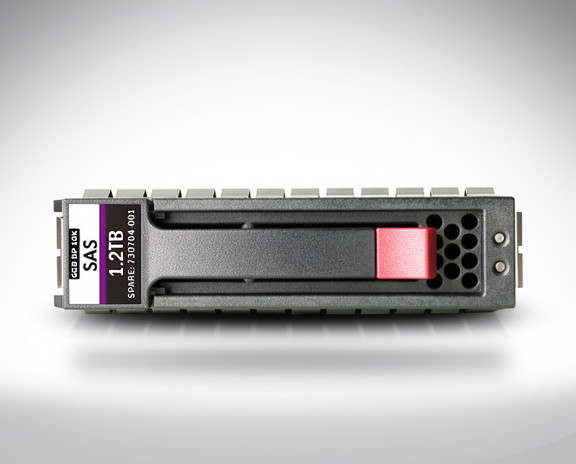
HPE E7W474 1.2TB 10K RPM SAS Drive – Powering MSA 1040/2040 with Enterprise‑Grade Speed, Resilience & Hot‑Swap Agility
HPE E7W474 1.2TB 10000RPM 2.5-Inch SFF Dual Port SAS-6Gbps Hot-Swap Enterprise Hard Drive — A Complete Guide
If you manage storage infrastructure for a living, you already know that not all hard drives are created equal. The kind of drive you plug into a workstation at home and the kind that keeps a hospital's patient records, a bank's transaction logs, or a retailer's real-time inventory online are worlds apart. The HPE E7W474 sits firmly in that second category — a purpose-built enterprise drive designed to live inside HPE's Modular Smart Array (MSA) 1040 and 2040 SAN Storage systems and simply never stop working.
This article takes you deep into everything you need to know about this drive: what it is, how it works, where it fits, and why it might be exactly what your storage environment needs.
What Exactly Is the HPE E7W474?
Before diving into specs and use cases, it helps to understand the product at a conceptual level. The HPE E7W474 is not a standalone hard drive you can just plug into any server and call it a day. It is a Smart Carrier hard drive — a factory-certified, HPE-branded storage component that is engineered, tested, and optimized to operate within the HPE MSA 1040 and MSA 2040 SAN (Storage Area Network) storage arrays.
Think of it like a genuine OEM part for your car versus an aftermarket replacement. Sure, the aftermarket part might technically fit, but the OEM version is built to the same tolerances as the machine it goes into, carries the manufacturer's warranty, and integrates with the car's onboard diagnostics without throwing error codes. The E7W474 is that OEM part for HPE's mid-range SAN storage platform.
The Core Identity: Part Numbers and Compatibility
The HPE E7W474 carries a few identifiers you may encounter in procurement databases, data center asset management tools, or HPE's own QuickSpecs documentation. The primary part number is E7W474, and it is also referenced under spare part number E7W47A. Knowing both identifiers matters when you are raising a purchase order or searching HPE's support portal, because the two can appear interchangeably depending on whether you are buying a new unit or ordering a replacement.
Compatibility is tightly scoped. This drive is validated and supported specifically for the HPE Modular Smart Array 1040 (MSA 1040) and the HPE Modular Smart Array 2040 (MSA 2040) SAN storage platforms. Attempting to install it in other HPE arrays or third-party storage systems may result in the array refusing to recognize the drive, triggering unsupported hardware warnings, or voiding your support agreement.
Breaking Down the Technical Specifications
There is a lot packed into the spec sheet for this drive, and understanding each element helps you appreciate why each choice was made — and whether this drive matches the demands of your workload.
Capacity: 1.2 Terabytes of Raw Storage
At 1.2TB, this drive occupies a useful middle ground in enterprise storage. It is large enough to provide meaningful capacity per bay without pushing into the high-capacity territory of nearline SAS drives, which sacrifice rotational speed for raw volume. For workloads where performance-per-gigabyte is the key metric — transactional databases, OLTP applications, virtualization clusters — 1.2TB per spindle at 10K RPM represents an excellent balance.
When you populate a fully loaded MSA 2040 chassis with E7W474 drives, the aggregate raw capacity climbs quickly. Planning your RAID groups and usable capacity figures is straightforward because the consistent per-drive capacity eliminates variable sizing headaches.
Spindle Speed: 10,000 RPM
Rotational speed is one of the most direct determinants of mechanical hard drive performance, and 10,000 RPM is the hallmark of enterprise performance-tier spinning media. At this speed, the drive's platters complete 10,000 full rotations every minute, which translates to significantly lower rotational latency compared to 7,200 RPM nearline drives.
Rotational latency is the time a drive must wait for the correct sector on the platter to rotate under the read/write head. At 10,000 RPM, the average rotational latency is roughly 3 milliseconds — a number that may sound trivially small but has enormous cumulative impact when a storage system is handling thousands of I/O operations per second. For environments where sub-10ms response time matters — think SQL Server databases, VMware datastores, ERP platforms — every millisecond shaved from rotational latency translates directly into better application performance.
Form Factor: 2.5-Inch Small Form Factor (SFF)
The 2.5-inch SFF form factor is the modern standard for enterprise-class spinning hard drives, and for good reason. Smaller platters mean shorter seek distances, which reduces seek time and mechanical wear. More importantly, the smaller physical footprint allows storage enclosures to pack more drives into a given rack unit, increasing density without requiring larger, heavier chassis.
The HPE MSA 1040 and 2040 platforms are designed around this SFF standard, and the E7W474's 2.5-inch profile ensures a clean, tested fit within those bays.
Interface: SAS-6Gbps Dual Port
The interface is where this drive truly distinguishes itself from consumer or even entry-level business-class storage. The E7W474 uses Serial Attached SCSI (SAS) with a 6 Gbps transfer rate, and critically, it is a dual-port implementation.
Why SAS Over SATA?
Both SAS and SATA use a similar physical connector family, but they are fundamentally different in enterprise suitability. SAS was designed from the ground up for multi-initiator environments — meaning multiple servers or controllers can issue commands to the same drive simultaneously without conflicts. SATA is inherently a single-initiator protocol, making it unsuitable for shared storage architectures.
Beyond multi-initiator support, SAS offers superior error handling, command queuing depth (up to 256 outstanding commands versus SATA's 32), and the ability to daisy-chain enclosures through an expander topology. In a SAN environment, these differences are not academic — they are the difference between storage that performs reliably under real-world mixed workloads and storage that begins dropping I/O operations under pressure.
The Significance of Dual-Port Connectivity
The dual-port capability deserves particular attention because it underpins the high-availability architecture of the MSA platform. A dual-port SAS drive has two independent physical ports, each capable of maintaining a full data path to the storage controller. In an MSA 2040 deployment with redundant controller modules, the drive connects simultaneously to both controllers.
If one controller fails, the storage subsystem automatically redirects all I/O through the surviving controller's path to the drive without interruption. There is no manual failover, no service window, and no data loss. The application running on the server above continues writing and reading without ever knowing a hardware failure occurred below. For any organization operating under a service level agreement that includes storage uptime commitments, this architecture is not a luxury — it is a requirement.
Hot-Swap Capability: Storage Maintenance Without Downtime
The hot-swap designation means the E7W474 can be physically removed from and reinserted into a running, powered storage array without taking the system offline. This capability is fundamental to enterprise storage operations for several interconnected reasons.
When a drive begins showing signs of impending failure — elevated reallocated sector counts, growing uncorrectable error logs, or SMART attribute degradation — a storage administrator can replace it proactively during normal business hours. There is no need to schedule a maintenance window, notify application owners, or bring services down. The administrator slides the failed drive out of its hot-swap bay, inserts the replacement, and the array controller immediately begins rebuilding the RAID stripe onto the new drive in the background.
This operational model changes the economics of enterprise storage maintenance. Instead of the expensive, disruptive model of scheduled downtime for hardware replacement, teams can service their storage infrastructure continuously, replacing drives as needed while the business runs uninterrupted.
The HPE Smart Carrier: More Than Just a Tray
Every HPE drive sold for the MSA platform ships in what HPE calls a Smart Carrier — the drive sled or caddy that holds the bare hard drive and allows it to interface mechanically and electronically with the storage bay. The Smart Carrier is not merely a passive bracket.
The Smart Carrier includes an integrated LED assembly and controller logic that communicates with the array's management plane. When the storage system needs to identify a specific drive — during a replacement procedure, a slot audit, or a fault isolation exercise — it can illuminate the drive's LED through the Smart Carrier. An administrator standing in front of a fully populated rack no longer has to count bays or pull drives one at a time to find the right one. They query the management interface, the correct drive lights up, and the replacement takes thirty seconds.
This UID (Unit Identification) LED function is a small detail that has enormous practical value in dense data center environments where time pressure and the cost of mistakes are both high.
Understanding the MSA 1040 and MSA 2040 Platforms
To fully appreciate the role the E7W474 plays, it helps to understand the platforms it lives in. The HPE Modular Smart Array 1040 and MSA 2040 are mid-range SAN storage systems positioned at the intersection of enterprise capability and cost efficiency.
MSA 1040: Entry-Level SAN with Enterprise DNA
The MSA 1040 is HPE's entry point into the SAN storage market. It supports both Fibre Channel (FC) and iSCSI host connectivity, making it flexible enough to integrate with a wide range of existing server and network infrastructure. The array supports up to 48 SFF drives across its expansion enclosures, providing respectable scalability for growing environments.
Organizations that are taking their first step from direct-attached storage into true shared SAN storage frequently choose the MSA 1040. The familiar HPE management interface, the integration with HPE's broader ecosystem (including OneView and iLO-based server management), and the competitive price point make it an accessible entry into enterprise-class shared storage.
MSA 2040: Dual-Controller Performance for Business-Critical Workloads
The MSA 2040 steps up the performance profile significantly. With dual active-active controllers, the 2040 supports simultaneous I/O across both controllers, effectively doubling the bandwidth available to connected servers compared to a single-controller architecture. The dual-controller design also delivers the high-availability story described earlier — with the E7W474's dual-port SAS interface, there is no single point of failure in the path between server application and storage media.
The 2040 supports tiered storage configurations, allowing organizations to mix SAS performance drives like the E7W474 with higher-capacity, lower-cost nearline SAS drives in the same array. Automated tiering policies can migrate frequently accessed data to the faster drives and push cold data down to the capacity tier, optimizing both performance and cost across the storage pool.
Real-World Use Cases: Where the E7W474 Earns Its Keep
Technical specifications tell you what a drive can do. Use cases tell you when it matters.
Virtualization Platforms and VDI Deployments
VMware vSphere, Microsoft Hyper-V, and similar hypervisor environments create dense, mixed I/O workloads where many virtual machines compete for the same underlying storage resources simultaneously. A single physical host running 40 virtual machines generates storage I/O that looks nothing like any single application — it is a chaotic mix of sequential and random reads and writes from multiple VMs, each with its own access pattern.
The 10,000 RPM spindle speed, high queue depth enabled by SAS, and the MSA 2040's dual active-active controllers combine to serve this demanding workload effectively. The E7W474 is well-suited to serve as the primary storage tier for vSphere clusters running business workloads.
Relational Database Servers
SQL Server, Oracle Database, PostgreSQL, and MySQL installations all generate intensive random I/O workloads that stress storage heavily. Transaction logs require sequential write performance with low latency, while the data files themselves generate heavily random read patterns as queries retrieve records scattered across large tables.
The 10K RPM speed and SAS protocol's deep command queue allow the E7W474 to handle concurrent database I/O from multiple sessions without the kind of queue backup that causes query response times to climb. For mid-sized database deployments that are not yet large enough to justify an all-flash array, a properly configured RAID group of E7W474 drives in an MSA 2040 provides a reliable, cost-effective foundation.
Business Continuity and Backup Infrastructure
Not all storage workloads need maximum IOPS. Some require reliable, high-capacity storage for backup targets, disaster recovery replicas, or archival data that is accessed infrequently but must be available immediately when needed. The E7W474, in a capacity-optimized RAID configuration, can serve as a backup target within an MSA deployment, particularly in environments that already use the MSA platform for primary storage and want to consolidate their backup infrastructure on familiar hardware and management tools.
Reliability, Warranty, and Support Considerations
Enterprise drives are specified differently from consumer drives in ways that matter enormously in production environments.
Mean Time Between Failures and Annualized Failure Rates
Enterprise SAS drives like the E7W474 are designed and tested to a workload rating of 550 TB per year — a figure that represents the total data written to the drive annually that falls within the warranty parameters. Consumer and entry-level NAS drives are typically rated for far lower annual workloads and will experience elevated failure rates when pushed into enterprise I/O environments. Running the wrong class of drive in a production storage array is a common and costly mistake that shows up not immediately but over the two to three year period as the drives accumulate wear beyond their designed limits.
HPE's Support Ecosystem
Because the E7W474 is an HPE-branded drive sold through HPE's supply chain, it integrates fully with HPE's support infrastructure. HPE's Insight Remote Support (IRS) platform can monitor drive health metrics through the MSA array controller, proactively alerting support teams (or HPE's own support organization) when a drive begins showing signs of impending failure. In environments with HPE Proactive Care or Datacenter Care support agreements, this automated health monitoring enables proactive part replacement before failure events occur.
This level of integration is not available with non-HPE drives installed in MSA arrays — the management and monitoring features depend on HPE-certified components communicating through HPE's management protocols.
Installation and Deployment Best Practices
Getting the most out of the E7W474 involves more than just physically inserting drives into bays. A few deployment practices make a meaningful difference.
RAID Configuration Selection
The MSA platform supports multiple RAID levels, and the right choice depends on the workload. RAID 5 provides a good balance of capacity efficiency and read performance, making it suitable for read-heavy workloads like file serving or database read replicas. RAID 6 adds a second parity drive, providing protection against simultaneous dual-drive failure — important in large RAID groups where the rebuild time after a single failure leaves the array vulnerable for an extended period. RAID 10 (mirroring plus striping) delivers the highest write performance and fastest rebuild times at the cost of 50% capacity efficiency, making it the preferred choice for write-intensive workloads like transaction logs or high-churn OLTP databases.
Spare Drive Strategy
Maintaining one or more global hot-spare drives in the array is a best practice that pays dividends when a drive fails. A hot spare sits in a powered, ready state within the array. The moment a drive failure is detected, the array controller automatically begins rebuilding the lost data onto the hot spare, restoring the RAID group to full redundancy without requiring human intervention. Given the relatively low cost of an additional E7W474 compared to the risk of an extended period without redundancy, most organizations operating this hardware in production environments maintain at least one hot spare per array.
Drive Mixing Considerations
HPE strongly recommends populating a single RAID group with drives of the same model, capacity, and firmware revision. Mixing drive models within a RAID group — even drives with identical rated specifications from different manufacturers — can result in subtle performance mismatches and complicates firmware management. For a homogeneous deployment using E7W474 drives exclusively, this is naturally addressed, but it becomes relevant in environments where the E7W474 is being added to an existing array alongside older drive models.
Comparing the E7W474 to Alternative Storage Options
Understanding where the E7W474 fits requires understanding what alternatives exist and when each makes sense.
10K SAS vs. 15K SAS
HPE and other manufacturers offer 15,000 RPM SAS drives that deliver somewhat higher rotational performance than 10K options. The 15K RPM class provides approximately 2ms average rotational latency versus 3ms for 10K drives. However, 15K drives are generally limited to smaller capacities, consume more power, generate more heat, and carry higher price points. For most workloads that were historically served by 15K drives, the performance gap between 10K SAS and 15K SAS has narrowed considerably as controller caches and RAID stripe alignment have improved. Organizations with new deployments are increasingly choosing 10K SAS over 15K for the better capacity-to-performance-to-cost ratio.
10K SAS vs. Solid State Drives (SSD)
The more significant comparison is between 10K SAS spinning media and enterprise SSDs. SSDs eliminate rotational and seek latency entirely, delivering random I/O performance that 10K SAS drives simply cannot match — the gap is measured in orders of magnitude for random read IOPS. For extremely latency-sensitive workloads, all-flash configurations are increasingly cost-competitive as SSD prices have fallen.
That said, 10K SAS drives like the E7W474 retain meaningful advantages in specific contexts. Per-gigabyte cost for spinning media remains lower than enterprise SSD at scale. For workloads that are moderately I/O intensive but not extreme — the kind of workloads that represent the majority of mid-market enterprise computing — a well-configured 10K SAS RAID group in an MSA platform delivers performance that fully satisfies application requirements at a cost point that SSDs at equivalent capacity cannot yet match. The E7W474 is not the right choice for a high-frequency trading platform, but it is entirely appropriate for a mid-sized company's ERP system, file sharing infrastructure, or virtualization cluster.
Why HPE Certification Matters in Enterprise Storage
A theme running through this entire discussion is the importance of HPE certification for drives used in the MSA platform. This is worth addressing directly because the temptation to use lower-cost, non-certified drives in expensive storage arrays is understandable — on paper, a generic SAS drive with the same capacity and interface specification looks identical.
In practice, HPE's certification process validates much more than basic electrical compatibility. It confirms that the drive's firmware responds correctly to the specific SCSI command set variants used by the MSA controller, that the drive's error recovery timing settings are compatible with the controller's timeout values, and that the drive's performance characteristics fall within the range the controller's I/O scheduling algorithms expect. Non-certified drives that fail these validation criteria may work in testing but degrade under production load conditions in ways that are difficult to diagnose because the symptoms manifest as performance problems or intermittent errors rather than obvious incompatibility.
Beyond performance, installing non-HPE drives in an MSA array typically voids the array's support agreement. When a problem occurs — and in enterprise storage, problems eventually occur — having HPE support engaged with a fully certified configuration is considerably more valuable than the savings achieved by using non-certified components.
Final Thoughts: Is the HPE E7W474 Right for Your Environment?
The HPE E7W474 1.2TB 10K RPM 2.5-inch SFF Dual Port SAS-6Gbps Hot-Swap Enterprise Hard Drive is a mature, well-proven component in HPE's storage ecosystem. It is not the newest or fastest storage technology available — enterprise SSDs have claimed that title — but it occupies a critical and enduring niche in mid-range enterprise storage deployments.
If your organization runs an HPE MSA 1040 or MSA 2040 SAN array, or is evaluating these platforms, the E7W474 delivers exactly what a performance-tier spinning drive should: reliable high-speed I/O, robust dual-port high-availability connectivity, hot-swap serviceability, and full integration with HPE's management and support ecosystem. For transactional databases, virtualization environments, and mixed enterprise workloads where consistent, predictable performance is the priority, this drive delivers a tested, supported, warranty-backed solution that will serve reliably through years of production operation.
For organizations that need more performance than spinning media can deliver, the MSA 2040's hybrid tiering capability means the E7W474 can coexist with SSDs in the same array — serving the warm and cold data tiers while SSDs handle the hottest, most latency-sensitive workloads. It is a practical, flexible architecture that does not force a binary choice between performance and cost.
In the world of enterprise storage infrastructure, reliability and integration matter as much as raw speed. On both counts, the HPE E7W474 earns its place in the data center.
Recent Posts
-
HPE 759208-B21 300GB 15K SAS: Unleashing Blazing Enterprise Performance in Every ProLiant Drive Bay
HPE 759208-B21 300GB 15000RPM SAS Hard Drive: High-Performance Hot-Swap Storage for ProLiant Servers …Sep 15th 2026 -
HPE 870753-B21 300GB 15K SAS Drive: Unleashing High-Speed Enterprise Storage for ProLiant Servers
HPE 870753-B21 300GB 15000RPM SAS Hard Drive: High-Speed Enterprise Storage for ProLiant Gen9 and Ge …Sep 14th 2026 -
HPE AG804B 450GB 15K Fibre Channel Drive: Powering Legacy EVA Storage with Enterprise-Class Speed and Reliability
HPE AG804B 450GB 15000RPM Fibre Channel Hard Drive: High-Speed Storage for Legacy Enterprise Environ …Sep 13th 2026