
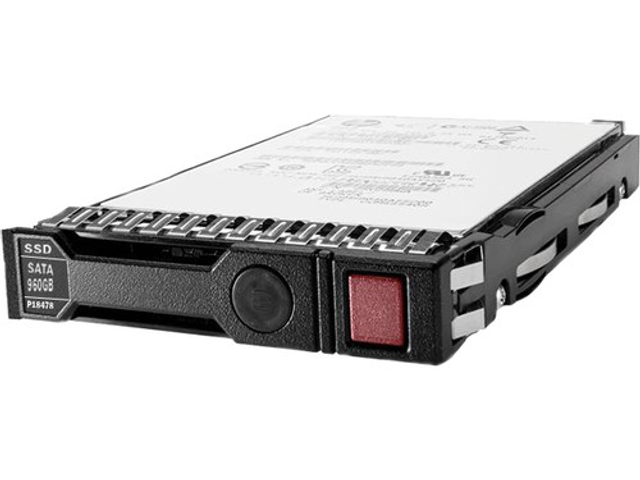
Precision in Motion: The Enterprise Power of the HPE 960GB SFF Mixed Use Multi Vendor SATA SSD for ProLiant Servers
HPE 960GB 2.5" Small Form Factor SATA-6Gbps Smart Carrier Mixed Use Multi Vendor SSD for ProLiant Gen9 / Gen10 Servers: Overview
The HPE 960GB 2.5" Small Form Factor (SFF) SATA-6Gbps Smart Carrier Mixed Use Solid State Drive (SSD) for ProLiant Generation 9 and Generation 10 servers is a server-grade storage device engineered to deliver a balanced mix of performance, endurance, compatibility, and manageability in enterprise environments. Designed for mixed workload profiles that include virtualized servers, databases, application servers, and tiered storage systems, this SSD targets IT teams that need reliable capacity with solid I/O performance while preserving longevity under sustained, real-world server loads.
Key Specifications Snapshot
Form factor and interface
2.5 inch SFF; SATA 6 Gbps (SATA III) interface; standard 7 mm/9.5 mm carrier thickness depending on caddy.
Capacity and NAND type
Nominal capacity: 960 GB formatted usable capacity varies by vendor firmware and overprovisioning. Mixed use NAND classification: typically MLC or TLC with enterprise-optimized firmware tuned for endurance and consistency.
Performance
Sequential read/write and random IOPS vary by vendor firmware and server configuration, but designed for strong sustained sequential throughput and consistent random read/write latency suitable for mixed read/write workloads.
Endurance and reliability
Endurance rating expressed as DWPD (Drive Writes Per Day) or TBW (Terabytes Written) depending on vendor. Enterprise-grade power-loss protection, wear-leveling, bad block management, and error correction (typically on-controller ECC) are included.
Manageability and security
Digitally-signed firmware for secure boot compatibility with HPE Smart Carrier; support for S.M.A.R.T., TRIM, secure erase, and drive locking depending on implementation; hot-pluggable with HPE ProLiant drive carriers.
What “Mixed Use” Means for Real Deployments
Mixed use classification indicates the drive is tuned to handle both read-heavy and write-intensive operations without sacrificing lifespan or predictable latency. Mixed use SSDs sit between read-centric enterprise SSDs and pure high-endurance write-optimized models, offering:
Balanced endurance and cost
Sufficient write endurance for virtualization, moderate database write activity, and general-purpose workloads while keeping acquisition cost lower than high-endurance drives.
Predictable latency
Firmware and controller algorithms prioritize consistent response times under sustained load, which improves application performance and user experience in multi-tenant or virtualized environments.
HPE Smart Carrier and Multi Vendor Interoperability
The Smart Carrier is HPE’s drive caddy and identification system that helps ProLiant servers detect and validate supported drives. This 960GB SSD is available from multiple qualified vendors and is validated to operate in HPE ProLiant Gen9 and Gen10 platforms.
Smart Carrier benefits
Smart Carrier provides physical compatibility, helps with drive hot-swap operations, and enables firmware validation and inventory reporting through HPE management tools.
Multi vendor considerations
Although the physical and electrical interface is standard, performance characteristics, endurance ratings, and firmware feature sets differ between vendors. HPE qualification ensures compatibility, but administrators should validate vendor-specific firmware release notes before large-scale rollouts.
Firmware Security and Digitally Signed Firmware
Digitally signed firmware reduces the risk of corrupted or malicious drive firmware being installed. For enterprise deployments this means:
Secure firmware updates
Only firmware images signed with a trusted certificate are accepted by the drive. This prevents accidental or malicious downgrades and helps meet corporate compliance requirements.
Auditability
Digitally-signed firmware provides traceability for firmware provenance, which simplifies audits, change control, and security posture reviews.
Performance Characteristics and Tuning
SSD behavior depends on workload profile, RAID configuration, and the host controller. Typical considerations include:
IO profile impact
Large sequential workloads favor throughput and benefit from SATA 6 Gbps bandwidth. Small random IOs, common in virtual machines and databases, are bounded by IOPS and latency; SSD controllers and internal parallelism improve random IO performance.
RAID and caching
When used in RAID arrays, parity calculations and rebuild windows impact effective performance. Pairing SSDs with server-side caching or tiering solutions can optimize hot data placement and improve response times.
Overprovisioning and firmware tuning
Vendors often ship drives with a percentage of unexposed NAND for spare blocks and wear leveling. Increasing overprovisioning in firmware or via vendor tools can improve steady-state performance and endurance.
Compatibility with ProLiant Gen9 and Gen10 Servers
These drives are intended for easy insertion into HPE ProLiant hot-swap bays using the Smart Carrier. Compatibility highlights:
HPE system management integration
Support for HPE System Insight Manager (SIM), Integrated Lights-Out (iLO) reporting of drive health, and array controller compatibility with HPE Smart Array controllers.
BIOS and controller considerations
Ensure server BIOS and controller firmware (HBA, RAID) are updated to the versions recommended by HPE and the drive vendor for full feature support and optimal performance.
Deployment and Best Practices
To get the most from these SSDs, follow enterprise best practices:
Pre-deployment validation
Test drives in a staging environment that closely mirrors production workloads. Validate drive firmware, controller compatibility, and RAID behavior.
Firmware management
Use vendor-signed firmware packages and adhere to change control. Schedule firmware updates during maintenance windows and follow vendor rollback guidance.
Monitoring and lifecycle management
Monitor S.M.A.R.T. attributes, vendor health metrics, and write amplification indicators. Track TBW or DWPD consumption and plan replacements proactively before wear limits are reached.
Maintenance and Troubleshooting
Having a clear maintenance plan reduces downtime and data loss risk.
Regular health checks
Leverage HPE iLO and management tools to poll for drive errors, predictive failure indicators, and SMART warnings.
Failure handling
If a drive signals failure, remove it per hot-swap procedures, replace with a qualified HPE Smart Carrier drive, and allow RAID rebuild or array repair operations to complete. Always ensure backups and snapshots are available before maintenance.
Common issues and resolution steps
- Drive not recognized: check carrier seating, backplane connections, controller firmware, and drive vendor compatibility.
- Performance degradation: confirm firmware versions, review host CPU and memory contention, verify RAID rebuilds are not occurring, and consider increasing overprovisioning.
- Unexpected SMART warnings: collect vendor logs, run vendor diagnostics, and escalate to vendor support with drive serial numbers if needed.
Use Cases and Workload Fit
This SSD is well suited for:
Virtualization hosts
VMware, Hyper-V, KVM hosts where many moderate IOPS virtual machines coexist and predictable latency matters.
Application servers and databases
Moderately write-heavy databases and application stacks where a balance of capacity and endurance is required.
Boot and system volumes
High-speed OS and application boot volumes across blade or rack servers to reduce startup time and improve manageability.
Capacity Planning and Total Cost of Ownership (TCO)
When planning storage tiers, balance cost, endurance, and performance:
Cost per usable GB
Factor in vendor-provided usable capacity, overprovisioning, and enterprise features when comparing to other SSD classes or HDD tiers.
Endurance lifecycle
Calculate expected TBW or DWPD relative to workload write rates to estimate service life and replacement cycles. Include logistics and vendor support costs in TCO models.
Final Thoughts and Recommendation
The HPE 960GB 2.5" SFF SATA-6Gbps Smart Carrier Mixed Use SSD for ProLiant Gen9 and Gen10 servers presents a pragmatic option for organizations that need a stable mix of capacity, reliability, and consistent performance for mixed workloads. It is not the highest-end write endurance device, nor is it purely optimized for read-only workloads. Instead, it provides a middle path that suits virtualization hosts, mixed application stacks, and general-purpose enterprise storage tiers. For best results, validate vendor firmware compatibility, monitor drive health continuously, and include these drives in a disciplined lifecycle and backup plan.
Recent Posts
-
Unlock Blazing NVMe Speed: HPE P22276-B21 1.92TB U.3 PCIe x4 High Performance SSD for ProLiant Gen8 Gen9 Gen10 Servers
HPE P22276-B21 1.92TB NVMe U.3 Read Intensive SSD for ProLiant Gen8 Gen9 Gen10 Servers The HPE P2227 …Mar 5th 2026 -
Lightning Speed Enterprise Storage: HPE P07192-B21 1.92TB NVMe U.2 PCIe x4 Read Intensive SSD for ProLiant Gen8 - Gen10 Servers
Power Up Enterprise Storage with the HPE P07192-B21 1.92TB NVMe U.2 Read Intensive SSD High Performa …Mar 4th 2026 -
Unleash NVMe Power: HPE P20139-B21 1.92TB U.3 PCIe x4 Read Intensive SSD for ProLiant Gen8 Gen9 Gen10 Servers
HPE P20139-B21 1.92TB NVMe U.3 Read Intensive SSD for ProLiant Gen8 Gen9 Gen10 Servers The HPE P2013 …Mar 3rd 2026