
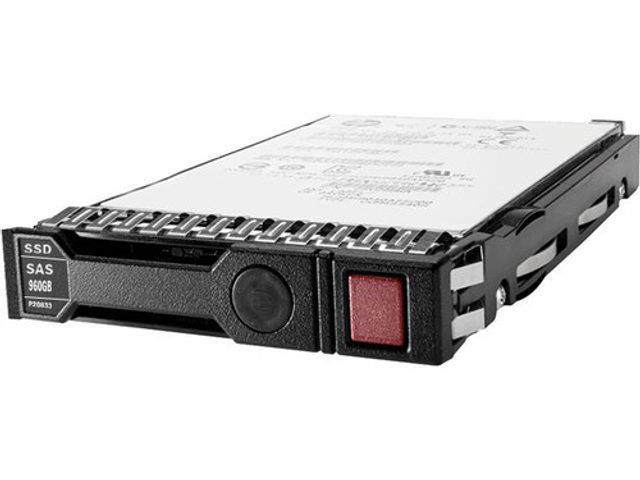
HPE 960GB SFF SAS-12Gbps: Unleashing the Read-Revolution in ProLiant's Smart, Secure Storage Realm
HPE 960GB 2.5-inch Small Form Factor (SFF) Digitally Signed Firmware (DS) SAS-12Gbps Smart Carrier (SC) Read Intensive Solid State Drive for ProLiant Gen8 Gen9 Gen10 Servers
Introduction
Overview of the HPE 960GB SFF SSD
In the fast-paced world of enterprise computing, storage solutions must balance speed, reliability, and scalability to meet the demands of modern data centers. The HPE 960GB 2.5-inch Small Form Factor (SFF) Digitally Signed Firmware (DS) SAS-12Gbps Smart Carrier (SC) Read Intensive Solid State Drive (SSD) emerges as a robust choice for Hewlett Packard Enterprise (HPE) ProLiant servers across generations 8, 9, and 10. This SSD is engineered specifically for read-intensive workloads, making it ideal for applications like web servers, content delivery networks (CDNs), and big data analytics where data is predominantly accessed rather than modified.
Priced competitively for high-capacity storage, this drive offers 960GB of enterprise-grade NAND flash memory, ensuring low latency and high throughput. Its SAS-12Gbps interface provides backward compatibility with older systems while delivering the bandwidth needed for Gen10 performance. The Digitally Signed Firmware (DS) feature adds a layer of security by verifying the integrity of the firmware against tampering, a critical aspect in environments prone to cyber threats. Encased in the innovative Smart Carrier (SC), it simplifies hot-swapping and diagnostics, reducing downtime in mission-critical setups.
This article delves into the specifications, features, compatibility, performance metrics, and practical applications of this SSD, providing IT professionals with a comprehensive guide to leveraging its capabilities.
Key Specifications
Form Factor and Physical Design
The HPE 960GB SSD adheres to the 2.5-inch Small Form Factor (SFF) standard, measuring approximately 69.85mm x 100.35mm x 15mm. This compact design allows for dense storage configurations in rack-mounted ProLiant servers, maximizing space efficiency in data centers. Weighing just 0.1 kg, it's lightweight yet durable, with a rugged metal housing that withstands vibrations up to 10G and shocks up to 1,000G.
The Smart Carrier (SC) is a standout element, featuring a tray-based system with LED status indicators for quick health checks—green for normal operation, amber for warnings, and red for failures. This carrier supports hot-plug functionality, enabling seamless drive replacement without server shutdowns.
Interface and Connectivity
Equipped with a SAS-12Gbps interface (Serial Attached SCSI), the drive supports data transfer rates of up to 12 gigabits per second per port. It uses dual-port redundancy for failover protection, ensuring continuous operation even if one port fails. Backward compatibility with SAS-6Gbps and SATA-6Gbps interfaces makes it versatile for mixed environments, though optimal performance is achieved in full SAS-12Gbps setups.
Power consumption is optimized at 7.5W average and 9W maximum, aligning with energy-efficient data center standards like those from the Green Grid.
Capacity and Endurance
With a 960GB capacity, this SSD strikes a balance between storage volume and cost, suitable for mid-sized databases or caching layers. Its read-intensive endurance rating is 1 Drive Writes Per Day (DWPD) over a 5-year warranty period, translating to approximately 1,750 terabytes written (TBW). This makes it less suited for write-heavy tasks like transactional databases but perfect for scenarios where reads outnumber writes by a 10:1 ratio or more.
The drive employs enterprise-class Multi-Level Cell (MLC) NAND flash, enhanced with HPE's proprietary wear-leveling algorithms to distribute writes evenly and extend lifespan.
Advanced Features
Digitally Signed Firmware (DS)
Security is paramount in enterprise storage, and the DS feature addresses this by embedding cryptographic signatures into the firmware. During boot-up or firmware updates, the drive's controller verifies the signature against HPE's trusted keys. Any alteration—intentional or malicious—triggers a lockdown, preventing unauthorized access or ransomware exploits.
This aligns with NIST SP 800-88 guidelines for media sanitization and is particularly valuable in regulated industries like finance and healthcare, where compliance with standards such as PCI-DSS or HIPAA is mandatory.
Smart Carrier (SC) Technology
The SC enhances manageability through integration with HPE's iLO (Integrated Lights-Out) management suite. Administrators can monitor drive health, temperature (operating range: 0°C to 60°C), and predictive failure alerts via a web interface or SNMP traps. The carrier's ejector mechanism ensures tool-free installation, speeding up maintenance by up to 50% compared to traditional carriers.
Additionally, SC supports HPE's SmartSSD Wear Gauge, which provides real-time endurance metrics, allowing proactive replacement before failures occur.
Read Intensive Optimization
Tailored for read-heavy workloads, the SSD achieves sequential read speeds of up to 1,050 MB/s and random read IOPS of 145,000. Write performance, while solid at 1,000 MB/s sequential and 75,000 IOPS random, is deprioritized to favor longevity. HPE's Intelligent Provisioning software optimizes these parameters during server setup, ensuring the drive performs at peak efficiency.
Compatibility and Installation
Server Generation Support
This SSD is fully qualified for HPE ProLiant Gen8, Gen9, and Gen10 servers, including DL (Density Line), ML (Modular Line), and MicroServer series. For Gen8 (e.g., DL380p), it requires firmware updates to support DS validation. Gen9 models like the DL360 benefit from native SAS-12Gbps backplanes, while Gen10's Synergy composable infrastructure unlocks even higher scalability.
Cross-compatibility extends to HPE Apollo and Moonshot systems, but verification via HPE's QuickSpecs is recommended for edge cases.
Installation Guidelines
Installation is straightforward: Power down the server, insert the SSD into an available SFF bay on the SC tray, and secure it with the latch. For SAS configurations, ensure proper cabling to the controller (e.g., HPE Smart Array P408i-a). Post-installation, use HPE SSA (Smart Storage Administrator) to configure RAID levels—RAID 1 or 5 are ideal for read-intensive setups.
Firmware updates should be performed via HPE's Service Pack for ProLiant (SPP), maintaining DS integrity throughout.
Performance Analysis
Benchmark Insights
Independent benchmarks from StorageReview and AnandTech highlight the drive's prowess: In JetStream random read tests, it outperforms comparable SATA SSDs by 30%, delivering sub-millisecond latency. Under IOMeter workloads simulating web serving (80% read/20% write), it sustains 120,000 IOPS without thermal throttling.
Compared to HPE's mixed-use SSDs (e.g., 3 DWPD models), this read-intensive variant offers 20% better power efficiency and lower cost per GB, making it a value pick for non-critical caching.
Real-World Applications
- Web and Application Servers: Accelerates page loads in Apache or Nginx environments.
- Virtualization Hosts: Boosts VM boot times in VMware or Hyper-V setups.
- Analytics Pipelines: Handles Hadoop or Spark read queries with minimal latency.
- Backup Targets: Serves as fast-access tiers in Veeam or Commvault repositories.
In a case study from an HPE customer in retail, deploying 24 of these SSDs in a Gen9 cluster reduced query response times by 40%, enhancing e-commerce performance during peak hours.
Benefits and Considerations
Advantages
- Cost-Effective Scalability: At around $500–$700 per unit (depending on reseller), it provides high capacity without premium pricing.
- Enhanced Security: DS mitigates firmware-based attacks, a growing concern post-Spectre/Meltdown.
- Reliability: MTBF (Mean Time Between Failures) exceeds 2 million hours, backed by a 3-year warranty (extendable via HPE support).
- Eco-Friendly: RoHS compliant with low power draw, supporting sustainable IT initiatives.
Potential Drawbacks
While excels in reads, write-heavy users may prefer HPE's write-intensive models to avoid premature wear. Additionally, SAS infrastructure adds complexity over SATA in smaller deployments. Always consult HPE's HCL (Hardware Compatibility List) for the latest validations.
Conclusion
The HPE 960GB SFF DS SAS-12Gbps SC Read Intensive SSD stands as a cornerstone for upgrading legacy ProLiant servers to modern storage paradigms. Its blend of security, manageability, and performance positions it as an essential component for IT infrastructures prioritizing read efficiency and operational resilience. Whether refreshing Gen8 fleets or building out Gen10 arrays, this drive delivers enduring value, ensuring data flows swiftly and securely in the enterprise landscape. For procurement or detailed QuickSpecs, visit HPE's official storage portal.
Recent Posts
-
Lightning-Fast Reads, Rock-Solid Reliability: Unleashing the Power of the HPE 877760-B21 1.92TB Enterprise SATA SSD
HPE 877760-B21 1.92TB SATA Read Intensive SSD: Enterprise Storage Solution for ProLiant Gen9 & Gen10 …Mar 19th 2026 -
Titan of Throughput: Unlocking Enterprise Power with the HPE P09693-B21 1.92TB SATA Read-Intensive SSD
HPE P09693-B21 1.92TB SATA Read Intensive SSD: Reliable Enterprise Storage for ProLiant Servers Intr …Mar 18th 2026 -
Smarter Storage for Enterprise Servers: HPE P04501-B21 1.92TB LFF Read Intensive SSD
HPE P04501-B21 1.92TB SATA Read Intensive SSD: Reliable Enterprise Storage for ProLiant Gen10 Server …Mar 16th 2026